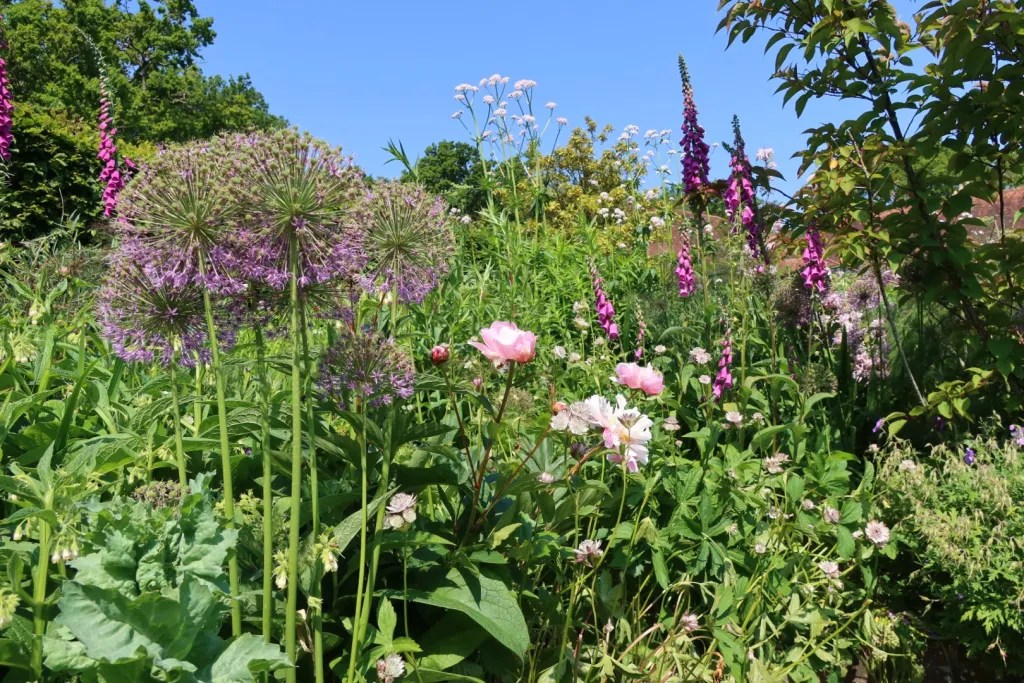
What is it about some days that they seem charmed in some way? Travel plans work like a dream, the weather is perfect and the welcome at the garden visited is equally warm. Such was the experience of going to Great Comp Garden in the village of Platt, near Borough Green in Kent in early August with fellow Friday morning garden volunteers from NT Osterley.
Within a few minutes of arriving at Great Comp, we admired the Black Moon heritage tomatoes in the greenhouse near the Entrance kiosk, progressed around the edge of the Crescent Lawn before spying the Moon Gate across the immaculately striped lawn known as the Square. Cue the title to this post!
Black moon tomatoesThe Moon GateThe Moon Gate
At seven acres, the garden is relatively small but because the geometric layout of the formal borders and Italian Garden give way to numerous sinuous paths weaving through mature woodland the site feels much larger. At this point I must confess that close examination of the map on my return home revealed that we had missed walking around the southern end of the garden with its North Lawn and Top Terrace. Reason enough to return for a visit in the spring.
Let’s return to The Square, the opposite sides of which house deep herbaceous borders: the hot border facing the cool border. In the former the heat of single yellow dahlias and coral salvias is tempered by the Agastache’s dusky purple spires and clumps of perennial grasses.
Silvery leaved ‘immortelles’ (Anaphalis yedoensis) line the paths of the latter, their spherical white flowerheads mimicking the shape of the Moon Gate which punctuates the cool border. Our exceptionally dry summer had rendered the usually pallid tones of Miss Willmott’s Ghost (Eryngium giganteum) somewhat golden. Like its hot counterpart across the way, this border includes perennial grasses.
The Moon Gate leads into the Italian Garden, a narrow rectangle containing waist high clipped box compartments containing generously planted urns and classical statues. The tinkling sound of a fountain led us towards the Pond at the far end of the Italian Garden, where largely contrasting leaf shapes such as Tetrapanax and a graceful bamboo are given an injection of zinging deep pink Phlox.
The Italian GardenThe PondPhlox opposite the Pond
The Crescent Lawn is a gracefully curving expanse of grass lined with shrubs and specimen conifers in multiple shades of green. A strange monument stands sentinel at the peaky end of the crescent: the Tower.
This is perhaps the largest of the ‘follies’ or ‘ruins’ made by the garden’s last private owners, Roderick and Joy Cameron, in the 1970s. Steps lead up to a viewpoint from which the contrasting colours and shapes of the tree and shrub planting around the Crescent Lawn and the lawned area called The Sweep can be seen.
Alongside the Tower is a curving border of vivid yellow Rudbeckia backed by dark leaved single yellow dahlias.
From here the woodland paths are narrow and inviting, the shade of the towering trees lowering the temperature of the hot day by a noticeable several degrees. The Hydrangea Glade is a magical space of large, mainly white flowered specimens, gleaming in sunlight filtering between the tall trees nearby. With the southern boundary of the garden to our left we walked towards the circular Temple, from which the route wends back, slightly unexpectedly, to the rear of the Pond.
I was especially keen to see the salvias in the Gravel Garden, knowing that the garden’s curator, William Dyson, cultivates numerous hybrids in the onsite nursery.
Salvias have become something of an obsession with me in recent years. Their resilience, in most cases, to drought and their ability to attract bumblebees and other pollinators, is matched by their intriguingly formed flowers and colours ranging from reds though purples to intense blues, dark and light. Needless to say I bought two salvias to add to my collection: a pale yellow flowering cultivar, Salvia Lemon Light and S. Pink Mulberry. The latter has two-tone pink flowers. I’ve planted it beside the pond here but shall pot it up and protect it over winter as the label states that ‘hardiness is untested’, this variety having been bred in Australia.
The plant sales area
I’ve already mentioned the need to return to Great Comp in the spring to see the area we missed, and the guidebook mentions a large collection of magnolias. Let’s hope the day of that visit is equally satisfactory. And it goes without saying that I’ll be bringing at least one more Dyson salvia home with me.
In early May I walked the last three stages of the West Highland Way with my dear friend Pat. I kept a brief log of the walk, noting the scenery and the wildflowers seen along the route. What follows is effectively a transcript of my notes. Equipped for all weather and armed against midges, we were incredibly lucky to have the most magnificent weather. It had been dry for some weeks before we arrived and the pesky midges were nowhere to be seen. The soundtrack to our walk was the repeated call of the cuckoo. Not just one call in the distance but scarcely a mile passed without hearing one nearby. A symptom of the remarkably warm spring or evidence of climate change? It certainly seems that the range of these summer migrants is edging northwards. And it wasn’t only the birdlife that bore the cuckoo moniker as you will read!
9 May 2005. Arrived at Bridge of Orchy Hotel at about 4pm. Warm sunshine. Walked eastwards alongside the river (River Orchy) for a mile or so before dinner. Not following the West Highland Way route. Busy A82 on the opposite side of the river, and the railway. Water very low in the water: peaty brown colour. Heard cuckoos in coniferous woodland beside the path. And saw cuckoo flowers (Cardamine pratensis) on path verges. Anemones growing stream side: A. blanda or A. nemorosa? Or another species because very small flower and a low feathery crown.
10 May. Bridge of Orchy to Kingshouse. 12 miles.
Rocky track for most of the walk: the old drovers’ trail. Stone bridges along the route built by Thomas Telford in 1802. Steady climb until route opens onto Rannoch Moor: 360° views ringed by mountains. Peaty pools dotted amidst the heather. Early on, good views of Loch Tully. Many fellow walkers on the trail, but barely a building in sight. We were aware of the A82 in the far distance for much of the route, but only in the distance until a quarter of a mile or so from the Kingshouse Hotel, when we had to cross it.
We heard cuckoos calling for much of the first half of the walk. And a few miles along the route, passing Forest Lodge, a building set in woodland, we saw an orange tip butterfly. Shortly before Ba Bridge, we found a hollow beside the path, sheltered from the breeze. A friendly chaffinch shared our lunch. It felt very warm, dry and comfortable. Not at all what I expected: no rain here for about five weeks: very unusual in the Highlands. The rocky burns looked quite low and dry in places.
There are few trees save the copses of downy birch (Betula pubescens) growing around the stone bridges crossing the burns. Their small shivery leaves remind me of aspens. The leaves are new and shiny, a reminder that it’s only a few weeks since bud break.
Flowers spotted today:
Bird’s foot trefoil (Lotus corniculatis) also called eggs and bacon become of its yellow and orange flowers.
Heath milkwort (Polygala serpyllifolia): deep violet flowers arranged in a pair of petals with a fringed ‘trumpet’ between.
Arctic starflower (Lysimachia europaea). Primrose family. I read that in Scotland it grows on acid soils, often on moorland which has supported woodland in the past.
Birds foot trefoilArctic starflower
The view from Kingshouse Hotel is stunning. The spectacular mountain is Buachaille Etive Mor, which I read is the most photographed mountain in Scotland. It stands guard at the entrance to Glencoe.
11 May. Kingshouse to Kinlochleven. 9 miles.
Wagtail and thrush on grass outside the hotel. And two deer standing in the stream at the rear of the hotel. Flat but rocky track of about two miles from the hotel to the tiny hamlet of Altnafeadh at the eastern entrance into Glencoe. Then the climb away from Glencoe up the Devil’s Staircase! Thankfully there are ‘steps’ built into the mountainside, but the views at the top of the climb are worth the effort. 360° again: northwards to Ben Nevis.
Trail busy in places. A few hardy people running! Walking on, we found a perfect spot for lunch, looking across to Blackwater Reservoir. Spotted a raptor with dark plumage at high point of the walk. Golden eagle? Cuckoos calling almost all the way along our route. The last part of today’s walk was downhill: slippery in places.
The scenery tames, becomes more wooded. Giant pipework lies across the hillside. I read later that it carries water from the Blackwater Reservoir to the now defunct aluminium plant on the outskirts of Kinlochleven. We walked the length of the plant on the route into town. Our hotel (MacDonald’s) is modest but is situated on the shore of Loch Leven: postcard perfect view along the loch at sunset at about 9.30pm*. Tranquil water, wooded banks. Reminds me of the lakes of Killarney.
Lousewort (Pedicularis sylvatica). Small pink or white flowers. Seen at the wayside most of the day. Also called Irish lousewort. I read that it grows on the Macgillycuddy’s Reeks in County Kerry. Likes moist acidic soils.
Foxgloves (Digitalis purpurea)
Eared willow (Salix aurita). Shrub growing on acidic soils on heathland and by watercourses.
Common dog violet (Viola riviniana)
Tormentil (Potentilla erecta). Erect cinquefoil. Member of the rose family. Again acidic soils.
From opposite the hotel the West Highland Way rises steeply through the woods. We missed a left turn and ended on a higher path parallel with the WHW! Seeing from the map that it reconnected with the route a couple of miles further along, we didn’t need to retrace our steps! The way follows an old military road built two centuries ago across broad and dramatic Lairig Mor. We passed two sheilings or ‘steadings’: ruined stone cottages. Picturesque on our hot sunny day, but a bleak location in times past. The right hand side of the glen is flanked by the Mamores mountain range. Sheep scattered on either side, many with plump black-faced lambs.
As the route curved away to the right we entered a small deciduous and conifer woodland-many birds calling. We stopped here in the shade for lunch. According to the guidebook we were near a Lochan on an island in which Macbeth is said to have lived. After lunch we saw drifts of cuckoo flowers attracting flurries of orange-tipped butterflies. At one point a smallish white butterfly fluttered along in front of us. Fewer walkers today. The narrow path dipped into a steep-sided glen, with wooden bridges over cascading streams, downy birch on the stream banks, and an understorey of exquisite flowers: primroses, water avens, bugle, a purple orchid.
We saw a raven at close quarters, having heard his croaking call from afar for several minutes. Ahead of us loomed Ben Nevis, its face apparently folded into several massive vertical gullies. Here the path bears left and enters Glen Nevis, its woods awash with bluebells. The path widens considerably, but is incredibly stony. A boggy sided stream runs parallel to the path, the banks studded periodically with the insectivorous common butterwort (Pinguicula vulgaris). Small violet and white flowers grow on delicate stems rising from a lime green star-shaped rosette. This section of the WHW runs for about three or four miles before reaching Fort William. A sign reading Failte greets walkers at the finish of the walk. Meaning ‘welcome’ as in Irish Gaelic. Although we had walked only the final three of the seven stages of the walk, we still felt a great sense of achievement.
Butterwort. Pinguicula vulgaris
Kew Gardens, 2 August 2025
*checking later I read that sunset on that date was at 9.24pm.
How an apparently impossible subject on the north west coast of Scotland was made to produce good trees, shrubs, fruit and flowers
Title of a lecture delivered by Osgood Mackenzie in 1908
I don’t make a habit of peering over garden walls, but the wall was partly demolished, the house abandoned, and I’d glimpsed what looked like a large cultivated shrub amidst a wilderness of weeds. It was festooned with waxy scarlet flowers or fruit, I couldn’t tell which, shaped like teardrops suspended on long slender stems. This was in Kinsale in West Cork, about 25 years ago, and I was on holiday with my parents. We were just taking an evening stroll after supper and collectively fell in love with this plant and determined to find out what it was. This was long before plant identifier apps and it took a little while, on returning from the trip, to locate the mystery plant in the RHS Gardeners’ Encyclopedia of Plants & Flowers. I forget where, but I tracked down the plant and bought it for my mother’s birthday that year. It grew in their tiny courtyard garden in Petersfield for many years until the house was sold in 2013.
Crinodendron hookerianum
And the name of the shrub which so caught my imagination? Crinodendron hookerianum or Chile lantern tree. It is named for William Jackson Hooker*, who was appointed the first full-time director of Kew Gardens in 1841, and studied many plants from Chile. I believe that ‘crinodendron’ means lily tree. A specimen grows in a side border of the woodland garden at Kew near the boundary wall with Kew Road and always reminds me of my mother and that warm evening in Ireland.
I was thrilled last week to find a superb specimen of C. hookerianum growing by the front door of the garden lodge, which was to be our home for three nights while we explored Inverewe gardens in the north west of Scotland. This superb National Trust for Scotland garden’s south-facing location on Loch Ewe means it benefits, like the gardens of south west Ireland, from the warming influence of of the Gulf Stream. In the 1860s, the maker of the garden, Osgood Mackenzie, planted a shelter belt of Scots pines around the peninsula on which Inverewe stands, to maximise the unique climate in his garden to grow species which wouldn’t be expected to survive, let alone thrive, in a place on the same latitude as Hudson’s Bay. The garden lodge shrub was so high and wide it almost hid the front door of the house.
During the two days I was at Inverewe I tried to walk as many of the paths through the wooded areas of the peninsula on which the garden is located as I could, admiring the fabulous collection of plants favouring the peaty, acidic soil. Amongst the Rhododendrons and Azaleas, I found several towering Crinodendrons, some at least four metres high. On the last evening, I walked down to an exquisite little cove, Camas Glas, to see the sun setting over Lough Ewe, and as I walked back came across an exquisite pink flowered cultivar, C. hookerianum Ada Hoffman. My mother died 11 years ago last week and it seemed very fitting that my visit to a garden which I know she would have loved discovering should be bookended by this plant which she took such pleasure in.
Reading more on my return home from the garden, I find it is not a coincidence that Inverewe and Chile lie on the west coasts of their respective land masses. As I explain later in this post, there is there some similarity in climate between the north west coast of Scotland and the temperate regions of Chile. Even during my short visit to Inverewe I spotted several other plants hailing from Chile. I should mention here that almost every plant I encountered was clearly labelled with a Kew style black label citing its botanical name and region of origin.
These are some of the other Chilean plants I found during my two day exploration of the plant lover’s paradise that is Inverewe:
Senecio candicans: Known in the horticultural trade as Angel Wings, S. candicans is often sold for summer bedding as it makes a striking statement plant in a container, its velvety pearl-grey leaves a foil for cerise pink pelargoniums or burgundy coloured dahlias. But at Inverewe itspreads several feet across a gritty bed in the Rock Garden. The terraced Rock Garden is partly constructed from stone salvaged from the grand mansion built by Osgood Mackenzie’s mother Mary in the 1860s, which burnt down in 1914, to be replaced in the 1920s by the art deco style Inverewe House built by Mackenzie’s daughter Mairi and her second husband Ronald Harwood. The low-key but very evocative interpretation installed in the ground floor rooms by the National Trust for Scotland brings the house and Mairi’s lifestyle vividly alive.
Araucaria araucana: more commonly called the monkey puzzle tree. This uniquely formed coniferous tree has of course become a fairly common sight in suburban front gardens. At Inverewe young specimens have been planted on the cliff edges below the High Viewpoint overlooking Loch Ewe, their distinctive spiky limbs visible in the centre of this image. I’m always intrigued by the story of its ‘collection’ by naval doctor Archibald Menzies who accompanied George Vancouver on the voyage to map the west coast of the Americas (1790 – 1795). Invited to supper by a local dignitary who served a dessert made from the tree’s pine-nuts, Menzies is said to have popped a few seeds into his pocket which he sowed on the return voyage to London, delivering the germinated plants to Kew Gardens.
Vancouveria hexandra
Vancouver’s name appears in the name of another plant I saw in Inverewe’s damp woodland areas: Vancouveria hexandra or duckfoot.
Jovellana violaceae
Jovellana violaceae, is native to Chile, its dainty mauve round bell-shaped flowers earning it the common name violet teacup flower. I haven’t come across this before and saw it growing in several places across the garden, where it spreads over rocks in sunny clearings in the woodland areas. A low-growing shrub, I read that it is vulnerable to below zero temperatures, and would need protection if grown in gardens without Inverewe’s benign climate.
Embrothrium coccineum or Chilean Firetree. Reading about the native habitat of this spectacular shrub is a fascinating geography lesson. It is endemic to a narrow strip of land along the coasts of Chile and Argentina called the Valdivian temperate rain forest, whose climate is influenced by the prevailing winds, the ‘westerlies’, which carry warm, equatorial waters and winds to the western coasts of South America. The flower heads of this evergreen shrub consist of tubular scarlet petals narrowing to slender ‘stems’ held together in a loose clusters. The specimen I came across was several metres high.
Ourisia macrophylla
I also happened upon another plant connected to William Jackson Hooker: Ourisia macrophylla, the mountain foxglove. A woodland under-storey plant, it was described by Hooker in 1843, having been collected on Mt Egmont in New Zealand and the specimen brought to Kew. An evergreen perennial which favours shade and moist peaty soil, it was growing amongst tree roots lining a path leading to the jetty at the tip of the Inverewe Garden peninsula.
A random fact I picked up when researching this post, is that Sir William Jackson Hooker rented a house called Brick Farm in Kew, renaming it West Hall. Feeling an urge to peer over a garden wall again, on Sunday afternoon I wandered down what is now very much a suburban street to see what, if anything, remains of the house where Hooker and his family lived, a few minutes walk from Kew Green and the gardens he curated. And there it stands, a few metres from the South Circular Road, a whitewashed double-fronted house behind a very high wall almost entirely surrounded by mature trees and shrubs. How many of them date from Hooker’s time, I don’t know, and the high wall prevented my seeing if they included a Crinodendron. But I wouldn’t have made a detour to find one of the oldest houses in Kew had it not been for the magical garden at Inverewe.
This morning London was enveloped in dank drizzle but I flew into a Dublin enjoying dazzling sunshine on the first day of October. I dumped my luggage at the hotel and set off to the west of the city to Islandbridge, Dublin 8. My walk took me along the quays on the south side of the River Liffey, with wonderful views across to the Custom House and the Four Courts, not to mention historic bridges like the Halfpenny Bridge footbridge. This was my Dublin born mother’s favourite landmark in the city and I was so happy to see it on a fine autumn afternoon.
The Custom House, the Four Courts and Halfpenny Bridge
Past Guinness’s vast St James’s Gate brewery I walked, then crossed the river and followed the road to the south of Phoenix Park, until I reached my destination, the Irish National War Memorial Gardens. I wasn’t prepared for the scale and grandeur of the place. The Gardens form the centrepiece of a peaceful park beside the river. The appoach is dotted with Lutyens’ distinctive wave-backed benches. Each bench is painted red, which lends the place an almost Japanese garden air, save for a circular domed temple in classical style. In 1929 Sir Edwin Lutyens was commissioned by the Irish Government to design a Garden of Remembrance and a War Memorial. Ironically, the project was completed in 1939 on the eve of WW2. The Gardens are dedicated to Irish soldiers who died during the First World War.
This aerial view of the Gardens conveys the symmetrical design adopted by Lutyens, each ‘wing’ of the design occupied by identical sunken rose gardens and pillared colonnades entwined with vines and wisteria linking granite ‘book rooms’. Sadly locked this afternoon, I’ve read that the rooms house Ireland’s Memorial Records, eight volumes listing the names of Irish soldiers who died in the Great War. From the photographs I’ve seen of these beautifully illuminated books, they are truly beautiful objects. The artist was Harry Clarke, whose usual medium was stained glass.
Irish National War Memorial Gardens
An expanse of lawn lies between the book rooms, two large circular pools containing obelisk fountains lie to either side of a low and very plain rectangular monument. Beyond this wide shallow steps lead to a simple stone cross. The exquisitely carved inscriptions on the walls around the cross, in Gaelic and English, refer to the 49,400 Irish soldiers lost between 1914 and 1918.
My maternal great grandfather, Edward O’Leary, and paternal grandfather, James Roche, Irish men both, fought in the First World War. Thankfully both survived, although Grandad Roche as I called him, was wounded on the Somme. But I can’t help thinking that they must have known some of the men listed in the books housed in the book rooms of the memorial.
The calm elegance of Lutyens’ Gardens and monuments provide a peaceful oasis on the outskirts of a busy city. But also serve to remind us of the scale of the losses of the First World War. How sad to think that WW1 was not the war to end all wars and that so many parts of the world are still mired in bloody conflicts.
Mark Street, Dublin 1 October 2024
The herbaceous borders around the perimeters of the rose gardens are going strong. Including the Romneyacoulteri, this one looking for all the world like a crinkly fried egg.
Since my last visit to The Newt* in Somerset about three years ago, the Roman Museum and Villa experience has opened at the gardens. The Newt brought a corner of pre-earthquake Pompeii to Chelsea in the form of a replica of the colonnaded courtyard garden of a villa belonging to a wealthy Neapolitan as it might have looked in 78CE. Dominated by a mulberry tree, the garden is planted with species that might have been used in the 1st century. It was fun to see some well-known TV gardeners wittily depicted in frescoes inspired by Virgil’s Dido & Aeneas. Can you spot them here? **Answers below.
As well as having children vote for their favourite show garden, this year’s show featured a garden designed by students from a primary school in Fulham with designer Harry Holding: the No Adults Allowed Garden. To quote from the show’s programme:
…the garden is a celebration of the natural world and the joyous wonder children experience within beautiful landscapes.
I’d have loved to try the slide which led to an underwater den! In this image you can see the Chinese fringe tree (Chionanthus retusus) which I have since read won the RHS Tree of the Show.
The Balcony & Container Gardens category of the show is always a great place for ideas for small space gardening and here are a few of them. I confess it was the beautiful blue scatter cushions that first drew my eye to the Anywhere Courtyard! The centrepiece was a waterfall flowing out of a living wall of ferns and Fatsia.
The weather conditions (by this stage of the day steady rain!) were perfect to demonstrate the message of the Water Saving Garden with stylish blue water butts fitted to the wall fed by copper rain chains. The three subtly lit items of ‘wall art’ were vertically planted frames containing drought tolerant succulents.
Tree ferns (Dicksonia antarctica) and nasturtiums burst forth from the balcony of the Junglette Garden, the vibrant green and orange shades intensified by the deep charcoal backdrop and furniture.
Sustainability is at the heart of the garden designed by Tsuyako Asada of Alice Garden Design. The ‘living drain’ at the top of the wall of the Japanese townhouse allows rainwater to filter along yet another rain chain to the water tank beneath, with the overflow directed to the various planters. A large terracotta pot without a base is buried deep into the raised bed for use as a compost bin and the beds are mulched with chopped prunings and collected leaves (conserving moisture and keeping the soil warm). The planters are stuffed to approximately half way with cardboard and newspaper as a solution to the weight limitations associated with balcony gardening.
Highlights from the Great Pavilion follow: a feast of plants from both well-known names and smaller specialist growers.
I was very happy to see the No Name Nursery from Sandwich in Kent won a gold medal. I visited the nursery in September 2022.
Pollinators will flock to this single petalled Rosa moyesii Geranium.
Kevock Garden Plants from Midlothian displayed these moisture lovers. I enjoyed chatting to Kevock about their beautiful planting scheme for the stream-side Church Walk area at Hever Castle which I revisited in April.
The mother and daughter team behind Days of Dahlia, another exhibitor from Scotland, created this ethereal installation of cut flowers grown on their flower farm and displayed on botanically dyed silk.
One year I’ll try to go to the show twice: one day for the show gardens and another for the Great Pavilion. So many treasures, not enough time!
27 May 2024, Kew Gardens
*The Newt is the sponsor of this year’s Chelsea Flower Show.
** From left to right: Monty Don, Joe Swift and Arit Anderson
The route from Sloane Square station to the Royal Hospital, Chelsea is lined with flower show themed window displays. Roses, daisies and a panoply of picturesque edibles adorn the show-goers’ outfits. All this creates a growing sense of excitement as you approach the showground. I booked the tickets back in dreary November and here I am at last at the entrance to the greatest flower show in the world. Sadly, on Tuesday morning the weather was more dreary November than balmy May, but as soon as I reached the first show garden that faint niggle melts away.
The plot on the corner of Royal Hospital Way and Main Avenue (for this one week in May, the routes around the grounds of the Royal Hospital Chelsea acquire street names) is occupied this year by The National Garden Scheme Garden designed by Tom Stuart-Smith. Celebrating the wonderful charity that raises funds for nursing and health charities, the garden is designed as a woodland edge garden. The green and white colour scheme felt immensely calming, with pale flowers in contrasting shapes lining the path to the oak hut. Coincidentally, one of the volunteers stewarding the garden I recognised as Sarah Pajwani, whose beautiful garden St Timothee in Pinckney’s Green, near Maidenhead, I visited in January. She kindly said she recognised me too. She explained that many of the herbaceous plants had been donated by NGS garden owners including Melica altissima Alba, the delicate grass at the bottom left of this image, which came from her garden.
Ann-Marie Powell designed the neighbouring garden, inspired by the legacy of Octavia Hill, a founder of the National Trust, who pioneered access to open spaces for urban workers. For the first time, the RHS has introduced a Children’s Choice Award for the garden voted as the best in show by a panel of young judges and this garden won the award. The children clearly loved the colourful planting designed to attract wildlife. The tactile hand-carved benches are made from reclaimed timber from National Trust sites. While we were admiring the garden, Andy Jasper, Director of Gardens and Parklands at National Trust, brought out a precious cutting from the Sycamore Gap tree to show us onlookers.
There’s a National Trust connection with the next port of call, the Bridgerton Garden, because NT Osterley, where I volunteer on Friday mornings, was used as a location in the latest season of the show. Here the romantic style planting softened the stonework structures and, like both the gardens I’ve already mentioned, featured foxgloves. As did its neighbour, The Burma Skincare Initiative Garden, which highlights the work of a partnership supporting Burmese healthcare workers to treat and manage skin disease. In this image a boardwalk snakes over a pool to a traditional Burmese stilt house, blue Anchusa azurea lining the path.
Several years ago, Kazuyuki Ishihara designed a garden featuring a garage housing a mini and using his trademark surfaces of living moss. A spectacular waterfall forms the backdrop to his garden this year, the graceful acers and Siberian irises giving colour in an otherwise green scene. To one side of the garden a living wall of sedum camouflages a building. At the next plot we chatted to a representative of Landform Consultants, the contractors who designed and constructed the garden for financial consultants, Killik & Co. It was fascinating to hear about the complicated logistics involved in constructing then dismantling a show garden. Landform are involved in several gardens across the show. I was interested to see Cirsium used in the planting scheme in this garden, the pollinator-friendly thistle flowers vividly cerise with the acid yellow of an Achillea.
15 or so years ago willow sculptor Tom Hare displayed several huge seedhead sculptures along the mini Broad Walk leading from Kew Gardens’ Elizabeth Gate to the Orangery restaurant. I spotted his trademark style in the willow waves which flow through the garden made for Freedom from Torture, between groups of drought resistant plants supplied by Beth Chatto’s Plants and Gardens, where one of the first gravel gardens was created. This garden will be moved to the North London HQ of the charity for use as a place for rest and rehabilitation by the survivors supported by the organisation. A bread oven presides over a sunken communal space, a pebble mosaic forming an eye-catching centrepiece. Like several other gardens at Chelsea this has been funded by Project Giving Back.
Where philanthropy and horticulture meet: Project Giving Back is the vision of two private individuals who want to support a wide range of charitable causes whose work suffered during the global Covid-19 pandemic and continues to be affected by the economic downturn and cost-of-living crisis. The grant-making scheme gives UK-based charities and other charitable organisations the chance to apply for a fully-funded garden at the RHS Chelsea Flower Show, subject to the usual RHS selection process. This is a unique opportunity for charities to raise awareness of and support for their work at the world’s most famous horticultural event.
Project Giving Back’s website
The other side of the climate change coin was tackled in the garden next door, Flood Re: The Flood Resilient Garden. Designed to harvest rainwater and minimise flooding during a period of exceptionally heavy rain, the central feature of the garden is a ‘swale’ where an ephemeral stream channels water into a pond. Additional tanks store water and the rain chains leading from the extra wide guttering are a stylish and effective alternative to downpipes. I loved the planting scheme: foxgloves and Verbascum in varying shades of pink with silvery poppies clustering at the foot of the spectacularly pollarded willow. Rodgersia with its deep pink zig-zag stems grows happily at the pond’s edge alongside Siberian Iris.
The World Child Cancer Garden is essentially a container garden formed of a series of circular raised beds of varying heights in a ‘keyhole’ shape, each with a gap leading to the hollow centre for access purposes. The beds themselves are made with interlocking 3D printed terracotta blocks, the soft reddish colour of which echoes paths of reclaimed brick and sets off the greyish leaves of aromatic plants such as Artemisia. We were intrigued to learn that the sculpted forms topping the posts punctuating the space were made from light tan leather, each designed to represent the five senses. Another garden financed by Project Giving Back, this calming space is to be re-located to the charity’s facility in Bristol accommodating families where a child is having cancer treatment.
I liked the soft lemon and apricot shades of the bearded Iris and Geum Tangerine Dream in the foreground of the next garden, again the work of Landform and sponsored by jewellers Boodles to celebrate the 200th anniversary of the National Gallery. I was intrigued to read since my visit that the metal canoe-like structures were inspired by the play of light on water in a canvas by Monet: ‘The Museum at Le Havre’.
Resilience was again the theme in the next garden on our tour of the show, co-designed by Tom Massey, the pioneer of this movement so important to address the challenges and opportunities faced by gardeners because of climate change. With wetter milder winters and hotter dryer summers, harvesting rainwater is becoming ever more important and the graceful funnel forms of the pavilion at the heart of The WaterAid Garden do just that. Tom Massey’s co-designer for this inspiring garden is architect Je Ahn. Before being raised into the air onto seemingly delicate pillars, the roof of each funnel was planted up. Enormously tall alder trees are planted around and through the eye-catching structure. Plants adapted to suit the damp conditions in this part of the garden: ragged robin, Siberian iris and Rodgersia, looked very at home. Foxgloves and Sanguisorba line the stone path leading to the pavilion. A conifer with a strongly horizontal silhouette, a form of Pinus, contrasts with the lighter greens of a field maple.
Whilst it’s not possible to walk onto and through these show gardens, the perspective that the average show-goer sees is often a path leading tantalisingly to a structure at the rear of the garden. In the National Autistic Society Garden the wooden boardwalk lined with the greyish-blue flowers of Camassia leads to a cork-block structure. Intended as a metaphor for the masking strategy adopted by some autistic people to blend in and be more accepted in society, the structure and the garden will be transferred in due course to a supported living site in Scotland. This is another garden built by Landform and financed by Project Giving Back. And another featuring a rain chain.
Two structures dominate the St James’s Piccadilly garden: one a recreation of a corner of the Sir Christopher Wren designed church itself, complete with vast arched window, and the other a circular timber cabin topped by a tall spire which, when the garden is re-located to the church’s garden, will be used for a drop-in counselling service. The bed which hugs the cabin exemplifies the largely green and white planting theme, with foxgloves, ferns (Blechnum spicant) and silvery Brunnera macrophylla Jack Frost clustered around the foot of a handsome Cornus kousa. The design incorporates a reference to artist Mary Delany* (1700-1788) to whom there is a memorial in the church. Her exquisite paper-cut flowers created using layers of coloured tissue paper on a black background can be seen in the British Museum. This and the next garden are financed by Project Giving Back.
I was happy to see the white-flowered Brunnera macrophylla Betty Bowring, used in the underplanting of more than 50 birch trees in Muscular Dystrophy UK’s forest bathing garden. As is always the way at Chelsea, some plants seem to crop up in several show gardens, and here again is the dainty white grass Melica altissima Alba. This garden generated a very serene atmosphere, which will be invaluable when it is recreated at the Institute of Developmental and Regenerative Medicine in Oxford.
Hard landscaping featuring jagged Welsh slate emulates a quarry cut into a hillside, with woodland giving way to a flooded pool in the Terrence Higgins Trust Bridge to 2030 garden. Pale coloured flowers and foliage give way to a more colourful scheme towards the centre of the garden, with a couple of plants seen elsewhere in the show: the wine-red poppy, Papaver somniferum Lauren’s Grape and the dark peach-pink spires of Verbascum Petra. The dots of red which lead the eye from the pale to the deeper shades were I later read, the almost circular flowerheads of Dianthus cruentus. Discovering plants I’ve not encountered before, whether species like this one or new cultivars, is for me one of the joys of the Chelsea Flower Show.
I’ve tried here to do justice to the eight sanctuary and eight show gardens at this year’s show, but I’ve realised, compiling this account of the show gardens, that I failed for some reason to photograph the Stroke Association’s Garden for Recovery. I must have been distracted by watching the process of Adam Frost presenting to camera and interviewing the designer, Miria Harris. I also remember that is was at this point that the rain began to fall, and indeed it rained for the rest of the day.
In the second part of this blog I’ll visit a children only garden, a Roman villa, the balcony and container gardens and explore the Great Pavilion.
Kew Gardens, 25 May 2024
*In 2022 David Austin Roses renamed the ‘Mortimer Sackler’ rose ‘Mary Delany’ in her honour.
Saving and sowing the seeds of the cup-and-saucer vine, plus a day spent with Plant Heritage
It’s 10pm on the 1st of January, and before going to bed I see that the outer case of the cup-and-saucer vine (Cobaea scandens) seedpod I saved in October is dry and brittle, its four seams parting slightly. The twining flower stem and shrivelled leaves cling to the base of the pod. I gently prise the four curving lobes apart to reveal the treasure within: four chambers comprising satin coated beds of pith on which flattish brown seeds overlap one another, resembling hibernating dormice snuggled together for warmth. As I shake the seeds onto a sheet of kitchen paper they fall easily from their resting place. About 1.5cm long, similar in scale to pumpkin seeds, the plump tan storage area of each seed flattens out to a darker brown wavy margin. Certain that the seeds are thoroughly dry, I pop them into a small plastic clip-lock box.
Fast-forward to early March, and the heated propagator is in play, having already accelerated the germination of tomato and sweet-pea seeds. I station sow the 17 saved seeds into individual seed tray cells and wait. By 19 March every seed has germinated, the seed leaves thrusting upwards on fleshy red speckled stalks. I prick them out into 9cm pots and place them on the shelf above the window in the shed for protection.
Thankfully there have been few frosts and the seedlings have survived. Most of them were sold for £1 each at the plant sale held on Good Friday by my client in Richmond, the proceeds of which were donated to Parkinsons UK. I’ve kept back three plants: one of which I shall grow again on the south-facing fence, once the danger of frost has passed and the others I’ll take to clients looking to clothe a wall or fence this summer, albeit with a half-hardy annual. The plants have now reached a similar stage to the form in which I bought the ‘mother’ plant a year ago at a garden centre in Sherborne, Dorset. The true leaves have developed and measure about 11cm long, with four rich green leaflets arranged in pairs and two tiny ‘stipules’ or outgrowths near the base of the leaf stalk. The leaf stalk ends with a terminal leaflet. I can just see a couple of further leaves unfurling at the junction of the two leaves. When mature, the leaflets end in a tendril with tiny hooks with which it clings to its support.
Once planted in situ, the cup-and-saucer vine, also commonly known as cathedral bell, will spread quickly and the flowers begin to emerge during July. They emerge pale green, maturing to a deep shade of purple. I picked a bunch last August to submit to the Kew Horticultural Society’s annual flower & produce show and was delighted to be awarded third prize in the category of, if I remember rightly, a vase of a single species of annuals.
Like their cousins in the Polemoniaceae, the phlox family, the flowers of the cup-and-saucer vine are fragrant, though the scent is not as pervasive. They originate in Mexico and the genus, Cobaea, was named for Bernabé Cobó (1582-1657), a Spanish Jesuit missionary and writer based in Peru. Cobó’s most notable contribution to botany was to describe the bark of the cinchona tree and its use as a remedy for malarial fever in his Historia del Nuevo Mundo.
In 1875, Charles Darwin made a study of a number of climbing plants, to see how they reacted to the stimuli of light and touch. His findings were published in The movements and habits of climbing plants in 1906, and included his observation of the cup-and-saucer vine. Here he noted the exceptionally long tendrils (11 inches in old money), and their capacity to revolve rapidly, as well as the arrangement of tiny hooks with which they cling to the surface on which they grow. On one tendril, he counted 94 ‘of these beautifully constructed little hooks‘ with the hook at the end of the tendril being ‘formed of a hard, translucent, woody substance, and as sharp as the finest needle‘. He also noted that ‘every part of every branchlet is highly sensitive on all sides to a slight touch, and bends in a few minutes towards the touched side’.
What a remarkable plant this is, which deserves to be better known. It thrived last year in its south-facing position and it’s good to know that when I plant one of the seedlings in late May, it’s a direct descendant of that plant I bought a year ago. I recently heard Carol Klein describing the miracle of raising plants from seed and I couldn’t agree more. Furthermore, it’s sustainable, because you’re not buying a new plant in the inevitable plastic pot, but re-using old pots.
Still on the subject of seeds, a month ago I spent the day volunteering for Plant Heritage, the charity which seeks to ensure the cultivated plants we grow now will be available to future generations for cultural, medical, culinary and aesthetic use. The staff at Stone Pine, the HQ of the charity in the village of Wisley in Surrey, were very welcoming. The office we four volunteers worked in overlooked RHS Wisley though we were too busy sorting and cleaning seeds saved in the Sir Harold Hillier Arboretum to admire the view! The other volunteers were very experienced and it was fascinating to learn how to sift through the piles of seeds, removing chaff and so on. Many of the shrub fruits were challenging to deal with, being large and quite leathery.
I spent the day working through a large heap of Lilium regale seeds, trying to neither sneeze nor laugh too enthusiastically, and risk blowing away the fruits of my labours. The final stage of the process was to decant the seeds into small waxed paper bags and then into brown envelopes ready for labelling. The seed packets will be sold throughout the summer at Plant Heritage events and at garden shows and plant sales, to raise funds for the charity. I plan to return for another day’s volunteering in May and am looking forward to more planty conversation and the opportunity to contribute to the work of such a worthwhile cause.
Reviewing last year through images of the gardens I visited and worked in has emphasised to me how much of my life is occupied with gardens and gardening. And how uplifting it is to be involved in the gardening world on a day to day basis. I’m excited about the year to come, which I plan to make as fulfilling as the one that has just finished. Here’s a summary of the last six months of 2023.
July
Seamus luxuriated on the garden bench in the summer sun whilst at NT Osterley the produce was fattening up beautifully in the vegetable plot in the walled garden. I went to the RHS Hampton Court Palace Garden Festival for the first time in several years to enjoy the show gardens and displays in the marquees. One highlight was the RHS Wildlife Garden designed by Jo Thompson, where the presence of dozens of small skipper butterflies was a testament to the wildlife friendly planting scheme. The assistance dog I captured in the photo was very taken with them too! At Pensford Field the wildflowers flourished and the trustees arranged summer activities including a butterfly talk and a summer picnic, the latter captured by a drone-borne camera. The daylilies and white Verbascums (V. chaixii Album) in the large herbaceous border in my Richmond client’s garden were a joyful sight. Hydrangeas and star jasmine attracted attention away from the parched lawn in another garden, which despite my best efforts has always struggled because of the shade cast and moisture taken by the mature trees in the neighbouring gardens.
August
Extreme heat then a damp start to the month saw off the sweetpeas with powdery mildew, but the rain freshened up the garden and turned it into something of a jungle for Seamus whose obsession with the residents of the pond intensified. My plant of the month was a tall intensely blue salvia (S. patens Guanajuato) which went on to flower well into November, despite an inauspicious start on the sale bench at North Hill Nurseries. Astrantia major also thrived, a seedling from a client’s garden the year before. I saved, then sowed, its seeds at the end of August and now have a dozen or so small plants which I hope will form part of the stock at a client’s charity plant sale in April.
A kind friend took me for a picnic tea at Highclere Castle, the location for Downton Abbey. The towers and turrets of the house rise dramatically from the surrounding parkland and meadows. Like many grand estates, the walled garden is located at some distance from the house. Here the dark greens of the parkland trees give way to colourful herbaceous borders.
From High Victorian style to the simplicity of the Arts & Crafts movement later in the month when I went to Rodmarton Manor and Kelmscott Manor. Inspired by a visit to the Emery Walker House in June, where I noticed a watercolour of Rodmarton, both the house and the garden are elegantly spare in style and very beautiful. William Morris’s spirit pervades Kelmscott Manor which has been lovingly restored by the Society of Antiquaries of London. The house dates from the C16 and is a treasure trove of furniture and textiles collected or designed and made by Morris and his family. This exercise of reviewing the past year has reminded me that both these properties deserve a separate blog post. Watch this space.
I entered some exhibits into The Kew Horticultural Society’s annual Flower & Produce Show on the Bank Holiday weekend and was delighted to receive two second prizes and one third for, respectively, a selection of herbaceous perennials, a single Annabelle hydrangea head and a vase of cup & saucer vine flowers. I’m afraid the produce from the allotment plot did not warrant competition with the high standard of the entries to the show.
September
Audley End in Essex was the venue for BBC Gardeners’ World Autumn fair and the first of these fairs I’ve attended. I went with a fellow freelance local gardener, Liz, and we had a great day chatting to the exhibitors. The palatial mansion formed an elegant backdrop to the show and I particularly liked a ‘dry’ show garden where sun-loving plants were planted into a substrate topped with pebbles, larger rounded stones providing variation in height and texture. Back at the allotment, my plot yielded a good crop of potatoes and in a client’s garden I was very happy to see how well my pot planting scheme had turned out. Zonal pelargoniums, Mexican fleabane (Erigeron karvinskianus), purple nemesia and Senecio cineraria ‘Silver Dust’ made for a generous and colourful display. At the rear of the same garden, Rudbeckia Goldsturm fulfilled the client’s brief for a bright colour scheme.
The splendid Lords’ Robing Room in the Palace of Westminster was the location for a recording of Radio 4’s Gardeners’ Question Time for which I was fortunate to get free tickets through BBC shows and tours. The show was eventually aired in November, to coincide with the publication of a report into the state of the UK’s horticulture industry by the House of Lords’ Horticultural Sector Committee. It was fascinating to see the show being recorded and to hear the answers by the panel (Matthew Wilson, Dr Chris Thorogood and Christine Walkden) to the audience questions. At home, the China rose Rosa mutabilis which I’d planted in a large pot earlier in the summer, was awash with flowers, the lax petals ranging from pale lemon to watery pink. Caryopteris clandonensis proved once again to be the best flowering shrub at this time of year for attracting pollinators. We revelled in Tom Hart Dyke’s zest for the exotic specimens in his care in The World Garden at Lullingstone Castle when he welcomed a group of us from the Garden Media Guild.
Having heard Xa Tollemache speak at the Garden Museum in 2022 about A Garden Well Placed, her account of creating the garden at Helmingham Hall near Woodbridge in Suffolk, and how doing so inspired to become a professional garden designer, it was good to visit the place where her career began. The exuberantly planted walled garden complements the moated Elizabethan house which resembles something from a fairytale.
October
Giving a talk about wildlife gardening to the friends of Pensford Field conservation area was great fun and I’ve recently been invited back (in May) when I’ll be taking about adapting our gardens and gardening practices to the changing climate. Reading the biography of Ellen Willmott led to visiting Kingston Water Gardens when they opened for the NGS.
On the last day of the month I went to Leonardslee Lakes & Gardens in West Sussex to admire the autumn foliage reflected in the seven lakes which run through the landscaped estate. Sitting in the bird hide beside one of the lakes, we saw a female Sika deer and her fawn tread gently in front of us whilst we held our breath and savoured the magical experience. I was charmed too by the delightful scenes of Edwardian country life in the village and at the big house, captured in the 1:12 scale models in the ‘Beyond the Dolls’ House’ exhibition. The dense tapestry of planting almost obscures the Pulhamite stone structures which form the basis of the Rock Garden created in 1900. I was particularly interested to see this artificial material again, having so recently been to the Kingston Water Gardens where it was used for the area around the Fernery. Leonardslee is one of the three Sussex gardens associated with the Loder family.
The Loder family boasted many gifted gardeners. Combined, they founded three significant gardens in Sussex, passing down a love of plants and botany throughout generations.
Royal Botanic Gardens, Kew website
Leonardslee is the creation of Sir Edmund Loder. His father Sir Robert started the garden at High Beeches which was further developed by brother Wilfrid and his son Giles. Another brother, Sir Edmund Loder, bought the Wakehurst estate in 1902, administered by Royal Botanic Gardens, Kew and home to part of its living collection of rare plants.
November
As we hurtled towards Christmas, there was still a surprising amount of colour evident in the garden at NT Osterley, due no doubt to the mild weather which characterised last autumn. On 17 November, two salvias shone out in the long border of the walled garden: Salvia Amistad and S. confertiflora. Earlier in the month the alluring but poisonous Aconitum napellus dominated a bed near the Garden House in Mrs Child’s Flower Garden. Visiting a friend in Oundle, Northants I couldn’t resist being photographed outside a houseplant shop whose strapline echoes my own sentiments. At home, Rosa Sceptr’d Isle flowered until late in the month and one afternoon the garden was illuminated by a rainbow which arced over the scarlet hips of Rosa Rambling Rector. We spent a morning planting bulbs in Pensford Field (snowdrops, native daffodils, snakehead fritillaries, wood anemones) and admired the autumnal tints ringing the wildlife pond.
December
Visiting family in south Somerset, I went to NT Montacute House and marvelled at the monumental cloud-pruned yews. As ever, the final garden visit of the year was to Christmas at Kew, where the lit trail didn’t disappoint.
With the start of the year dominated by domestic issues around a boiler failure and kitchen refurbishment, publication of this blog has taken far longer than intended. As I write this on a chilly February evening, I know that in the darkness outside, spring bulbs are nosing yup through the soil. Late last evening, I opened the back door and beyond the welcome sound of heavy rain (it’s been bone dry for a few weeks), I detected frogs croaking their welcome to the season to come.
With only a day and a bit of the old year to go, it seems timely to review my horticultural year: in my own garden, in my clients’ gardens and when visiting gardens and shows. So, rattling through, month by month, here goes with the first six months of the year.
January
After Christmas at Kew on the evening of New Year’s Day, it was time to admire the gardens by day, particularly the newly planted winter garden. I popped back yesterday morning to see that the plants in this image from a year ago have filled out considerably. Fridays mornings at NT Osterley were sunny and crisp, the ghost bramble in the Garden House an unusual addition to the winter display. Back at Kew, I did a couple of ‘mossing’ sessions in the Princess of Wales Conservatory to prepare for the February orchid festival themed around Cameroon. Temperatures stayed below freezing for several days at the end of the month, making life difficult for these Egyptian geese at the pond on Kew Green. In my clients’ gardens, I applied mulch and found a way to rescue a broken Whichford pot with wallflowers. Garden reading: The Jewel Garden by Monty and Sarah Don reveals the hard work and hard times behind the Long Meadow of today.
February
At NT Osterley and East Lambrook Manor Gardens carpets of Crocus tommasianus heralded spring, whilst in my garden the watermelon pink of the flowering quince (Chaenomeles x superba Pink Lady) brought colour to an otherwise drab palette. On the feline front cheeky Seamus was caught posing beside the pansies on my neighbours’ front windowsill and a magnificent lion with a mane of colourful orchids roared out from the centrepiece of the festival display at RBG, Kew. The sunlight highlighted the trunks of the cherry trees (Prunus serrula) in the winter garden at Sir Harold Hillier Arboretum and Gardens. The Garden Press Event at the Business Design Centre in Islington was both sociable and informative, introducing new products and trends to the gardening media fraternity. A kind friend allowed me to use two plots on her allotment this year where I’ve grown potatoes and chard successfully and cauliflower and lettuce rather less successfully! I’ve sadly had to concede that there aren’t enough hours in the day to cope properly with a veg plot elsewhere and have decided not to proceed with it in 2024. In this image I’m making a fuss of working cocker spaniel Molly before mulching one of the beds with cardboard and well-rotted horse manure in preparation for adopting the no-dig system.
March
A gardening challenge this year has been to enliven the third ‘room’ of a client’s garden with woodland style planting beneath the silver birches. As the year has progressed I’ve introduced Brunnera macrophylla: both the species and Jack Frost and have planted dozens of Scilla sibirica and Tete-a-tete daffodils. More daffodils feature in this posed shot of Seamus in his favourite lookout spot, tail curled nonchalantly beneath the window ledge. I used the image during a one day CityLit course in cyanotype printing later in the month. I enjoyed refreshing a narrow Kew front garden by adding Nandina domestica Lemon and Lime between three Rosa Bonica plants which went on to flower profusely (and pinkly) throughout the summer. As the month wore on, I photographed the daffodils naturalised at NT Osterley between the walled garden and the rear of the Garden House, in my garden and amidst the hellebores in the terraced woodland border at my Monday morning client’s garden near Richmond Green. The annual carpet of scillas in front of Kew Palace and a pot of Scilla bifolia lend a blue note to the end of the month.
April
Parks and gardens style it might be, but the formal planting in St James’s Park on 2 April was stunning. Later that day I began chitting the seed potatoes and it was warm enough the next morning for Seamus to recline beside the pond. The stately stone pine, Pinus pinea, on the south west side of Richmond Green was stop 4 on the trail of Richmond’s Trees which a friend and I followed using the book of that name published in November 2022. I greeted the arrival of tulip season using my new Canon compact camera, in time for a mid month expedition to RHS Bridgewater in the rain (more tulips) and the next day a drier Piet Oudolf planting at the Trentham Estate (fritillary close-up). Back home I explored the Fulham Palace Walled Garden and admired the naturalised tulips beneath the cherries near Kew’s Davies Exploration House before walking down to the natural area of the Gardens to see, smell and photograph the bluebells. For the first time I tried a winter/spring windowbox combination of Bellis perennis and daffodils, the latter being rather longer stemmed than I’d anticipated. I’ve gone for a similar theme this year, with Narcissus ‘Golden Bells’ which I hope will be daintier. I noticed today that they are already nosing through and the first of the daisy flowers has emerged. Barely a week after the trip north I headed to East Sussex to see the tulips at Sarah Raven’s Perch Hill where the delicate shades of the glass bud vases in the shop caught my eye as did a pink themed tulip container featuring Merlot and Flaming Flag. The next day at NT Osterley we all donned protective headgear and fed the heavy duty shredder with rhododendron prunings, the resulting material which we later used to replenish the surface of the path through the winter garden. I completed the month with a garden rich stay in Cornwall’s Roseland peninsula, amply documented in the pages of this blog. On returning home on the last day of the month, the garden rewarded me with wisteria, sweet rocket about to bloom (Hesperis matronalis) and pots of tulips.
May
Having spent much of April either away or out for the day on garden visits, I caught up with client work including mowing in this Richmond garden. The bluebells in Kew were a joy as ever. I always look out for the deep rosy flowers of this special chestnut in Mrs Child’s garden at NT Osterley where the pots beside the entrance to the walled garden overflowed with a red white and blue combination: I forgot to ask whether it was to mark the Coronation on 6 May. Before standing to marshal for Richmond Ranelagh running club’s half marathon, I sneaked a peek at the nearby garden dedicated to Alexander Pope located beside the river in Twickenham. The pale yellow of Mrs Banks’ rose were a gentle backdrop for alliums and forget-me-nots and a cheeky squirrel posed on one of the elegant benches inscribed with quotations from Pope. At home, Seamus relaxed on the damp soil and I photographed the Ballerina tulips. April showers threatened my client’s fundraising plant sale for the Red Cross but we succeeded in selling most of the stock, all raised from seed or cuttings by Gill plus a few plants from cuttings or divisions from my garden. The car boot was brimful after a plant buying morning at North Hill Nurseries, stocking up for clients. Stood in crates through its central path, the new stock made my garden look especially full and verdant. It was great to be back volunteering in Pensford Field on a Saturday morning weeding around the base of the fruit trees and anticipating the flowering of the wildflower meadow as well as enjoying a talk by the beekeepers who passed around a comb and wax cells from the hives. At NT Hinton Ampner in Hampshire I noticed a china rose in flower very like my own Bengal Crimson, a precious purchase from Great Dixter a few years ago. In the Rock Garden at RBG, Kew a Ceanothus cascades over an arch. Eliza Doolittle clothed in moss greets visitors en route to the Chelsea Flower Show. Back at NT Osterley, head gardener Andy Eddy chats with fellow volunteers beside the abut to be planted vegetable bed in the walled garden, irises framing the walkway at the end of the cutting garden. By 26 May my garden is burgeoning, watched over by one of my precious metal hens. I returned to the gardens on Kew Green open for the NGS (white alliums) and Ramster Garden near Godalming (candelabra primroses) before ending the month with a session at a client’s garden where the Geum, Lychnis and Nandina I planted the previous November were holding their own alongside a beautiful pink rose.
June
I visited three historic gardens in June: Luton Hoo Walled Garden, Long Barn and Upton Grey, the last of which is to be the subject of a blog post early in 2024. For the last 20 years the owners of this property in north Hampshire have devoted their time to restoring the garden using Gertrude Jekyll’s original planting plans. The sight of the red-roofed house rising up behind a generously planted herbaceous border reminded me of one of the classic views of Great Dixter. At Pensford Field the wildflower meadow was at full throttle, the oxeye daisies dominating for a few weeks. In the garden at home, the roses revelled in the warm sunshine as did Seamus and the sweetpeas were a temporary triumph until powdery mildew set in a few weeks later. Every year, on the Tuesday closest to midsummer evening, my group at the running club undertakes the Richmond Park ponds run, with the aim of finding as many of the park’s 21 (I think) ponds as possible. It was a warm’ limpid evening and we found more than half the ponds before dusk defeated us. In a client’s garden my planting from the year before in a shady corner had filled out and improved the appearance of a problem area. The Garden House planting at NT Osterley this summer was vibrant and fragrant, featuring lilies and pelargoniums. I was impressed with the bold modern planting in a garden opened for the NGS in East Sheen, grasses softening the structure given by evergreen balls along the border’s edge where it met the lawn.
Reading matter this month: A Country Life publication from 1966, Miss Jekyll, Portrait of a Great Gardener by Betty Massingham, photographed here alongside a bloom from my Gertrude Jekyll climbing rose planted in 2022.
We humans like sorting things into categories: even when doing the laundry and the washing up. We separate socks from T-shirts and put knives, forks & spoons into the correct compartments of the cutlery drawer. I guess it’s our way of exerting some control in what sometimes feels like a chaotic world. Horticulture and botany excel in sorting. Botanists classify plants into families, genuses (genii?) and species. Gardeners divide them into trees, shrubs, herbaceous perennials, biennials and annuals, with sub-categories for plants thriving in particular soils or in certain aspects: sunny or shaded, dry or boggy. I could go on ad infinitum: herbs, grasses, succulents…..
Nowhere is the horticultural imperative to sort plants into categories more manifest than in a botanical garden. Traditionally these consist of sometimes dozens of rectangular order beds where plants of a particular family or genus are massed together forming a living textbook for study by professional and amateurs alike. I’m thinking here of the botanical gardens in Edinburgh, Oxford, Cambridge and the Chelsea Physic Garden. And, until a few years ago, The Royal Botanic Gardens, Kew. The Order Beds in the northern section of the Gardens were replaced in 2019 by the Agius Evolution Garden, where those rectangles were transformed into sinuous curved ‘rooms’ containing plants of species and families linked by evolutionary connections revealed by DNA research.
On 14 September this year I went with other members of the Garden Media Guild to a botanical garden in Kent created less than 25 years ago, where a map of the world informs the horticultural sorting. This is the World Garden at Lullingstone Garden near Eynsford in Kent, the creation of plant explorer Tom Hart Dyke within an existing one acre walled garden* and one acre of polytunnels. A world map is set into the walled garden, the continents containing ‘phyto-geographically’ categorised species, the borders against each perimeter wall housing hybrids and cultivars. Tom was our hugely enthusiastic guide around this unique garden, generously spending the morning with us and regaling us with fascinating facts about the many rare species featured in the garden.
This is a remarkable garden for many reasons. It’s been made with a small budget, 92% of the plant material having been donated, often raised from cuttings and small plants. The ‘continents’ are landscaped with rocks from the British Isles, but chosen because their geology mirrors that of the continent featured. Where appropriate, Lullingstone’s flinty alkaline soil has been replaced with acidic soil sourced from glacial deposits near Wisley in Surrey.
But perhaps the most remarkable fact about the World Garden is that when Tom had the idea for it he didn’t know if he would live to see his beloved Lullingstone Castle again let alone make the garden of his dreams there. In 2000, whilst on a orchid hunting trip to Central America, he and fellow adventurer Paul Winder were kidnapped and imprisoned by guerillas when crossing the notorious Darien Gap between Panama and Colombia. Tom made very light of his ordeal in the introduction to his tour, but I’ve been reading The Cloud Garden (2003), his and Paul’s account of their 9 month captivity, which reveals the desperately dangerous and terrifying nature of their situation during that period.
After being kidnapped a day or so after beginning their 66 mile trek to the Colombian border, they were forced to move between several encampments, trekking many miles through the thickly forested mountain terrain. They often spent several weeks in each camp, some of which were located in the cloud forest where Tom found relief from the oppression of his circumstances when he found immensely rare orchids growing in profusion. Bizarrely his captors would occasionally allow him to wander from the camp to collect these epiphytic plants which he brought back to camp and displayed on a makeshift luggage rack he had fashioned out of cut branches. When the time came to decamp, he was forced to abandon his living collection of rare species which would have been the envy of many an orchid specialist.
Their captors changed leader several times during the nine months, as did the armed guards in the camps, some reappearing after a few weeks. Despite their protestations, the kidnappers believed that the pair came from wealthy families able to afford million dollar ransoms for their release. Or that they were CIA operatives intent on foiling the exploits of the drug cartels operating in the area. Between gruelling interrogations, Tom and Paul found solace in playing draughts with pieces hand carved by Paul or teaching the guards to sing ‘Always Look on the Bright Side of Life’! Their good humour and resilience saw them through dark times of illness induced by poor food and parasites, as well as the terrifying uncertainty of their circumstances.
The pair were held from February until being freed shortly before Christmas 2000, having endured many months of deprivation. They never established for certain who their captors were, though they were thought to be guerrillas belonging to FARC, the anti-government armed militia with whom the Colombian government reached a peace deal in 2016. Tom has written about the building of the World Garden and his plant-hunting exploits in An Englishman’s Home: Adventures of an Eccentric Gardener (2007).
Starting his tour near the crenellated gatehouse built in 1493, Tom introduced us to the rare conifers planted between the house itself and the walled garden. I think this photograph captures something of his infectious enthusiasm for the plants in his care. In all there are 450 different species of tree at Lullingstone.
A series of island beds, approximately 3m across, planted with about 500 dahlia cultivars, draw the visitor towards the moon gated entrance to the World Garden.
Our first stop in the World Garden was Asia where we saw species from across the continent, before moving to Australia to admire a Eucalyptus volcanica, one of the specimens which make up the National Collection of Eucalyptus of which Tom is the registered curator. Mexican plants, including a tree Dahlia from the cloud forest region, enjoy a south-facing aspect. Protection against winter cold takes the form of a polytunnel about 18 metres long and over a metre wide.
I was fascinated by the use of a coal mulch on the South American bed to protect many tender plants from slugs and snails. I’ve not come across this material being used in this way before.
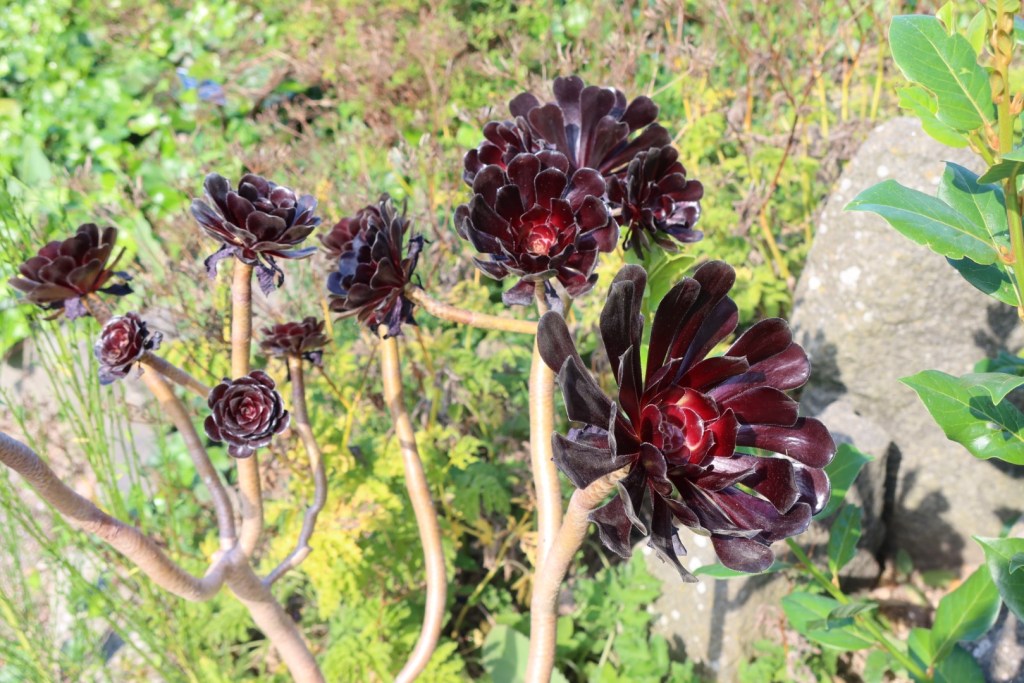
Pots of aeoniums are embedded into soil and dug up and protected under cover during the winter. The south-facing border provides the right place for numerous salvias, Helianthus, and South American Dahlias such as species Dahlia Dahlia merkii.
I am now going to let the photographs do the talking. Sadly I didn’t photograph all the plant names so a few of the plants featured are unidentifiable.
The anti-burglar plant Colletia histrix, also hails from South America.
The following images of a Begonia, Pelargonium and spectacular cacti were taken in the polytunnels.
Tom and his small team run a nursery shop stocked with plants raised at Lullingstone. A beautiful garden in its own right, few of us could resist the temptation of buying a souvenir of a memorable visit to this unique place. I treated myself to a pretty light purple Salvia Lavender Dilly Dilly, destined for new resilient planting in the front garden, a project I plan to progress and document here in the coming months. Also a green tinged Aeonium Velour, now getting VIP over-wintering treatment on the shelf in the spare bedroom. I feel a responsibility to nurture these two plants, given that Tom mentioned them both when signing my copy of his book!
How much the poorer the horticultural world would be had the kidnappers not freed their prisoners 23 years ago. Tom Hart Dyke’s vision of a garden encompassing unique specimens from across the globe would never have seen the light of day, a garden which has put Lullingstone Castle well and truly on the map for all plant lovers.
Kew Gardens, 3 December 2023
*The walled garden was formerly home to the white mulberry bushes (Morus alba) for the Lullingstone Silk Farm set up by Tom’s grandmother Lady Zoe Hart Dyke. Silk produced by the farm was used for the late Queen’s wedding dress in 1947 and her coronation dress in 1953. I love the fact that until the operation of the farm moved to Hertfordshire in 1956, hundreds of thousands of silkworms were bred in 30 rooms in the house where they grazed on the leaves of the mulberries.
Queen Elizabeth II’s Coronation gown. The Royal Collection TrustSir Norman Hartnell’s design for the gown. The Royal Collection Trust
What follows is a summary of a talk I gave on 14 October to the Friends of Pensford Field, a conservation project here in Kew.
A garden doesn’t have to be a wilderness in order to be a haven for wildlife. I’ll detail the key components for a wildlife friendly garden, and argue this isn’t merely a trend, but that it’s vital that we all take steps to maintain and hopefully increase the biodiversity in our gardens.
Biodiversity loss is increasing at an alarming rate: Since 2004 the insect population in these islands has decreased by 64%. In the State of Nature report issued in the last week of September, it was stated that 1 in 6 of 10,000 species assessed is at risk of being lost from the British Isles, with a far higher figure for birds. In the January 2023 Big Garden Birdwatch the sighting of sparrows, song thrushes and skylarks was down again as it had been the year before.
Gardens are said to occupy more landspace than all Britain’s conservation areas and nature reserves combined, so re-wilded gardens could create important wildlife corridors between fragmented woodlands, meadows and other wild habitats.
As a gardener, my instinct is to keep the garden looking neat and tidy so surely making it wildlife friendly will mean sacrificing that sharp-edged smartness for something resembling a jungle? Not at all, you can for example devote a small area of the garden to a ‘re-wilded’ area where the grass is longer, there are woodpiles and wildflowers, perhaps a pond or a bog garden and after a while, the place will be buzzing with insect and amphibian life. This doesn’t mean that the rest of the garden should still need treating with pesticides and herbicides: if you get the balance right pesticides won’t be needed because birds and invertebrate predators like solitary wasps will have seen off the destructive bugs. As for weedkillers, there’s nothing like a session of intensive hand weeding to clear the mind, relieve stress and achieve attractive results without the equivalent of that scorched earth effect when the poison has done its stuff and the weeds have turned to an unsightly brown crispy mess.
What are the fundamental elements of a wildlife friendly garden? If you think about the three things we all need to function the same applies to garden wildlife: shelter, water and food. Dealing with each of these in turn:
SHELTER
Imagine micro versions of the habitats that wildlife thrives in: woodlands, meadows and wetlands.
Trees: You might already have a tree in your garden which shelters many different organisms, both at the invertebrate level as well as larger creatures like birds and squirrels. If you possibly can do introduce a tree into your garden. Many trees are well suited to smaller gardens and there are cultivars that have a narrow growing habit rather than having wide spreading branches. Examples are Prunus Amonagowa and Amelanchier Ballerina: both are deciduous but with interest in all seasons with spring blossom, fruits attractive to birds in late summer and attractive autumn foliage. Use the height and protection offered by the tree to install bird nesting boxes or open-bottomed bat boxes. Bear in mind that brand new boxes are usually made from treated wood which will smell of the chemicals used to preserve the wood (do also make sure that the product you buy is made from wood from sustainable sources). Birds and bats prefer to wait for a season or two until the box has weathered before setting up home. A bat box has an open bottom for the roosting bat to fly up into and needs to be fixed as high as possible, say at least 2 metres. Bird boxes must be sited away from potential danger points, such as fencing where a determined cat is likely to be able to take a swipe at a parent flying in or out while feeding a brood or indeed a fledgling leaving the nest for the first time.
Log piles: Piles of rotting wood in the form of log piles or stacks of brash, such as the prunings from a renovation prune of a favourite shrub, can be placed in shady corners to accommodate myriad invertebrates, including stag beetles. Despite their scary appearance and erratic bumbling flight, these fascinating animals are garden friends and by feeding on rotting wood the larvae help to keep our gardens tidy. The adults live for a few weeks of the summer and when seen on the wing are likely to be in search of a mate. Their distribution is confined to the southern counties with the highest concentration recorded in the south east. They are classed as endangered in many European countries and indeed have gone extinct in Denmark and Latvia. If you have to have a tree cut down for some reason, do not have the stump ground down but leave it to decay naturally where it will provide a des. res. for stag beetle larvae. If the stump looks unsightly in the centre of a bed or border, plant herbaceous perennials around it to grow up around it each spring and summer and hide the stump. Amphibians such as frogs, toads and newts will favour log piles for over-wintering. They also like to shelter in compost heaps, leaf litter, and spaces under sheds or greenhouses and decking: somewhere damp and protected. Their bodies need to be allowed to enter a period of low metabolic function to help them survive the cold. You don’t have to have a pond to attract amphibians (although a pond is a wonderful addition to a wildlife friendly garden as I shall go on to demonstrate). As long as there is dense planting rich in insect life for hunting which provides a damp hideaway, amphibians can reach other nearby ponds.
Bug hotels are another fantastic way to provide shelter for invertebrates in your garden and there’s a splendid example of one at Pensford Field. They’ve also become a popular garden accessory and can be bought off the shelf, though they’re not quite the same as creating one out of a log drilled with varying sizes of holes and stuffed with hollow stems for solitary bees and wasps. A commercially made bug hotel, like the bird and bat boxes, might smell and feel rather new and strange so may take a while to be occupied. There are houses for solitary bumble bees in the kitchen garden at Kew Gardens.
Long grass/meadows: Since the 1970s we’ve lost a shocking 97% of flower rich meadows in this country. The No Mow May campaign has been running now for a few years, started by Plantlife, the charity which aims to protect the vital habitats which so many creatures call home. The purpose of the campaign is to encourage gardeners and green space managers not to mow during May, thereby creating a space for nature. Long grass shelters many species of insect, grass hoppers included, and is a vital habitat to support their life cycles. If you do decide at the end of the month of May that you want to make the lawn look more Wimbledon Centre Court than Serengeti, there are a few things you can do to protect wildlife as you mow.
Before starting to cut, hand search longer grass areas for small mammals like hedgehogs.
For the first cut, set the blades as high as possible, and mow strips only half as wide as the mower to reduce the load on the mower.
Don’t mow around the edges to the centre, as this prevents the creatures which have adopted this area as home from escaping towards the uncut section of grass.
As you mow progress gradually towards sanctuary areas such as uncut grass strips at boundaries.
Let it Bloom June allows the lawn wildflowers which began to emerge in May to bloom by extending No Mow May into June and making part of the garden a wildflower landscape: encourage an area of lawn to be left as a flowering lawn to be mown once every 4 to 8 weeks during the growing season. Common low growing plants will re-grow and re-flower throughout the summer after a cut to maintain a shorter, neater height: red and white clovers, golden trefoils, blue self heal and white yarrow. Even in a period of drought, when the grasses fall dormant and go brown, the wildflowers remain green.
You can go one step further by mowing only twice a year avoiding the period from April to July. This enables you to recreate the effect of a traditional hay meadow. Taller flowers like red campions, purple knapweeds and mauve scabious will thrive. Treat an area like this as a perennial herbaceous border you never need to feed or water: by leaving it undisturbed for longer, the wildflowers and grasses will support the lifecycles of the invertebrates which depend on them.
By leaving some grass permanently unmowed, it won’t support as many wildflowers but will provide a sanctuary for wildlife in hot summers and cold winters: this could be a sanctuary strip at the base of a hedge or fence for toads and voles with seed heads acting as natural bird feeders for finches. This is low maintenance gardening with the only management being to snip out woody saplings or over-vigorous brambles.
When you do cut the meadowed area, it is advisable to collect and rake off cuttings : leave them for a day or so to dry and for invertebrates to escape. This prevents a build-up which might inhibit the re-growth of wildflowers and no cuttings rotting down into the soil means less soil fertility. The more fertile the soil the better the grass will grow at the expense of wildflowers. A further advantage of a wilder lawn is that it captures and locks away more carbon helping you to do your bit for the climate. In the next section I look at creating a wildflower meadow from scratch.
The wildflower meadow at Pensford FieldField scabiousThe Pensford meadow after scything down
FOOD
Soil dwellers: When you’re planning a garden that will provide food for the creatures you want to attract, it helps to start at the bottom of the food chain with the invertebrates and other creatures and organisms which occupy the soil in your garden. We are constantly being told by gardening pundits to enrich our soil with organic matter. Not only does this improve the structure of the soil (particularly important here in Kew where we have very sandy soil from which nutrients are easily washed away), it provides fodder for the soil fauna like earthworms, mites, nematodes, springtails, ants etc. that spend much of their life underground. These in turn feed burrowing rodents like moles as well as omnivorous birds such as robins and blackbirds. You can mulch the garden with garden compost you’ve made yourself in a home compost heap or bin or with a number of media which will bulk up sandy soil or open out the structure of clay based soil. Examples are spent mushroom compost, composted bark fines or well-rotted farmyard manure. The best time to apply such mulches is in late winter just as spring bulbs and last year’s herbaceous perennials are nosing through so you can work around them rather than submerging them. As well as helping the underground creatures, your garden plants will thank you too as such mulches help to conserve moisture in the soil and feed the plants for the rest of the season.
Butterflies: Moving up the food chain brings us to the larvae of the butterflies and moths which when full grown will help to pollinate many of the flowers and food plants we grow. It’s easy to forget that a beautiful peacock butterfly was once a plump caterpillar. Caterpillars are also a favourite food of many bird species and invertebrates such as solitary wasps. A bluetit chick can eat as many as 100 caterpillars a day. In a fascinating butterfly talk and walk at Pensford in July the supervisor of Kew’s natural habitat areas, highlighted a number of plants which are particular favourites of certain species of butterfly:
Brimstone caterpillars feed on buckthorn.
White species of butterfly famously eat brassicas but as they also like nasturtiums these can be planted alongside as a sacrificial plant to distract the caterpillars from your cabbages.
Tortoiseshells feed on stinging nettles.
As well as holly, holly blue butterfly caterpillars feed on ivy and brambles
Meadow browns and small skippers feed on grasses
Thistles are also good caterpillar food plants. If possible, leave an area in a sunny corner of the garden as a caterpillar larder for some of these plants to thrive. The results of the Big Butterfly Count this summer organised by Butterfly Conservation published in September revealed the great news that butterfly numbers increased this summer compared to the last four summers, though sadly many species have been shown to be in decline since the count started 13 years ago. This year’s mixed weather meant there was an abundance of green food plants for caterpillars and nectar-rich flowers for adult butterflies. The most successful species were red admirals, gatekeepers and holly blues. Since it is habitat loss which causes species to decline, it’s all the more important that we create wild spaces in our gardens for butterflies to feed, breed and shelter.
Small skipper butterfly photographed at Hampton Court RHS Flower Show July 2023Holly tree planted 14 Oct 2023 in Pensford Field
Pollinating insects: Choosing nectar-rich plants is easy these days when many garden centres use special labelling to highlight ‘plants for pollinators’ using a bee logo to reinforce the message. The important thing to remember is that the flowers you choose give insects easy access to the sweet nectar at the base of the flower and enable the pollinating insect almost incidentally to brush against the male pollen-bearing stamens and transfer the pollen to the female organ, the stigma. This can mean for example:
Open, single-flowers are easy for flying insects to access: the petals are arranged as a guide, directing the pollinators to the centre of the bloom where the nectar is found. Think of daisies where the petals arranged around a central disc guide the insect to the bectar via the pollen. With dahlias, the slim-petalled ‘Honka’ dahlias or the ‘Bishop’ series like the dark-leaved, scarlet flowered Bishop of Llandaff are more likely to appeal to flying insect pollinators than the big showy blooms of dahlias like fashionable Cafe au Lait. Roses are another popular flower where we all fall for the multi-petalled beauties promoted by the likes of David Austin Roses. For a wildlife friendly garden choose a single-flowered china rose like the multi-coloured Rosa mutabilis, the deep red Bengal Crimson or the white climber White Star.
Flowers with a wide landing platform (technically known as an umbel) where the flower heads consist of dozens of tiny flowers arranged in a plate-like structure. These include members of the carrot family such as fennel or sweet cicely, the succulent Hylotelephium (formerly Sedum) spectabile also known as the ice-plant or several members of the daisy family such as Achilleas. A. Goldsturm is a deep yellow cultivar which is very popular and looks particularly good in the borders either side of Kew’s Great Broad Walk.
Flowers with a landing strip often highlighted with markings on the petals at the entrance to a tube or trumpet leading to the nectaries. Think of the spots near the lip of foxglove flowers or the wide apron like lower petal of salvia flowers.
‘Thistle’ like flowers attract pollinators. Examples include the globe thistle, Echinops ritro ‘Veitch’s Blue’ or the crimson Cirsium rivulare ‘Atropurpureum’ which featured a lot at this year’s Chelsea Flower Show. Also teasels and cardoons.
Spires of flowers are popular with pollinators: I’m thinking of Veronicastrum virginicum ‘Fascination’ from North America or the various cultivars of loosestrife, Lythrum salicaria, whose nectar and pollen rich flowers are a hit with bees, butterflies and moths.
Verbena bonariensis, has become a garden staple over the last few years and is a good flower for the hummingbird hawk moth whose long proboscis is able to feed on the nectar at the base of the tiny tubular flowers which make up the purple flowerheads.
Early and late flowers: Many of the flowers I’ve listed so far bloom through the summer months but let’s not forget the early months of the year when some of the early emerging pollinators are foraging for sustenance. This is where the early spring bulbs like snowdrops, scillas and crocus are important. And if you choose carefully from the bulb catalogues advertising their wares at this time of year, you’ll find varieties of Narcissus (daffodil) covering February all the way through to April, when some of the herbaceous perennials start to flower in earnest. Late sources of nectar are important too, and the creamy globe-shaped flowerheads of mature ivy are perfect for providing nourishment in October and November.
Flowerhead of mature ivy
Flowering shrubs. The many forms of flowering shrub provide nectar. An obvious example is lavender, but early in the year Forsythia flowers are good, followed by Buddleia which if you keep deadheading them will flower well into September and are called the butterfly bush for good reason. In the last few weeks of Sepember I revelled in the bright blue spiky flowers of deciduous shrub Caryopteris x clandonensis which plays host to dozens of solitary bees, hoverflies and honey bees. A useful evergreen shrub for pollinating insects is Abelia.
BuddleiaCaryopteris clandonensisCaryopteris
Establishing a wildflower meadow I promised earlier to return to wildflower lawns and meadows. I’m including this topic when considering the food that will attract wildlife to the garden because the flowers that thrive in this kind of habitat are usually rich in nectar for flying insects. You can supplement the naturally occurring flowering wildflowers you find in lawns (aka weeds! like plantains and dandelions) with a wider range of meadow plants. either by sowing a wildflower mix of seeds, planting individual plug plants or installing a square or strip of wildflower turf as has been done here at Pensford. If you decide to make a meadow on bare soil don’t be tempted to enrich the soil with fertiliser, the poorer the soil the better. And dig out all perennial weeds like nettles and docks! Nurture these instead in the area you’ve set aside as a caterpillar larder. Let the area rest for a few weeks before sowing or planting, so that any ephemeral weeds can be hoed off and the soil raked, levelled and firmed lightly with penguin steps.
Seeds. Broadcasting a packet or packets of seeds is the cheapest method of making a meadow. The seed companies produce mixes to attract particular creatures (eg. pollinating insects, birds) and it’s a question also of whether you want to make an annual or a perennial wildflower meadow. An annual mixture of seeds consists of colourful cornfield annuals like cornflowers, field poppies, corn marigolds and corncockles which will distribute their seed at the end of the season and produce flowers the following year although further sowings may be needed. Other mixes contain the seeds of perennial meadow plants. These can take longer to establish and might include ox-eye daisies, ragged robin, red campion, knapweed and field scabious. The best time to sow wildflower seeds is March or April or in September. The site you choose should ideally be in full sun and well-drained, though there are mixes for other areas such as shady or damp sites where the species chosen will thrive in such conditions.
Plug plants. Using plug plants to create a meadow is more labour intensive and expensive but ultimately often more effective at establishing perennial meadow plants. Approximate cost: a tray of 104 plugs of 13 different species is about £90 and would cover an area of approximately 20 square metres. Method: create a grid of metre squares with canes and garden string and plant about 5 plugs per square metre.
Meadow turf is sold by the metre and has been created by the suppliers sowing onto a mesh or a biodegradable plant fibre backing. The latter is the preferable method. Like seed mixes, in the case of both plug plants and meadow turf, there are numerous permutations depending on aspect, site conditions etc. The method of site preparation is the same. You’ve probably all seen the wildflower meadow around the base of The Hive in Kew Gardens? This was made using metres and metres of wildflower turf, much of which had to be pinned to the steep sides cut into the mound on which the structure is built.
It is always recommended, in particular where a meadow is being created in a formerly lawned area, to sow yellow rattle seed in late summer to suppress the growth of the grass which if left unchecked will out-compete the floral element of the meadow. Yellow rattle, Rhinanthus, is a semi-parasitic plant which reduces the vigour of established grass.
Teasels. Dipsacus fullonum, grow to about 2 metres and as well as looking pretty in flower with fluffy mauve flowers to attract pollinators, dry back to spectacular seed heads which will attract charms of goldfinches during the winter months. Like foxgloves, teasels are biennials and complete their life cycles in two years: growing a crown of leaves in year 1 and flowering and setting seed in year 2. To establish an annually recurring display, plant the crowns two years running.
Berries & hips for birds I’ve concentrated on pollinators but as the season progresses and berries and hips develop, many shrubs are good food sources for birds. Examples include the shiny berries of the so-called Guelder rose, Viburnum opulus, a favourite for thrushes and redwings, or the pink and orange fruits of the spindle tree Euonymus europeaeus beloved of starlings. Another good reason for planting this useful shrub is that it is host plant of the species of aphid that in their turn attract an army of predators such as ladybird larvae which will deter aphids from infesting your roses and broad beans. Rosehips are a great food source in late autumn and winter for birds.
WATER
Ponds. On a bat walk in August at the field, led by one of the rangers from Barnes Common, he described a pond as a ‘food funnel’ for species such as bats because it draws insects towards it on which bats can predate. In the same way that a watering hole in East Africa attracts animals from many miles around to quench their thirst, so a pond in your garden will act as a gathering point for an army of invertebrates. Not only the obvious waterside dwelling insects like dragon and damselflies, which if the pond is large enough to support a population of underwater creatures on which dragonfly larvae can feed, might breed there, but also pollinators like bees, hoverflies, moths and butterflies will swoop down to the surface of a pond to drink. As I mentioned before, a garden pond will provide a wonderful habitat for amphibians like frogs, newts and toads. It doesn’t have to be enormous, but you must provide some form of exit route for these creatures to get out of the pond because they spend much of their time on land, sheltered in the undergrowth. A staircase arrangement of bricks leading to the surface or a wooden ramp as I’ve seen in some gardens will enable them to get out when they need to. The huge advantage of having a resident colony of amphibians is that they will suppress the population of snails and slugs. An example of the phenomenon that introducing wildlife friendly gardening practices, like making a pond, will have a beneficial effect on the way you garden. If you’re making a pond from scratch, be sure to site it in a position where it will get direct sun for at least 8 hours a day in summer. The best practice is that one half or up to two thirds of the pond should be covered with vegetation. Having a small fountain in your pond will not deter the wildlife and will help to oxygenate the water. Even in a dedicated wildlife pond, as opposed to one that is ornamental, it is important to make sure that the water is kept moving, to avoid the water becoming stagnant. It is best not to install a water feature which throws the water high into the air as this will cause the water to evaporate more quickly in hot weather and in a dedicated wildlife pond would look incongruous. Just install a water pump with the fountain base just showing above the water line for a gentle bubble effect which is enough to agitate the water. Even with a fountain, you should still introduce submerged oxygenating plants (available from water garden suppliers) as these provide a habitat for small animals to live and breed.
Cleaning ponds. Even taking these precautions, ponds inevitably get clogged up and benefit from skimming over occasionally with a fishing net to remove blanket weed and any fallen leaves from neighbouring trees. Don’t immediately empty the debris you collect into the compost bin: just deposit it on the side of the pond to give any creatures that you’ve scooped up to disperse back into the pond. After about three days you can pick up the waste and dispose of it.
My pond needing the blanket weed skimmed off (Seamus far too interested in pond life)The large wildlife pond at Pensford Field after removal of excessive growth of water soldier Stratiotes aloidesthis summer
There are dozens of aquatic plants available for garden ponds, with waterlilies being the most popular. Whatever you choose be sure to avoid invasive species like parrot’s feather (Myriophyllum aquaticum), though the sale of this is restricted and shouldn’t even be available from a reputable aquatic plant retailer. Choose your plants according to the scale of your pond: there are several dwarf cultivars of water lily available for smaller ponds. Make sure to include some marginal plants around the edges of the pond for amphibians and insects like dragon and damselflies to shelter in. There are several rushes which look attractive though bear in mind they can grow quite densely and are hard to shift once established: an example would be Juncus effusus (Soft rush). If you’re looking for an online supplier, Lincolnshire Pond Plants is a good one. They won gold at both Chelsea and Hampton Court Flower Shows and are really helpful with advice as to the best plants to choose.
Bird bath If you hang birdfeeders in the garden for garden birds you should also provide a bird bath or similar to enable them to drink and bathe. Do keep it as clean as possible and make sure it’s kept topped up.
Bee bath. You don’t have to have a full-sized pond to help pollinators to swoop down and drink: you can provide a shallow saucer with a few pebbles which you keep topped up with water.
Having covered the basic 3 elements needed to attract wildlife to the garden, I’ve a list of DON’TS to share with you.
DON’T use weedkillers. In the words of Joni Mitchell in Big Yellow Taxi ‘Hey farmer, farmer put away that DDT now, give me spots on my apples, but leave me the birds and bees, please’. She went on to sing ‘they paved paradise, put up a parking lot’, but run off from hard-standing which causes surface flooding is a whole other talk about resilient gardens! There’s no substitute for hand weeding accompanied by a good podcast or audiobook, not to mention a hori hori or Japanese trowel which while it might look like an offensive weapon is the most useful tool in my gardening toolbag.
DON’T use pesticides. Once you establish a good balance in your garden by attracting natural predators with shelter, food and water, you won’t be as troubled by aphids, slugs, snails and pesticides won’t be needed. There are biological controls available for certain pests in the form of predators or pathogenic nematodes but this is a whole other topic and perhaps a talk designed to encourage wildlife is not the forum to be looking at ways to kill certain elements of it!
DON’T use slug pellets aka molluscicides. Although the really toxic ingredient in slug pellets (metaldehyde) is now banned, you might have some of the old product in the shed. It’s poisonous to birds and pets as well as gastropods and SHOULD NOT BE USED.
DON”T let the cat out at night. According to a Landscape & Urban Planning report in April 2022 on small mammal predation, UK cats kill 160-270 million animals a year, a quarter of them birds. Cats Protection League recommends the following steps to reduce predation: a dusk to dawn curfew, feed cats meat-derived protein food, and playing with your cat for at least ten minutes a day.
DON”T over-illuminate your garden. It’s better to use a few solar-powered bulbs than an elaborate lighting system that confuses birds who don’t know what time of day it is and a brightly lit garden deters bats.
DON”T deadhead roses from late summer onwards. Leave the spent flowers to develop into nutritious hips for over-wintering birds. They look decorative too.
DON’T cut hedges or large shrubs before checking for nesting birds.
DON’T cut sunflower heads when the flowers have finished. Leave them in place after they have finished flowering as blackbirds love the oil rich seeds.
Here are a few suggestions for wildlife friendly gardens which are open to the public:
Kew Gardens: especially the natural area in the south of the Gardens.
The Knepp Estate in West Sussex. Like the wider estate, the walled garden is being managed to maximise biodiversity, whilst being as sustainable as possible. You can join a ‘rewild your garden safari’. https://knepp.co.uk/knepp-estate/gardens/
Pembroke Lodge gardens in Richmond Park where there are two ‘wildflower’ meadows being established. One is a traditional wildflower meadow, the other is in the North American prairie style and planted with pollinating attracting flowers such as Dianthus carthusianorum and Echinacea.
Long Barn: Vita and Harold’s gardenbefore Sissinghurst
Most people, when they move to a new property, make some changes, perhaps a new kitchen or bathroom, or even an extension. When in 1913 Vita Sackville-West and Harold Nicolson, home from a diplomatic posting in Constantinople, bought two farm labourers’ cottages and adjoining land in the village of Sevenoaks Weald in Kent, they went a step further and moved a mediaeval barn from the bottom of the hill joining it to the cottages to create a large house. Their radical approach to property renovation extended to garden-making, culminating years later in the creation of the unique gardens at Sissinghurst.
I visited Long Barn on a blistering hot day in early June. Organised by the WGFA, the visit consisted of an introduction to the property by the owner Rebecca Lemonius, followed by a tutorial in plant sketching by head gardener Anna Ribo. It was a very memorable and rewarding day in a fascinating garden. The link with one of the twentieth century’s most celebrated gardeners and garden writers made it all the more special. As for the art element, Anna’s non-judgmental approach gave this non-artist the space and freedom to have a go at drawing the bold planting combinations without feeling daunted.
Having grown up only 1.5 miles away, in her ancestral home Knole (nicknamed ‘the calendar house’ because of its reputed 365 rooms), it was important for Vita to live somewhere with an intriguing history. Long Barn was reputed to have been occupied at one time by the founder of the printing press, William Caxton. The house went on to develop more history when in the 1930s, after Vita and Harold had decamped to Sissinghurst, it was let to aviator Charles Lindbergh and his wife when they sought solitude and privacy from the press intrusion following the kidnapping of their infant son in 1932. During the 2WW the house was used as a nursery by the NSPCC to accommodate children affected by air raids. Rebecca told a touching story of her correspondence with a gentleman who had lived at Long Barn during this period. Following his recent death, his ashes are to be scattered in the garden.
In developing a new garden at Long Barn, Vita and Harold addressed the property’s sloping site by installing a terrace. Architect Edwin Lutyens, a lover of Vita’s mother Victoria, the spirited Baroness Sackville, advised on the construction of a series of raised beds at the foot of the garden (now the Dutch Garden) and the planting of a long row of clipped yew columns across the middle of the main lawn, but is not known to have been involved elsewhere in either the remodelling of the house or development of the garden.
Lutyens’ contribution: the raised beds of the Dutch Garden with clipped yews beyondExtra wide Lutyens ‘wave’ bench
Vita and Harold made a good team when it came to making gardens. His strength was in the vision to create the structure and hard landscaping, whilst Vita’s talent was in choosing the planting, informed by her admiration for the writings of William Robinson, pioneer of the wild gardening style, a reaction to the rigidly formal bedding fashion of the Victoria era. The garden was said to be the glue which held their marriage together. When it was rumoured that a chicken farm was to be built on adjoining land, the Nicolsons looked for another property, a blank canvas on which to create a garden. And so they arrived at Sissinghurst which has of course come to be known as one of the great gardens of the world. They moved there in 1932 but didn’t sell Long Barn until 1945.
In terms of gardening partnerships, it’s clear that Rebecca and her head gardener Anna share a similar vision for the atmosphere they want the garden to evoke, their philosophy being that the design is led by their choice of plants. Anna explained that her approach to gardening at Long Barn (she has been there five years) is to be sympathetic to what is already there. A gardener has to approach a garden with a degree of humility, get a feel for the soil and condtions and get to know the client. The soil here is Weald Clay which is rock hard in summer and sticky and claggy in winter: they improve it as far as possible by mulching it with organic matter such as composted bark and spent mushroom compost which help to break up the clay. The only place they use grit is in the Cretean Bed, a narrow south-facing border running parallel to the Box Parterre where the plants are reminiscent of the Mediterranean style planting at Delos at Sissinghurst, with a limited colour palette accented by handsome multi-headed Aeoniums.
The Box Parterre
This large site consisting of several different areas or ‘rooms’ is maintained by what amounts to seven man days a week, and Rebecca and Anna recognise that ‘everywhere doesn’t have to be perfect all the time’. After an area has gone over, it is allowed to be quiet. With such a small team, there has to be a realistic view of what can be achieved in terms of maintenance. There is an irrigation system in place in the Dutch Garden, but everywhere else is watered by hand. A further challenge is posed by the rest of the village’s surface water draining down towards Long Barn. On the site of an old tennis court, they are developing the ‘Rose Meadow’ where roses are encouraged to be as tall as possible, interplanted with grasses and wild flowers such as cow parsley and buttercups.
Head gardener Anna is also a garden designer with a fine art background, and prefers to hand draw her designs rather than using a computer programme. When sketching a plant she told us you should look at the character of the plant and ask yourself is it, for example, upright, frothy, strong, structural? If you spent ten minutes a day on sketching the plants in your garden you would soon see progress. After these words of encouragement we were free to draw plants in the Dutch Garden which was a joyful experience. We hunkered down in the shade on the cool grass between the raised beds and drew the plants at close range, considering how one plant relates to its neighbours and trying to capture something of the sheer exuberance of the planting here. Since the day at Long Barn I have sketched in my garden for a few minutes but haven’t devoted enough time to it to see such progress. I certainly find it a mindful experience regardless of the results my concentration produces.
Anna shared some useful design tips for planning planting schemes. When assembling a choice of plants for a border you should introduce lots of different flower shapes. Umbels, the flattish umbrella-like flowerheads of plants such as Valerian officinalis, will attract beneficial insects like hoverflies which eat aphids. Heavily edit self-seeders when they have finished flowering, but don’t remove them altogether. For example bright cerise Gladiolus byzantina, itself a self-seeder, was lighting up the beds in the lower part of the garden with vibrant spires of flowers. In a large herbaceous border like those in the Dutch Garden, maintain planting pockets which carry a quiet period, during which you can introduce annual plants such as Ammi majus (more umbels!) Anna’s plant descriptions were wonderfully lively: she pointed out zesty euphorias and described small flowered, low growing plants as ditsy.
There was something of Great Dixter about the garden at Long Barn. I think it’s the handsome and weathered old house rearing up amidst a sea of bold colours and diverse flower shapes and leaf textures. The team at Long Barn have certainly honoured Vita and Harold’s horticultural legacy by maintaining the unique structure of a historic garden but within that framework experimenting and playing with scale and colour.
Here are some more of my images of the three acre site.
After a few non-gardening days last week with family coming to stay, I returned to volunteer at Osterley, to find that an interloper had arrived in the vegetable bed in the Tudor Walled Garden that we had thoroughly weeded a week earlier. Numerous substantial seedlings of gallant soldier had pioneered their way along the aubergine and chilli pepper rows. Gallant soldier is a corruption of this plant’s scientific name Galinsoga parviflora, a member of the daisy family which bears very small white flowers amidst serrated oval leaves.
I’ve got a new plant identifier app on my phone, Flora incognita, which swiftly identified the vigorous invader. Subsequent reading reveals other common names for this fast reproducing plant: quickweed, potato weed and (my favourite) galloping soldier. It was originally collected in its native Peru in 1796 and brought to Kew Gardens, from whence it escaped, earning the moniker the Kew weed! There’s a delicious description in William Edmondes’ ‘Weeds Weeding (& Darwin): The Gardener’s Guide‘, my weed bible, of the prolific Galinsoga parviflora being brought to Kew Gardens and ‘almost immediately galloping away down the street and all over London’. This conjures a vision of it heading north along Kew Road and marching across Kew Bridge to Brentford, with a breakaway battalion hopping onto the District Line to spread across the city.
We made short shrift of the energetic soldiers after some careful weeding around the precious crops. However, I’m expecting to see them back on duty this Friday after several days of heavy showers and relatively mild temperatures.
Every day’s a school day, as they say, and my education continued last Friday with an excellent butterfly talk and walk at Pensford Field, led by Ruth from Kew Gardens, who oversees the wildlife in Kew’s Natural Area (formerly the Conservation area). She began by listing the several benefits of butterflies: as pollinators, by spreading pollen from plant to plant while drinking nectar; as part of the food chain in the form of caterpillars which feed wild birds and even wasps; as an indicator species to signal the health of an environment as well as inspiring people to take an interest in the natural world. There’s a huge amount to learn about these fascinating creatures. For example that butterflies detect smell through their antennae which means that in polluted areas their numbers can be reduced because it’s harder for them to detect sources of food. It’s a blessing that places like Pensford Field and the surrounding gardens exist to support butterfly and moth populations, given the proximity of the Field to the South Circular Road.
Other key facts that Ruth shared with us: purple flowers attract butterflies; grow nasturtiums near brassicas as a sacrificial plant to prevent large and small white butterflies from feeding on the crop; stinging nettles are a vital food source for tortoiseshell caterpillars; always site a wilder area of the garden in a sunny spot; treat brambles as a beneficial plant because they provide shelter when other habitats are not available, perhaps during droughts; when you see two butterflies ‘dancing’ in the air, they might be mating or two males fighting! Species with darker wings such as the ringlet which has charcoal coloured wings are more tolerant of shade and can be found in woodland.
Ruth’s talk coincided with the Big Butterfly Count which runs until this Sunday 6 August. I sat in the sun in my garden at the weekend and spied a day flying moth (the Jersey tiger), a holly blue and what I think was a large white.
Although I did no gardening whilst my niece and three great nephews stayed last week, we did spend time in the garden when the weather improved mid week and I introduced the two older boys (aged 7 and 9) to ‘sun printing’. Earlier this year I attended a day course on cyanotype printing at London’s City Lit in March which I reported upon in a blog post. We collected some fallen leaves during a visit to Kew Gardens earlier in their visit and I had been collecting and drying some flowers and fern fronds for a few months in anticipation of their visit. The boys enjoyed the whole process starts with treating the paper with the light sensitive chemicals, drying it the paper with the hairdrier then carefully placing their finds onto the paper. They got really excited when they saw the change in colour of the background of the images once they were exposed to the sun. We dried the washed images on the clothes line and all agreed they weren’t bad for beginners!
Since visiting Chatsworth almost five weeks ago I have discovered the Channel 4 documentary Chatsworth House: A Great British Year. I’m glad not to have come across it before as it’s fun to see the house and garden again and learn how such a vast enterprise works. The kitchen garden featured in one of the shows and like everything at Chatsworth it is beautifully designed and cultivated. Even at the end of November when most of the crops had been harvested, there was plenty to see and interesting details to examine.
The kitchen garden occupies a sloping west-facing site of about three acres. A relatively new addition to the gardens, it was created in the early 1990s. As in the wider garden, water has been channelled from parkland behind the garden to feed rills and ponds. I was interested to see tulips being planted in handsome terracotta pots, tucked into a nook beside the cold frames. The lower boundary of the garden is formed by a tightly clipped beech hedge. Large golden stalks adorn a trio of metal frames fashioned into apples and a pear, each housing a yew shrub which in the years to come will fill out the frames to form topiary fruits at the entrance of the garden. Rhubarb forcers from Whichford Pottery in Warwickshire stand to attention like terracotta warriors. A couple of stone plaques caught my eye: a quirky mission statement for creativity from dress designer Paul Smith and a heart-shaped memorial to the late Duchess Deborah. Straight rows of chard and brassicas appear to radiate from the corner of the large plots in which they are planted.
Unmistakeable for their charred finish, David Nash’s sculptures look entirely at home in the Arboretum which occupies the upper slopes of the gardens. The gardens are separated from the surrounding parkland by a ha-ha, the eighteenth century innovation which enables a garden to blend seamlessly with the landscape beyond. Here the ha-ha is a stone retaining wall. I noticed that a meshwork fence has also been fitted near the top of the wall, presumably to deter deer from entering the garden and munching the rare specimen trees. On the subject of dry stone walling, an installation called ‘Emergence’ demonstrates the evolution of this ancient craft, fundamental to the rural landscape of not only Derbyshire but so many other areas of the country. It contains one giant rock, a reference to the practice of using naturally occurring boulders in field walls. The transition from the older random style of limestone dry stone walling to the more modern sandstone wall of shaped stones is marked by a giant pane of glass. The interpretation panel informed me that the glass also represents Joseph Paxton’s pioneering work on the Great Stove at Chatsworth which led to him designing the Crystal Palace for the Great Exhibition in 1851. Giant redwoods tower above the other conifers in the Pinetum, an echo for me of the area of Kew Gardens devoted to these majestic trees.
More nineteenth century technology features in much of the seating around the gardens at Chatsworth. Cast iron benches with a plant inspired designs are placed around the remains of the Great Stove and in the terrace beside the 3rd Duke’s greenhouse. I found nasturtiums, passionflowers and lilies of the valley, as well as a design showing gardeners sowing, raking, harvesting and scything.
The Serpentine Hedge separates the Maze from the woodland area beside the Canal Pond. A double row of symmetrically planted beech which curves in and out, this dates from 1953 and was inspired by the ‘crinkle-crankle’ walls found in many old gardens, the alternating concave and convex planes providing stability. Seeing the north face of the house reflected in the Canal Pond, the Emperor Fountain rising skywards in the centre, has to be one of my highlights of 2021. This end of the garden also contains more remarkable sculpture: a horse’s head by Nic Fiddian-Green
and Allen Jones’s Dejeuner sur L’Herbe, a 3D take on Edouard Manet’s famous painting. If asked to name a favourite work from the garden, I would choose Cornwall Slate Line by land artist Richard Long, which runs parallel with the Canal Pond. Not far away Dame Elisabeth Frink’s Walking Madonna strides through a grove of trees.
The north front reflected in the Canal Pond
The family’s dogs appear in several sculptures nearer the house, faithful hounds keeping watch or assembling on the steps leading to the north front with its Ionic capitalised pilasters and windows framed in gold leaf. A frieze above the windows features coiled serpents, part of the Cavendish family crest. This motif is picked out in a pebble mosaic on the terrace near the 3rd Duke’s greenhouse, reminding me of the two dachshunds, Canna and Dahlia, immortalised in similar fashion in the Walled Garden at Great Dixter.
Classical statuary also abounds in the gardens, reminding me that this place has been a treasure house of art for many centuries. More mundane perhaps, but elegant in its own way, is the weather station on the Salisbury Lawns near the Broad Walk where temperature, rainfall and hours of sunshine are recorded and reported to the Met Office.
In the Kitchen GardenThe weather stationA Campbell-Stokes Sunshine Recorder
I shall leave you here with a final image from my memorable visit to Chatsworth, Flora’s Temple decorated for Christmas.
Well, not quite the last image. The finger post pointing the way to Chatsworth marked my exit in the early evening dark from the park into the village of Baslow where I was staying. It’s also inviting me back one spring or summer to explore further and to see Dan Pearson’s Trout Stream planting and Tom Stuart-Smith’s Arcadia in their full glory.
33 years ago this month some colleagues and I started a book club. Dozens of books later we are still reading, discussing, agreeing, disagreeing, laughing. Members have come and gone and now we are nine. We meet about eight times a year in the ground floor of the Royal Festival Hall and often notice other groups clutching their paperbacks and doing the same as us. This is a contrast with our early days when we would gather in each other’s houses and the host would cook and often miss out on the best bits of the discussion. After a few years, with most of us working in central London, it made sense to decamp to the South Bank. Other than a sojourn at Pizza Express on Exhibition Road whilst the RFH underwent refurbishment some years ago, the venue has remained unchanged. Of course we had to resort to Zoom for about a year during the pandemic, and it was a great relief when we were able to meet face to face again.
For the first time this year we went on a book club day trip to follow in the footsteps of Virginia Woolf whose Mrs Dalloway we had read a few months before. We visited Charleston Farmhouse near Lewes, home of her sister Vanessa Bell. The day was a joy and we’re planning a 2026 trip to Jane Austen’s Cottage at Chawton in Hampshire, inspired by having read Sense & Sensibility as well as her 250th anniversary this month.
In the early days of the book club, Penguin Classics were being sold for £1 each and we read several novels we might not otherwise have done. Wilkie Collins ‘The Woman in White’ was one. More recently we’ve tended to choose more contemporary authors, often those shortlisted for book awards. I’ve always been intrigued to hear how other book clubs go about choosing the next book. I know one model is for one person to choose the book and lead the discussion about it. Our system, if it can be called that, is for as many as want to, to suggest books perhaps recommended by friends or mentioned on the radio and to advocate for our chosen titles. Being pragmatic individuals with busy lives, shorter books often get the vote. Several of us listen to the chosen book or perhaps, as I sometimes do, operate a hybrid system where I read some chapters and read others.
Some books have disappeared without trace from memory, others have elicited quite heated discussions. Often those we’ve enjoyed least give rise to the liveliest debates. And then there are those books which have really struck a chord with all of us and made us want to find out more about the context and the characters. Such a book was our most recent read, The Painter’s Daughters by Emily Howes.
The painter in the title is Thomas Gainsborough (1727-1788). He painted his two daughters Molly and Peg throughout his career and the book is a fictionalised account of their and their grandmother Meg’s stories. The author admits to having used artistic licence to alter key dates and characters to progress or enhance the tale. What emerges is a gripping story of a charismatic artist who moves to Bath to be close to the high society whose portraits he paints, leaving behind the more rustic and idyllic surroundings of Suffolk where the girls were born. It is clear from the start that the younger of the girls, Peg, realises from a young age that her sister Molly is vulnerable: prone to sleep walking and other episodes of unusual behaviour. She makes it her life’s mission to protect Molly and that relationship is at the core of the book. As is the source of Molly’s mental illness, inspired apparently by Margaret Gainsborough having been overheard to refer to herself as ‘the daughter of a prince’. Enter Prince Frederick, later Prince of Wales (1707-1751). The author surmises that Molly, like the future King George lll (Frederick’s first legitimate child), is suffering from porphyria, thought to be the cause of George lll’s ‘madness’.
The Painter’s Daughters Chasing a Butterfly (1756), National GalleryThe Artist’s Daughters (c. 1759) National GalleryPortrait of the Artist’s Daughters, 1763–64 Worcester Art Museum
At this juncture you’d be forgiven for wondering what a historical novel about the family of a famous portrait artist has to do with gardens, horticulture etc. which make up the bulk of the posts by Weeds Roots & Leaves. You’ll be relieved to hear that it’s not just because a book contains leaves! As I read this highly readable and warm-hearted novel, I picked up references to familiar locations in Kew and Bath. Kew is my home patch and the Bath setting resonated with me as I’ve visited the city three times over the last 18 months. The action also takes place in Ipswich, Harwich and London.
BATH
The Georgian Garden to the rear of 4 The Circus
The ‘new’ city of Bath which is still under construction when the Gainsborough family arrives, is vividly portrayed. The streets are awash with pale coloured mud, created by the dust from the Bath stone being used to build the grand houses occupied by Gainsborough’s clients. The large house on The Circus which the family move into when Gainsborough’s success grows, is described not altogether flatteringly as something akin to a new build. These days a Georgian home like that would be the ultimate Bath des res. When I went to Bath in July I was early for my appointment (receiving the Green Flag Award on behalf of Pensford Field Environmental Trust) and had time to explore. My route took me around The Circus as far as the Royal Crescent and back along Gravel Walk which runs along the rear of the houses on the south west of The Circus. Here I happened upon The Georgian Garden behind 4, The Circus, which has been recreated to the original plan of around 1760/1770. The rather austere, mainly evergreen, planting of box, yew and holly has been chosen to represent species used in gardens of that period. Perhaps the garden of the Gainboroughs’ house at 17, The Circus, had a similar layout?
The Gravel Walk, Bath: backing onto The Circus. The tree in foreground is a Monterey Cypress(Cupressus macrocarpa)
KEW
Prince Frederick, later Prince of Wales, is strongly associated with Kew. An estrangement from his parents George (later King George ll) and Caroline was established early. In 1714, when he was seven, he was left behind in Hanover in 1714 when his parents came to England on the succession of George l to the throne. When summoned to join his family on George ll’s accession in 1728, the antipathy deepened, but in what might have been ‘a gesture of reconciliation’*, he leased a house a very short distance from the Dutch House (now Kew Palace) in what is now Royal Botanic Gardens, Kew, intended as a rural retreat. Improvements to the house were carried out by architect William Kent including the white stucco rendering which gave rise to it being called The White House. Frederick clearly had plans for the grounds of his new house in Kew. He commissioned Italian statuary and is documented as having spent considerable sums on plants ordered from, amongst others, a nurseryman on Kew Green**. Frederick died in 1751 from complications thought to have arisen from an injury years before when he was struck in the chest by a cricket ball.
In a key episode in The Painter’s Daughters an important encounter between Frederick and Meg takes place during a cricket match on Kew Green.
Kew Cricket Club pavilion on Kew Green today
His widow Augusta, dowager Princess of Wales, dedicated herself to the improvement of the garden at the White House during the twenty years that she survived her husband. The Princess of Wales Conservatory, opened by Princess Diana in 1987, commemorates Princess Augusta. The White House was demolished in 1802. Its site is marked by a sundial on the lawn in front of Kew Palace.
The site of The White HousePrincess of Wales Conservatory
The relationship between Gainsborough and his younger daughter Peg is touchingly portrayed in the book. He is constantly working or entertaining friends at parties where he plays the violin. She yearns to spend time with him and learn to paint like him so as to make him proud of her. She tries her best to master the craft, but has to concede she doesn’t have the talent. In a scene towards the end of his life, he tells her ‘I wanted you to paint’. Shortly afterwards the author states
He is buried at Kew, in the shadow of the church. His grave is set near to his friend, as he had asked. ‘Social to the last’, my mother says, drawing her black veil down from her bonnet.’
Gainsborough’s grave stands close to the south elevation of St Anne’s church on Kew Green. According to the engraving on the tomb, he is buried with his wife Margaret and nephew Gainsborough Dupont, who also features as a character in the novel. The friend referred to is Joshua Kirby (1716-1774), who Gainsborough had met as a young man in Suffolk. He was an artist, draughtsman and architect who in 1770 designed a new north aisle for St Anne’s.
Thomas Gainsborough’s graveThe site of Gainsborough’s Grave
BROCCOLI
Lest you think I have strayed too far from gardens and horticulture in this post, I should mention that during our discussion of The Painter’s Daughters one member of the book club reminded us that Gainsborough had used broccoli as his design for trees!
His landscapes were often painted at night by candlelight, using a tabletop arrangement of stones, pieces of mirrors, broccoli, and the like as a model.***
We’re having a rare Saturday morning book club meet up in early January in Room 34 of the National Gallery which houses its Gainsborough paintings to see his daughters’ portraits and perhaps identify some broccoli!
Mr and Mrs Andrews (c. 1750), National Gallery. Spot the broccoli!
Kew Gardens, 22 December 2025
*p 21 Ray Desmond Kew.
**Richard Butt. p 26 Ray Desmond Kew
***Michael Rosenthal, Thomas Gainsborough. Oxford University Press.
P.S. Mary (Molly) and Margaret (Peg) Gainsborough are not buried at St Anne’s in Kew but in the graveyard at St Mary’s, Hanwell.
In our busy lives, with so much information being flung at us all the time, anything that helps us to remember useful facts without immediately resorting to Dr Google is valuable. For example, Every Good Boy Deserves Favour spells out the five lines of the treble clef. And I have a friend who can recite the whole of the rhyme reciting the royal monarchs starting Willy, Willy, Harry, Ste, Harry, Dick, John, Harry three, One, two, three Neds, Richard two….
The botanical world is not immune from mnemonics of this kind. Ed, a volunteer colleague at NT Osterley House and Garden, recently taught me this rhyme:
Sedges have edges, rushes are round, grasses have knees that bend to the ground.
Sure enough, sedges have triangular stems and a mature grass stem is jointed with a series of nodes along its length.
During our Friday volunteer stints we chat a great deal about plants and try our best to name what we’re weeding out or trimming back. Coincidentally on the same day that I learnt the rhyme, Jasper, assistant gardener, showed us a quick method of identifying a couple of shrubs and trees when they are not in flower. He demonstrated that dogwoods (Cornus) have ‘elasticated’ leaves. If you tear the leaf in half across the way, you can gently stretch the central rib so that the two halves of the leaf remain connected by the stretched rib. And he pointed out that cherry leaves have nectaries at the place where the leaf stalk joins the branch. Sure enough, when I got home I checked my Snow Goose cherry tree and there they were: little nodes at the base of every leaf. Intrigued as to their purpose, I found this theory on the website of the Oxford University Herbarium:
At the base of the blade of a cherry leaf there are two extrafloral nectaries, which are thought to protect the plant’s leaves from damage by herbivorous insects. The nectaries attract ants by producing small quantities of sugar-rich nectar, which appears to encourage additional patrolling by ants. If the ants encounter any caterpillars they aggressively defend the leaf, even carrying the offending animal back to their nests.
I can’t help considering the irony of the caterpillars I’m so keen to attract to the garden being prey to marauding ants. No ant activity on the tree to report to date!
Cherry leaves and nectaries
Whilst writing the notes for a recent talk I gave about planting wildflowers in the garden to attract butterflies and moths, the mint family came up several times. I was reminded that a shortcut to identifying members of this large plant family, which are also called the dead-nettles (Lamiaceae), is that they have square stems. Just a light touch of the thumb and forefinger around the stem reveals the stem’s angled sides. By the way, red dead-nettle, water mint, betony and selfheal are all well-behaved wildflowers to introduce into the garden. The first two are caterpillar food plants for several species of moth, and the flowers of the last two are rich in nectar for butterflies and other pollinators.
Mint moth on Water mint
Another gardening friend of mine distinguishes beech and hornbeam by noting that hornbeam leaves have toothed edges and beech leaves have wavy edges. When I visited Kathy Brown’s Stevington Manor Garden near Bedford yesterday, I asked Kathy if she had any quick routes to plant identification. She opened up a whole new dimension to the topic by introducing the element of light: how it plays upon a leaf or indeed the whole plant. For example, hornbeam leaves are matte and beech leaves shiny. And pointing towards tall grasses in a nearby border she showed me that light reflects off the graceful Miscanthus making it shimmer, whilst the nearby Calamagrostis overdam absorbs the sunlight and appears more solid and blocky.
I referred to the mint family earlier, one member of which is lavender. I can’t mention to the visit to Kathy Brown’s Garden without praising her fabulous edible flower cakes, not least the lavender and lemon drizzle cake. The lavender is harvested from the borders in front of the topiary jury scene in the Formal Garden. The 4.5 acre garden beside the meadows of the Great Ouse is a joy, with ‘rooms’ inspired not only by historic gardens but also great works of art. The ‘Art Gardens’ include two purple beech and Berberis lined chambers evoking Mark Rothko’s Seagram Murals. With not a drop of water in sight, Kathy and her husband Simon have recreated Claude Monet’s Water Lilies using grasses, Echinacea and Geranium Rozanne to emulate the muted shades of gold, white and violet in the paintings. There is great deal more to this garden than this and I strongly recommend a visit there this summer: details of opening times are on the website, linked above.
Rothko inspired plantingKathy Brown leading the tour with Jessica in towLooking from the fountain towards the gazebo
Do you have quick, non-digital ways to identify plants? I’d love to hear about them. As I write this it’s 28°C in the shade, so I shall sign off for now and retreat to a cool spot to ponder the endless variations in form, texture, colour we find in plants.
For a fan of container gardening like myself, Whichford Pottery near Shipston-on-Stour is heaven, especially in April and May. Not only can you see a multitude of tulips planted into magnificent terracotta planters, but you can watch the pots being made by master craftsmen and women. When I went a week ago, there were relatively few visitors, perhaps because the Straw Kitchen cafe isn’t open on Tuesdays, and it was a joy to be able to potter (excuse the pun) around and explore. The staff throughout the operation are very welcoming and everyone clearly loves the place and the products made there.
The first floor workshop, where the potters create their hand thrown wares on foot operated wheels, was softly lit by sunlight streaming through windows thrown open to the north Cotswolds countryside. The throwers were incredibly generous with their time, patiently answering our questions, all the while carrying on making pots which they stacked on a wooden plank alongside their work stations. We learned that one of the first jobs each day is to weigh out the individual lumps of clay needed for the morning’s work. We watched as the clay mixed onsite was thrown onto the wheel and worked up into a pot of the desired form, to a height matching that of a long curved twig placed at the side of the wheel. The thrower skilfully shaped the rim of each pot, trimming off any excess clay and throwing it out of the window onto a pile to be returned to the clay mixing area.
The throwing studio
Shelving laden with the kind of tools that have been used in throwing pots for centuries line the walls of the workshop, and you could almost imagine you had stepped back in time, were it not for the wonderfully bluesy playlist. Van Morrison’s vocals increased in volume as we approached the area where Adam Keeling, son of the pottery founders Jim and Dominique Keeling, was making large vessels about 1.5 metres high. After making the base and an additional cylindrical section, he was joined briefly by a colleague to lift the cylinder onto the base. The two sections were then bonded together with clay and the entire vessel further worked on the wheel. A blow torch was used on these large pieces to partially dry out the pot before they are moved downstairs to the kiln.
As if the pot throwing operation wasn’t enthralling enough, we walked through to the area where the pots are decorated. A friendly trio of women worked around a long worktable, very generously answering our queries. We watched as a mould was pressed against the surface of a pot and removed to reveal an intricate design of a charging horse and spear carrying rider, which was then expertly ‘fettled’ to sharpen the outline of the design. One of the decorators showed us the stamp with which she ‘signs’ her work, a small moth. She said that during half term week her children came to the pottery and had a lovely time looking for her pieces in the courtyard display area beside the shop. Another decorator was applying the distinctive basket design onto a large pot, using long ribbons of clay which are extruded using a hand cranked mechanism on the nearby wall.
The decorating teamdecorative moulds
At the entrance to the workroom, a whiteboard lists the workload for the day, as well as some of the clients for whom Whichford makes specially commissioned pieces. Burberry featured, explaining the horse and rider motif. As we admired the stacks of drying pots awaiting firing in the ground floor kilns, another very kind member of staff showed us both sides of the pots designed by Monty Don for his garden for dogs at this month’s RHS Chelsea Flower Show: retriever Ned with his forepaws on a large beachball on one side and his paw print on the other.
Head gardener Mark was wheeling a massive pot of tulips from one courtyard to the next when he stopped for a chat. He buys thousands of tulip bulbs each September, sourced from the Dutch grower who supplies the bulbs for the pottery’s annual bulb bonanza. With the help of an Excel spreadsheet, he groups the bulbs into colour, time of flowering, height and so on, before embarking on several weeks of planting. The exuberant volume of flowers in each pot is achieved by planting the bulbs in three layers, which prevents them touching and minimises the risk of any infection spreading from bulb to bulb. The bulbs all find their own level and grow to a uniform height. Spent bulbs from this year’s pots are planted into the meadowed areas around the site. Many of the pots are interplanted with wallflowers, and Mark chooses cultivars which will continue to flower well into the summer to maintain a colourful display.
Over the years I’ve collected four handsome Whichford pots, two featuring Shakespearian quotations on the rim, and they are treasured possessions. I don’t have room for another large pot, and instead settled for an elegant ‘long Tom’ design, with Chelsea Flower Show ‘printed’ around the base, beneath a ‘roulette’, a band of decoration applied using ‘slip’, a diluted clay in a pale greyish shade. Each ‘roulette’ is hand carved onto a wooden roller. We had watched as one of the throwers applied a similar design to his pots before removing them from the wheel.
It felt a real privilege to watch makers at the top of their game creating pots which fulfil William Morris’s maxim
Have nothing in your house that you do not know to be useful, or believe to be beautiful.
Had the great exponent of the Arts and Crafts movement visited Whichford Pottery, I am sure he would have added ‘garden’ to this expression of his design philosophy.
7 May 2025 Kew, Surrey
21 May 2025: At Chelsea Flower Show yesterday, I saw the wonderful pots made at Whichford for the ‘dog garden’ created by Monty Don and Jamie Butterworth. So exciting to have seen them in their pre-fired form three short weeks ago!
I wouldn’t normally begin a blog post with a hashtag, but here it seems appropriate. Ben Cross, who runs Crosslands Flower Nursery near Arundel, began the British Flowers Rock campaign to promote British grown cut flowers 15 years ago. He’s a passionate advocate for sustainable growing, speaking at garden shows and conferences, leading tours around the nursery as well as having a strong presence on social media.
His family has been established in West Sussex for nearly a century, starting out with a smallholding at Sidlesham near Chichester (‘Chi’) funded by the Land Settlement Association, before moving to the present site in Walberton in 1957. They began to specialise in growing Alstroemeria, also known as the Peruvian lily, in the 1980s. Why Alstroemeria? Positioned between the South Downs and the coast, the site enjoys excellent light levels and free draining silty soil: ideal conditions for this cool crop. Needing minimal heat in winter (10°C), means Ben can grow the plants as sustainably as possible. The salad crops which the nursery used to grow needed considerably higher temperatures. Since 2013 the glasshouses have been heated by a biomass-fuelled boiler, using locally harvested wood pellets. Climate change has seen the consumption of fuel drop from 100 tonnes each winter to between 30-40 tonnes.
Throughout the year the glasshouses yield between 200-300 stems per square metre of 70 different varieties of ‘alstro’. During a tour of the nursery with fellow Garden Media Guild members on 20 March, Ben showed us the set-up of one of the 1m x 30m flowerbeds. Heating pipes run around each bed to keep the soil dry and warm in the winter, keeping the leaves free of condensation. Irrigation pipes lain across the soil provide moisture to the beds but as alstros are a ‘dry’ crop, in winter they are watered only once a month for about 10-15 minutes, once every two weeks in spring and once every 10 days in summer. An overhead sprinkler system is used in summer to lower the temperature in the glasshouses. The stems of the plants (more than 2m in winter, hip-height in summer) are supported by a metal grid system which can be raised or lowered to accommodate the crop throughout the year. There is no artificial lighting in the glasshouses.
Example of a new plant
In order to introduce new varieties and colours, beds are occasionally replanted. In practice fewer than 5% of the beds are re-planted each year, a process which involves scything down the old crop and sterilising the bed, before covering it to kill the roots. The new plants go in in August to establish a good root system. They are supplied by a plant breeder in Cambridgeshire who is paid for the right to grow the new plants. It costs more than £3000 to replace one bed, so it’s far more economical to grow older varieties bred for their longevity and look after them. Sometimes a bed is re-planted in order to keep abreast of colour trends: for example, white flowers are becoming increasingly popular.
Ben demonstrated how the crop is ‘picked’. Only stems bearing fat elongated buds are chosen, and the stem is pulled rather than cut using a straight upward motion. Prospective pickers whose technique is too ‘wristy’ don’t meet the grade. Pulling from the root rather than cutting stimulates more growth and prevents disease. The crop is picked first thing every morning, meaning that no fully open flowers are visible throughout the glasshouses. As well as ‘grazing’ each bed, stray stems are tucked back inside the grid support and any blind stems removed. Nothing goes to waste, the foliage is sold to florists for winter greenery. The picked stems are placed into ‘boats’, contraptions on wheels containing a row of buckets, which can be wheeled to the processing room.
The beds are weeded by hand: pulled out and left on the soil to dry out and act as a mulch. Bio-control, rather than chemicals, is used to counter pests. By placing pots of tomatoes and aubergines along the aisles between beds, white fly is attracted off the crop. If the whitefly eggs’ chalky white residue appears on the underside of the leaves, containers of the parasitic wasp Encarsia are hung amongst the plants. Red spider mites tend to emerge in late summer and are treated with Phytoseiulus, another species of mite which preys on them. Sticky traps are suspended amongst the foliage: red for leafhoppers which prefer darker colours and yellow for other flying pests. Plants on which the tell-tale cabbage white butterfly larvae frass (poo) appears are sprayed with a natural bacteria. The glasshouses have on occasion been invaded by larger creatures, such as birds, pheasants and badgers and even a deer!
Once picked the boats of picked stems are wheeled to the processing room for the crop to be graded and trimmed. A red sorting and bunching machine several metres long cuts, de-leafs and strings the stems. Longer stems are classed as ‘premium’, with about 5 stems per bunch and the shorter 60cm stems as ‘posy’, consisting of between 6-10 stems per bunch. Once strung, the bunches are wrapped in biodegradable cellophane before being chilled at 6° and stored for a maximum of two days before sale.
#home grown not flown Ben contrasted this practice with flowers grown in, for example, Colombia, which are effectively frozen after treatment with a chemical to inhibit bud opening. Next comes export to Holland and shipping to one of the east coast ports like Great Yarmouth before being driven cross country to retailers. Alstroemeria grown by Crosslands Nursery are delivered to local retailers, as well as cafes, hairdressers and so on. Ben runs a mail order service (via crosslandsflowernursery@gmail.com), charging only £25 including P&P for approximately 40 stems.
With 90% of cut flowers sold in the UK imported from abroad, Ben is concerned at poor labelling practices. He says more is spent on advertising than on paying the growers, with even the large retailers exercising ‘greenwashing’ with potentially misleading labels like ‘direct from the growers’.
Like many gardeners I prefer to see flowers growing in the garden than picked and in a vase, especially when I fear they may have been grown abroad in possibly less than satisfactory conditions for the workers. But naturally I couldn’t leave the nursery without buying a couple of bouquets of alstros knowing they had been picked that very morning. Ten days later I can attest that the five stems in the bouquet are laden with five flowers apiece, each fully open with not a sign of going over and at least two more buds yet to open per stem! I often order early narcissi as gifts for friends from growers in the Scilly Isles, and I’m thrilled to have found a supplier of top quality flowers grown sustainably for when I want to send an uplifting gift during the rest of the year.
Thank you, Ben, for sparing your time to guide us round Crosslands and for sharing your passion for homegrown flowers. I couldn’t agree more that #British flowers rock!
The Funeral Flowers Directory
Having attended the funeral of a dear friend earlier this year, the subject of the best way of bidding farewell was very fresh in my mind when I attended the Garden Press Event on what would have been her birthday, 18 February. Gill and Carole of The Farewell Flowers Directory were preaching to the converted when I chatted to them. They launched the directory last year with the aim of making it easy for people to find florists supplying flower arrangements for funerals without using plastic and foam. Both run their own home-grown flower businesses (Gill Hodgson MBE: Fieldhouse Flowers near York and Carole Patilla: Tuckshop Flowers in south Birmingham). Having founded Flowers From The Farm Ltd in 2011, a not-for-profit body to promote the production of home-grown flowers and to support growers, Gill is now applying her skills to this campaign for sustainable funeral flowers. Their philosophy is so refreshing, encouraging florists to stop using ‘oasis’ and rigid and sterile formats in favour of beautifully natural and flowing arrangements.
I was excited to learn that Gill and Carole are taking The Farewell Flowers Directory to the RHS Chelsea Flower Show in May, with a display in the Floral Marquee. This will be the first time that funeral flowers will be shown at Chelsea. The display will feature flowers grown in Britain arranged without using plastic floral foam or single use plastic.
When the time comes for my own farewell, many years’ hence, I want to be sent off accompanied by my gardening boots overflowing with flowers grown as close to home as possible. Note to the florists: white and green shades please, home-grown and no plastic!
In 2021, when we were still in recovery from the pandemic and growing accustomed to both socialising and learning online, I undertook a course with Oxford Continuing Education on the subject of English Landscape Gardens 1650 to the present day. We were tasked with writing two assignments, the shorter of which was an account of an C18 landscape garden. I chose a garden in Oxfordshire which many people had recommended to me as unlike anything I would have seen anywhere else. The garden was Rousham, near Bicester, which I visited a few days after my birthday in early September 2017. The garden is indeed unique, not least for banning children under 15 and dogs!
In his recent British Gardens series for the BBC, Monty Don included Rousham in his seemingly helter skelter tour of gardens across England, Wales, Scotland and Northern Ireland. He clearly holds it in great affection and highlighted many of the same features which I highlighted in my essay, which follows.
Begun by Charles Bridgeman in the 1720s for Colonel Robert Dormer, the landscape at Rousham was further developed by William Kent for his brother General James Dormer (along with the house itself) from 1737. Kent retained much of Bridgeman’s layout such as the bowling green and riverside terrace, but he softened the outlines of the amphitheatre and transformed a series of descending formal pools into a cascade, the Vale of Venus.
Figure 1 The Vale of Venus 2 Sept 2017
Figure 2 Woodland edge, Rousham. 2 Sept 2017
Solitary classical statues (Apollo, Pan, Bacchus, Ceres, Mercury) at the edges of woodland beckon the visitor to the next episode in the garden, helping to create a mysterious atmosphere of a mythical realm at one remove from the world outside.
Well-lit lawns give way to shaded groves, the progression from light through shade to light again lending an air of drama to the landscape. A channelled rill snakes through the garden to the cascade, its route interrupted by a hexagonal plunge pool.
Kent borrowed neighbouring landscape by installing an eye-catcher on a hill visible from the bowling green at the rear of the house, emphasising the attractive view of the countryside beyond the estate. This feature consists of three arches in Gothick style. He continued this theme for Cuttle Mill, a building in the middle distance, which he fitted with a Gothick gable end.
Figure 3 The Praeneste 2 Sept 2017
Along a ridge overlooking the curve of the River Cherwell, stands a seven-arched arcade containing a shaded walkway, the Praeneste. General Dormer installed statue busts of his Roman heroes in the Praeneste, the only hint of a political message in this otherwise escapist garden. Many Whigs opposed to Sir Robert Walpole, prime minister from 1721 to 1742, installed pantheons or obelisks honouring classical heroes in their gardens, to contrast these ideal leadership figures with the, in their opinion, less than satisfactory current regime.
Nowhere in Kent’s Rousham is there a trace of the parterres which featured so strongly in the Baroque gardens of the previous century. Nor the serpentine walks through woodland which developed as the seventeenth century wore on. At Rousham there is no defined ‘landscape circuit’ as described by Uglow[1]. Most of the episodes in the garden can be entered and exited via different routes.
Like the early Hanoverian gardens of the first decades of the Eighteenth century, Rousham has elements of the naturalistic landscape design in vogue at that time. But what distinguishes it from those gardens is the dramatic flair introduced by William Kent who had first experimented with re-creating a classical landscape in his work for Lord Burlington at Chiswick House. At Rousham he succeeded in developing the conceit that when in residence the gentleman landowner is pursuing a rural idyll of the kind advocated by Virgil and Horace.
Within thirty years of its creation, the landscape at Rousham attracted the approval of Sir Horace Walpole, who described it in a letter to George Montagu as having
the sweetest little groves, streams, glades, porticoes, cascades, and river, imaginable; all the scenes are perfectly classic.[2]
We are fortunate that the early Eighteenth century garden at Rousham survives intact, as an example of Kent’s unique ability, described by Richardson, to combine designing ‘architectural caprices’ with ‘moulding physical space’. [3]
Footnotes
[1] Uglow J. (2004) A Little History of British Gardening p.131
[2] Wikipedia entry on Rousham. Letter from Walpole to George Montagu 19 July 1760
[3] Richardson T. (2007) The Arcadian Friends p.290
A pair of Adirondack chairs painted a deep blue stand either side of a table on which is a bottle of Famous Goose Scotch whisky. Tumblers of the spirit balance on one of the wide flat arms of each chair. To one side there is a tall terracotta oil jar. In the corner behind one of the chairs the tall stems of Agapanthus complement the bluish grey of the flint walls of the house. Slate paving slabs edge up against a gravel filled bed planted in a limited palette of purple, lime green and grey. Through the glass of the patio doors I see a figure sitting at a table lit by a desk lamp. He appears to be making notes with one hand and leafing through a large book with the other. A Matisse cut out figure print in the same blue as the chairs hangs on the wall beside him, alongside a painting of a plump ginger and white cat.
Joyce Robinson and John Brookes’ portraits hang in the cafe at Denmans
Let’s return to that scene later. In late April 2024 I went to Denmans Garden, the creation of two far-sighted garden makers. Denmans is situated between the westbound carriage of the A27 and the foot of the South Downs, roughly halfway between Arundel and Chichester in West Sussex. It’s a garden that feels very contemporary so it comes as something of a surprise to learn that the garden was started 70 years ago. Joyce Robinson and her husband Hugh built a house and operated a market garden at Denmans after buying the land in 1946. A few years later Mrs Robinson began to plant an ornamental garden alongside the productive part of the site. After a visit to the Greek island of Delos in May 1969 where she was charmed by the sight of flowers growing everywhere in the island’s gravel, she resolved to use gravel as a growing medium. Ten years later she extended the garden into an area that had been a cattle paddock, and made two dry riverbeds. Enter modernist garden designer John Brookes (1933-2018) who in 1979 converted the stable block into his home calling it Clock House and set up a school of garden design. In 1984 Mrs Robinson retired and John Brookes took over management of the garden.
Mrs Robinson herself called her planting style ‘glorious disarray’ and when John Brookes arrived he introduced a more disciplined structure in layout and planting by reshaping some beds and adding clipped topiary features, all the while retaining the curving contours of the garden. He referred to his planting style as ‘controlled disarray’. The garden feels informal, with spaces flowing naturally from one to the next. John Brookes wrote:
I often see people going round the garden here at Denmans with their noses almost amongst the planting, and while I can understand their interest in individual plants, I long to say to them: ‘Now stand back and look at the associations and contrasts between individual masses and then see the plants individually up close, afterwards’.
John Brookes A Landcape Legacy
I confess to being one of those garden visitors who focus on plants first, but there is something about Denmans which makes you slow down to appreciate the unpretentious elegance of the garden which I hope some of the images which follow illustrate.
Now let me share some of those plants which I had my ‘nose amongst’. I’m afraid I’ve not been able to identify all of them.
Teucrium fruticans or shrubby germanderSalvia libanensis in the glasshouseTeucrium fruticans or shrubby germanderAn orange tip butterfly on (I think) Daphne pontica
But what of the scene I described at the beginning of this blog? In July last year I was delighted that Denmans was one of the RHS Partner Gardens featured in the Hampton Court Palace Garden Festival. Denmans Garden: Room Outsidecleverly incorporated many of the elements of this Sussex garden and paid homage to its late custodian, John Brookes by showing him working on one of his many books, perhaps about to finish work for the day and enjoy a sundowner with a friend on the patio. The blue painted furniture and Mediterranean oil jar are trademark features of the garden, seen below in the garden itself. I shall certainly return to Denmans, where the joint legacy of Joyce Robinson and John Brookes is being lovingly maintained.
Woolbeding Gardens and West Dean Gardens in West Sussex
In this ‘Twixtmas’ period of short dark days with the promise of lengthening days around the corner, it’s a good time to reflect on garden visits this past year. Despite all good intentions, the number of blogs I write by no means reflects the number of gardens I visit. Inevitably some go unrecorded, save for a clutch of digital images, secured on the cloud but destined for obscurity unless I wrangle them into a blog such as that to follow here.
In late April I was on the road to West Sussex with a friend and colleague from Kew days, who is as comprehensive in her exploration of a new garden as am I. Not a plant or design detail goes unheeded or commented upon, meaning that visits take as long as necessary for us to feel we’ve not missed an important feature or tree! That’s not to say we don’t factor coffee, lunch and tea into the itinerary. These form an important part of the day and all the better if available in the garden to be visited.
We ambitiously plotted a course to two gardens near Midhurst, a stay in an Air BnB within a stone’s throw of Chichester Cathedral, and two gardens to the east of Chichester. In this and the next blog I’ll try to do justice to the gardens we explored. The first stop on the tour was the National Trust’s Woolbeding Gardens.
Because there is no parking at Woolbeding, a minibus picks you up in the car park of the Midhurst leisure centre. The jolly driver advised us that we were in good time for the opening of the glasshouse. As veterans of Kew’s visitor services team, and used to tracking the opening times of visitor attractions in the Gardens, we noted this and didn’t ask for further particulars. On having our membership cards scanned on arrival, we were again reminded of the glasshouse opening time and yet again in the cafe where we planned to orient ourselves over a coffee before setting off around the garden. We finally twigged that this wasn’t any old glasshouse, and that something rather special was about to happen. Trying not to be distracted by tempting borders to either side, we walked down to find a small cluster of people looking expectantly at a tall diamond-shaped glasshouse. Murmuring conversations petered away and above the sound of birdsong, we could hear a low mechanical hum whilst ten isosceles triangled panes of glass forming the upper section of the house slowly opened outwards, like the petals of a giant flower responding to the sun’s rays. After the process which took about three minutes in complete silence, it felt as though we’d taken part in some form of special ceremony.
Woolbeding is a curious blend of formal, landscape and contemporary gardens. At its heart is a C17 house which was leased to Simon Sainsbury in 1972, after being given to the National Trust in 1957 by the Lascelles family.
It is difficult to believe that the garden is barely 50 years old, especially the pleasure garden area called the Longwalk alongside the River Rother, which emulates the atmosphere and style of an C18 landscape garden, complete with ruined abbey, hermit’s hut, Chinese bridge, river god and gothic summerhouse. The abbey ruins were so authentic that it came as a shock to find they dated from the late 1990s! When I read the Longwalk was designed by Julian and Isabel Bannerman, I began to recognise their trademark theatricality, as exemplified in the Collector Earl’s garden at Arundel Castle. Yellow skunk cabbage (Lysichitonamericanus) and globeflower (Trolliuseuropaeus) were echoed in the colour of the painted Chinese bridge. A gnarly rustic fountain in The Four Seasons garden stands within a flint edged circular pool fed by a deep rill whose banks are planted with ferns and primroses.
We doubled back to designer Lanning Roper’s formal garden rooms, several of which are created around water features. High yew and hornbeam hedging divide the rooms within the old walled garden. The Fountain Garden’s centrepiece is a Renaissance style octagonal fountain surmounted by a figure of Neptune and dolphins. The original C16 Italian statue is on loan to the V&A. Trellised trained fruit trees adorn a brick wall on one side of the Vegetable Garden. The topiary and abundant greenery in that garden give way to an austere symmetry in The Swimming Pool garden.
A striking polished steel sculpture/water feature designed by William Pye dominates the elevation of the house facing the formal garden rooms. Again, this reminded me of a garden elsewhere: the eight water sculptures in the Serpent Garden at Alnwick are the work of Pye. One of these, ‘Coanda’, resembles that at Woolbeding:
THIS SCULPTURE SHOWS THE COANDA EFFECT WHICH MAKES WATER CLING TO THE UNDERSIDE OF SMOOTH OVERHANGING SURFACES, APPEARING TO DEFY GRAVITY. THE COANDA EFFECT WAS DISCOVERED BY HENRI COANDA, A FAMOUS AERONAUTICAL ENGINEER WHO WENT ON TO DEVELOP A FLYING SAUCER. HE STUDIED SCULPTURE WITH RODIN AND ENGINEERING WITH ALEXANDRE EIFFEL.
Extract from the Alnwick Gardens website
Leaving the classical formality of the garden rooms, we crossed an expansive lawn dominated by an eye-catcher, the circular Tulip Folly atop a low mound.
The garden zones of the Silk Route garden emulate the habitats of the ancient trade route from Asia to Europe, taking in the Mediterranean climate of the Istanbul region, the alpine environment of the Anatolian Plateau, followed by Iran represented by old roses and onwards to the Himalayas. Then come plants typical of Central Asia before arriving in the Chinese temperate region. Varying substrates distinguish one zone from the next, with rocks and gravel reflecting the geology of the regions along the route. The planting and landscaping throughout the Silk Route garden appear resilient to climate change: good drainage to cope with heavy downpours and a choice of species that might withstand droughty conditions without additional irrigation. In concluding my current talk to garden clubs on the topic of resilient gardening, I suggest a few gardens to visit where this kind of gardening can be seen in practice. Naturally the Silk Route garden features in my list.
The Silk Route ‘s destination is China’s sub-tropical zone inside the Heatherwick Studio’s glasshouse, designed to resemble an Edwardian terrarium, its glass ‘sepals’ opening and closing to maintain the correct temperature and climatic conditions for plants such as bananas and tender gingers.
April showers somewhat marred the afternoon visit to West Dean Gardens, a garden that I visited frequently when my parents were alive, as it was easily accessible from Petersfield where they lived after retirement. It is beautifully set, with views across the River Rother to sheep-grazed meadows at the foot of the South Downs and the St Roche’s Arboretum beyond.
The imposing flint built mansion is home to the Sussex campus of the West Dean College of Arts, Design, Craft and Conservation. The extensive walled gardens contain many restored Victorian glasshouses as well as a cutting garden area planted with dozens of tulips. I was disappointed to find that the 100m plus long Edwardian pergola was undergoing restoration, but the water gardens welcomed the damp conditions and the woodland planting was as varied as I had remembered. There’s an excellent cafe and shop at West Dean and I confess we retreated there for an hour or so to escape the elements.
We arrived in Chichester in the rain to plan the next day’s garden touring. The apartment block we stayed in was beside the multi-storey where I always parked on trips to Chichester with my parents! The apartment itself overlooked the elegant spire of the cathedral and the Downs in the distance.