Round-up of 2023: part 2 July to December

Featured

Reviewing last year through images of the gardens I visited and worked in has emphasised to me how much of my life is occupied with gardens and gardening. And how uplifting it is to be involved in the gardening world on a day to day basis. I’m excited about the year to come, which I plan to make as fulfilling as the one that has just finished. Here’s a summary of the last six months of 2023.

July

Seamus luxuriated on the garden bench in the summer sun whilst at NT Osterley the produce was fattening up beautifully in the vegetable plot in the walled garden. I went to the RHS Hampton Court Palace Garden Festival for the first time in several years to enjoy the show gardens and displays in the marquees. One highlight was the RHS Wildlife Garden designed by Jo Thompson, where the presence of dozens of small skipper butterflies was a testament to the wildlife friendly planting scheme. The assistance dog I captured in the photo was very taken with them too! At Pensford Field the wildflowers flourished and the trustees arranged summer activities including a butterfly talk and a summer picnic, the latter captured by a drone-borne camera. The daylilies and white Verbascums (V. chaixii Album) in the large herbaceous border in my Richmond client’s garden were a joyful sight. Hydrangeas and star jasmine attracted attention away from the parched lawn in another garden, which despite my best efforts has always struggled because of the shade cast and moisture taken by the mature trees in the neighbouring gardens.

August

Extreme heat then a damp start to the month saw off the sweetpeas with powdery mildew, but the rain freshened up the garden and turned it into something of a jungle for Seamus whose obsession with the residents of the pond intensified. My plant of the month was a tall intensely blue salvia (S. patens Guanajuato) which went on to flower well into November, despite an inauspicious start on the sale bench at North Hill Nurseries. Astrantia major also thrived, a seedling from a client’s garden the year before. I saved, then sowed, its seeds at the end of August and now have a dozen or so small plants which I hope will form part of the stock at a client’s charity plant sale in April.

A kind friend took me for a picnic tea at Highclere Castle, the location for Downton Abbey. The towers and turrets of the house rise dramatically from the surrounding parkland and meadows. Like many grand estates, the walled garden is located at some distance from the house. Here the dark greens of the parkland trees give way to colourful herbaceous borders.

From High Victorian style to the simplicity of the Arts & Crafts movement later in the month when I went to Rodmarton Manor and Kelmscott Manor. Inspired by a visit to the Emery Walker House in June, where I noticed a watercolour of Rodmarton, both the house and the garden are elegantly spare in style and very beautiful. William Morris’s spirit pervades Kelmscott Manor which has been lovingly restored by the Society of Antiquaries of London. The house dates from the C16 and is a treasure trove of furniture and textiles collected or designed and made by Morris and his family. This exercise of reviewing the past year has reminded me that both these properties deserve a separate blog post. Watch this space.

I entered some exhibits into The Kew Horticultural Society’s annual Flower & Produce Show on the Bank Holiday weekend and was delighted to receive two second prizes and one third for, respectively, a selection of herbaceous perennials, a single Annabelle hydrangea head and a vase of cup & saucer vine flowers. I’m afraid the produce from the allotment plot did not warrant competition with the high standard of the entries to the show.

September

Audley End in Essex was the venue for BBC Gardeners’ World Autumn fair and the first of these fairs I’ve attended. I went with a fellow freelance local gardener, Liz, and we had a great day chatting to the exhibitors. The palatial mansion formed an elegant backdrop to the show and I particularly liked a ‘dry’ show garden where sun-loving plants were planted into a substrate topped with pebbles, larger rounded stones providing variation in height and texture. Back at the allotment, my plot yielded a good crop of potatoes and in a client’s garden I was very happy to see how well my pot planting scheme had turned out. Zonal pelargoniums, Mexican fleabane (Erigeron karvinskianus), purple nemesia and Senecio cineraria ‘Silver Dust’ made for a generous and colourful display. At the rear of the same garden, Rudbeckia Goldsturm fulfilled the client’s brief for a bright colour scheme.

The splendid Lords’ Robing Room in the Palace of Westminster was the location for a recording of Radio 4’s Gardeners’ Question Time for which I was fortunate to get free tickets through BBC shows and tours. The show was eventually aired in November, to coincide with the publication of a report into the state of the UK’s horticulture industry by the House of Lords’ Horticultural Sector Committee. It was fascinating to see the show being recorded and to hear the answers by the panel (Matthew Wilson, Dr Chris Thorogood and Christine Walkden) to the audience questions. At home, the China rose Rosa mutabilis which I’d planted in a large pot earlier in the summer, was awash with flowers, the lax petals ranging from pale lemon to watery pink. Caryopteris clandonensis proved once again to be the best flowering shrub at this time of year for attracting pollinators. We revelled in Tom Hart Dyke’s zest for the exotic specimens in his care in The World Garden at Lullingstone Castle when he welcomed a group of us from the Garden Media Guild.

Having heard Xa Tollemache speak at the Garden Museum in 2022 about A Garden Well Placed, her account of creating the garden at Helmingham Hall near Woodbridge in Suffolk, and how doing so inspired to become a professional garden designer, it was good to visit the place where her career began. The exuberantly planted walled garden complements the moated Elizabethan house which resembles something from a fairytale.

October

Giving a talk about wildlife gardening to the friends of Pensford Field conservation area was great fun and I’ve recently been invited back (in May) when I’ll be taking about adapting our gardens and gardening practices to the changing climate. Reading the biography of Ellen Willmott led to visiting Kingston Water Gardens when they opened for the NGS.

On the last day of the month I went to Leonardslee Lakes & Gardens in West Sussex to admire the autumn foliage reflected in the seven lakes which run through the landscaped estate. Sitting in the bird hide beside one of the lakes, we saw a female Sika deer and her fawn tread gently in front of us whilst we held our breath and savoured the magical experience. I was charmed too by the delightful scenes of Edwardian country life in the village and at the big house, captured in the 1:12 scale models in the ‘Beyond the Dolls’ House’ exhibition. The dense tapestry of planting almost obscures the Pulhamite stone structures which form the basis of the Rock Garden created in 1900. I was particularly interested to see this artificial material again, having so recently been to the Kingston Water Gardens where it was used for the area around the Fernery. Leonardslee is one of the three Sussex gardens associated with the Loder family.

The Loder family boasted many gifted gardeners. Combined, they founded three significant gardens in Sussex, passing down a love of plants and botany throughout generations.

Royal Botanic Gardens, Kew website

Leonardslee is the creation of Sir Edmund Loder. His father Sir Robert started the garden at High Beeches which was further developed by brother Wilfrid and his son Giles. Another brother, Sir Edmund Loder, bought the Wakehurst estate in 1902, administered by Royal Botanic Gardens, Kew and home to part of its living collection of rare plants.

November

As we hurtled towards Christmas, there was still a surprising amount of colour evident in the garden at NT Osterley, due no doubt to the mild weather which characterised last autumn. On 17 November, two salvias shone out in the long border of the walled garden: Salvia Amistad and S. confertiflora. Earlier in the month the alluring but poisonous Aconitum napellus dominated a bed near the Garden House in Mrs Child’s Flower Garden. Visiting a friend in Oundle, Northants I couldn’t resist being photographed outside a houseplant shop whose strapline echoes my own sentiments. At home, Rosa Sceptr’d Isle flowered until late in the month and one afternoon the garden was illuminated by a rainbow which arced over the scarlet hips of Rosa Rambling Rector. We spent a morning planting bulbs in Pensford Field (snowdrops, native daffodils, snakehead fritillaries, wood anemones) and admired the autumnal tints ringing the wildlife pond.

December

Visiting family in south Somerset, I went to NT Montacute House and marvelled at the monumental cloud-pruned yews. As ever, the final garden visit of the year was to Christmas at Kew, where the lit trail didn’t disappoint.

With the start of the year dominated by domestic issues around a boiler failure and kitchen refurbishment, publication of this blog has taken far longer than intended. As I write this on a chilly February evening, I know that in the darkness outside, spring bulbs are nosing yup through the soil. Late last evening, I opened the back door and beyond the welcome sound of heavy rain (it’s been bone dry for a few weeks), I detected frogs croaking their welcome to the season to come.

Kew Gardens 7 February 2024

Round up of 2023: Part 1 January to June

Featured

With only a day and a bit of the old year to go, it seems timely to review my horticultural year: in my own garden, in my clients’ gardens and when visiting gardens and shows. So, rattling through, month by month, here goes with the first six months of the year.

January

After Christmas at Kew on the evening of New Year’s Day, it was time to admire the gardens by day, particularly the newly planted winter garden. I popped back yesterday morning to see that the plants in this image from a year ago have filled out considerably. Fridays mornings at NT Osterley were sunny and crisp, the ghost bramble in the Garden House an unusual addition to the winter display. Back at Kew, I did a couple of ‘mossing’ sessions in the Princess of Wales Conservatory to prepare for the February orchid festival themed around Cameroon. Temperatures stayed below freezing for several days at the end of the month, making life difficult for these Egyptian geese at the pond on Kew Green. In my clients’ gardens, I applied mulch and found a way to rescue a broken Whichford pot with wallflowers. Garden reading: The Jewel Garden by Monty and Sarah Don reveals the hard work and hard times behind the Long Meadow of today.

February

At NT Osterley and East Lambrook Manor Gardens carpets of Crocus tommasianus heralded spring, whilst in my garden the watermelon pink of the flowering quince (Chaenomeles x superba Pink Lady) brought colour to an otherwise drab palette. On the feline front cheeky Seamus was caught posing beside the pansies on my neighbours’ front windowsill and a magnificent lion with a mane of colourful orchids roared out from the centrepiece of the festival display at RBG, Kew. The sunlight highlighted the trunks of the cherry trees (Prunus serrula) in the winter garden at Sir Harold Hillier Arboretum and Gardens. The Garden Press Event at the Business Design Centre in Islington was both sociable and informative, introducing new products and trends to the gardening media fraternity. A kind friend allowed me to use two plots on her allotment this year where I’ve grown potatoes and chard successfully and cauliflower and lettuce rather less successfully! I’ve sadly had to concede that there aren’t enough hours in the day to cope properly with a veg plot elsewhere and have decided not to proceed with it in 2024. In this image I’m making a fuss of working cocker spaniel Molly before mulching one of the beds with cardboard and well-rotted horse manure in preparation for adopting the no-dig system.

March

A gardening challenge this year has been to enliven the third ‘room’ of a client’s garden with woodland style planting beneath the silver birches. As the year has progressed I’ve introduced Brunnera macrophylla: both the species and Jack Frost and have planted dozens of Scilla sibirica and Tete-a-tete daffodils. More daffodils feature in this posed shot of Seamus in his favourite lookout spot, tail curled nonchalantly beneath the window ledge. I used the image during a one day CityLit course in cyanotype printing later in the month. I enjoyed refreshing a narrow Kew front garden by adding Nandina domestica Lemon and Lime between three Rosa Bonica plants which went on to flower profusely (and pinkly) throughout the summer. As the month wore on, I photographed the daffodils naturalised at NT Osterley between the walled garden and the rear of the Garden House, in my garden and amidst the hellebores in the terraced woodland border at my Monday morning client’s garden near Richmond Green. The annual carpet of scillas in front of Kew Palace and a pot of Scilla bifolia lend a blue note to the end of the month.

April

Parks and gardens style it might be, but the formal planting in St James’s Park on 2 April was stunning. Later that day I began chitting the seed potatoes and it was warm enough the next morning for Seamus to recline beside the pond. The stately stone pine, Pinus pinea, on the south west side of Richmond Green was stop 4 on the trail of Richmond’s Trees which a friend and I followed using the book of that name published in November 2022. I greeted the arrival of tulip season using my new Canon compact camera, in time for a mid month expedition to RHS Bridgewater in the rain (more tulips) and the next day a drier Piet Oudolf planting at the Trentham Estate (fritillary close-up). Back home I explored the Fulham Palace Walled Garden and admired the naturalised tulips beneath the cherries near Kew’s Davies Exploration House before walking down to the natural area of the Gardens to see, smell and photograph the bluebells. For the first time I tried a winter/spring windowbox combination of Bellis perennis and daffodils, the latter being rather longer stemmed than I’d anticipated. I’ve gone for a similar theme this year, with Narcissus ‘Golden Bells’ which I hope will be daintier. I noticed today that they are already nosing through and the first of the daisy flowers has emerged. Barely a week after the trip north I headed to East Sussex to see the tulips at Sarah Raven’s Perch Hill where the delicate shades of the glass bud vases in the shop caught my eye as did a pink themed tulip container featuring Merlot and Flaming Flag. The next day at NT Osterley we all donned protective headgear and fed the heavy duty shredder with rhododendron prunings, the resulting material which we later used to replenish the surface of the path through the winter garden. I completed the month with a garden rich stay in Cornwall’s Roseland peninsula, amply documented in the pages of this blog. On returning home on the last day of the month, the garden rewarded me with wisteria, sweet rocket about to bloom (Hesperis matronalis) and pots of tulips.

May

Having spent much of April either away or out for the day on garden visits, I caught up with client work including mowing in this Richmond garden. The bluebells in Kew were a joy as ever. I always look out for the deep rosy flowers of this special chestnut in Mrs Child’s garden at NT Osterley where the pots beside the entrance to the walled garden overflowed with a red white and blue combination: I forgot to ask whether it was to mark the Coronation on 6 May. Before standing to marshal for Richmond Ranelagh running club’s half marathon, I sneaked a peek at the nearby garden dedicated to Alexander Pope located beside the river in Twickenham. The pale yellow of Mrs Banks’ rose were a gentle backdrop for alliums and forget-me-nots and a cheeky squirrel posed on one of the elegant benches inscribed with quotations from Pope. At home, Seamus relaxed on the damp soil and I photographed the Ballerina tulips. April showers threatened my client’s fundraising plant sale for the Red Cross but we succeeded in selling most of the stock, all raised from seed or cuttings by Gill plus a few plants from cuttings or divisions from my garden. The car boot was brimful after a plant buying morning at North Hill Nurseries, stocking up for clients. Stood in crates through its central path, the new stock made my garden look especially full and verdant. It was great to be back volunteering in Pensford Field on a Saturday morning weeding around the base of the fruit trees and anticipating the flowering of the wildflower meadow as well as enjoying a talk by the beekeepers who passed around a comb and wax cells from the hives. At NT Hinton Ampner in Hampshire I noticed a china rose in flower very like my own Bengal Crimson, a precious purchase from Great Dixter a few years ago. In the Rock Garden at RBG, Kew a Ceanothus cascades over an arch. Eliza Doolittle clothed in moss greets visitors en route to the Chelsea Flower Show. Back at NT Osterley, head gardener Andy Eddy chats with fellow volunteers beside the abut to be planted vegetable bed in the walled garden, irises framing the walkway at the end of the cutting garden. By 26 May my garden is burgeoning, watched over by one of my precious metal hens. I returned to the gardens on Kew Green open for the NGS (white alliums) and Ramster Garden near Godalming (candelabra primroses) before ending the month with a session at a client’s garden where the Geum, Lychnis and Nandina I planted the previous November were holding their own alongside a beautiful pink rose.

June

I visited three historic gardens in June: Luton Hoo Walled Garden, Long Barn and Upton Grey, the last of which is to be the subject of a blog post early in 2024. For the last 20 years the owners of this property in north Hampshire have devoted their time to restoring the garden using Gertrude Jekyll’s original planting plans. The sight of the red-roofed house rising up behind a generously planted herbaceous border reminded me of one of the classic views of Great Dixter. At Pensford Field the wildflower meadow was at full throttle, the oxeye daisies dominating for a few weeks. In the garden at home, the roses revelled in the warm sunshine as did Seamus and the sweetpeas were a temporary triumph until powdery mildew set in a few weeks later. Every year, on the Tuesday closest to midsummer evening, my group at the running club undertakes the Richmond Park ponds run, with the aim of finding as many of the park’s 21 (I think) ponds as possible. It was a warm’ limpid evening and we found more than half the ponds before dusk defeated us. In a client’s garden my planting from the year before in a shady corner had filled out and improved the appearance of a problem area. The Garden House planting at NT Osterley this summer was vibrant and fragrant, featuring lilies and pelargoniums. I was impressed with the bold modern planting in a garden opened for the NGS in East Sheen, grasses softening the structure given by evergreen balls along the border’s edge where it met the lawn.

Reading matter this month: A Country Life publication from 1966, Miss Jekyll, Portrait of a Great Gardener by Betty Massingham, photographed here alongside a bloom from my Gertrude Jekyll climbing rose planted in 2022.

Kew Gardens, 30 December 2023

Next time: July to December 2023

Weeds, prints and (butter)flies

Featured

A week in and out of the garden

After a few non-gardening days last week with family coming to stay, I returned to volunteer at Osterley, to find that an interloper had arrived in the vegetable bed in the Tudor Walled Garden that we had thoroughly weeded a week earlier. Numerous substantial seedlings of gallant soldier had pioneered their way along the aubergine and chilli pepper rows. Gallant soldier is a corruption of this plant’s scientific name Galinsoga parviflora, a member of the daisy family which bears very small white flowers amidst serrated oval leaves.

I’ve got a new plant identifier app on my phone, Flora incognita, which swiftly identified the vigorous invader. Subsequent reading reveals other common names for this fast reproducing plant: quickweed, potato weed and (my favourite) galloping soldier. It was originally collected in its native Peru in 1796 and brought to Kew Gardens, from whence it escaped, earning the moniker the Kew weed! There’s a delicious description in William Edmondes’ ‘Weeds Weeding (& Darwin): The Gardener’s Guide‘, my weed bible, of the prolific Galinsoga parviflora being brought to Kew Gardens and ‘almost immediately galloping away down the street and all over London’. This conjures a vision of it heading north along Kew Road and marching across Kew Bridge to Brentford, with a breakaway battalion hopping onto the District Line to spread across the city.

We made short shrift of the energetic soldiers after some careful weeding around the precious crops. However, I’m expecting to see them back on duty this Friday after several days of heavy showers and relatively mild temperatures.

Every day’s a school day, as they say, and my education continued last Friday with an excellent butterfly talk and walk at Pensford Field, led by Ruth from Kew Gardens, who oversees the wildlife in Kew’s Natural Area (formerly the Conservation area). She began by listing the several benefits of butterflies: as pollinators, by spreading pollen from plant to plant while drinking nectar; as part of the food chain in the form of caterpillars which feed wild birds and even wasps; as an indicator species to signal the health of an environment as well as inspiring people to take an interest in the natural world. There’s a huge amount to learn about these fascinating creatures. For example that butterflies detect smell through their antennae which means that in polluted areas their numbers can be reduced because it’s harder for them to detect sources of food. It’s a blessing that places like Pensford Field and the surrounding gardens exist to support butterfly and moth populations, given the proximity of the Field to the South Circular Road.

Other key facts that Ruth shared with us: purple flowers attract butterflies; grow nasturtiums near brassicas as a sacrificial plant to prevent large and small white butterflies from feeding on the crop; stinging nettles are a vital food source for tortoiseshell caterpillars; always site a wilder area of the garden in a sunny spot; treat brambles as a beneficial plant because they provide shelter when other habitats are not available, perhaps during droughts; when you see two butterflies ‘dancing’ in the air, they might be mating or two males fighting! Species with darker wings such as the ringlet which has charcoal coloured wings are more tolerant of shade and can be found in woodland.

Ruth’s talk coincided with the Big Butterfly Count which runs until this Sunday 6 August. I sat in the sun in my garden at the weekend and spied a day flying moth (the Jersey tiger), a holly blue and what I think was a large white.

Although I did no gardening whilst my niece and three great nephews stayed last week, we did spend time in the garden when the weather improved mid week and I introduced the two older boys (aged 7 and 9) to ‘sun printing’. Earlier this year I attended a day course on cyanotype printing at London’s City Lit in March which I reported upon in a blog post. We collected some fallen leaves during a visit to Kew Gardens earlier in their visit and I had been collecting and drying some flowers and fern fronds for a few months in anticipation of their visit. The boys enjoyed the whole process starts with treating the paper with the light sensitive chemicals, drying it the paper with the hairdrier then carefully placing their finds onto the paper. They got really excited when they saw the change in colour of the background of the images once they were exposed to the sun. We dried the washed images on the clothes line and all agreed they weren’t bad for beginners!

Kew Gardens, 3 August 2023

Winter Garden no.2

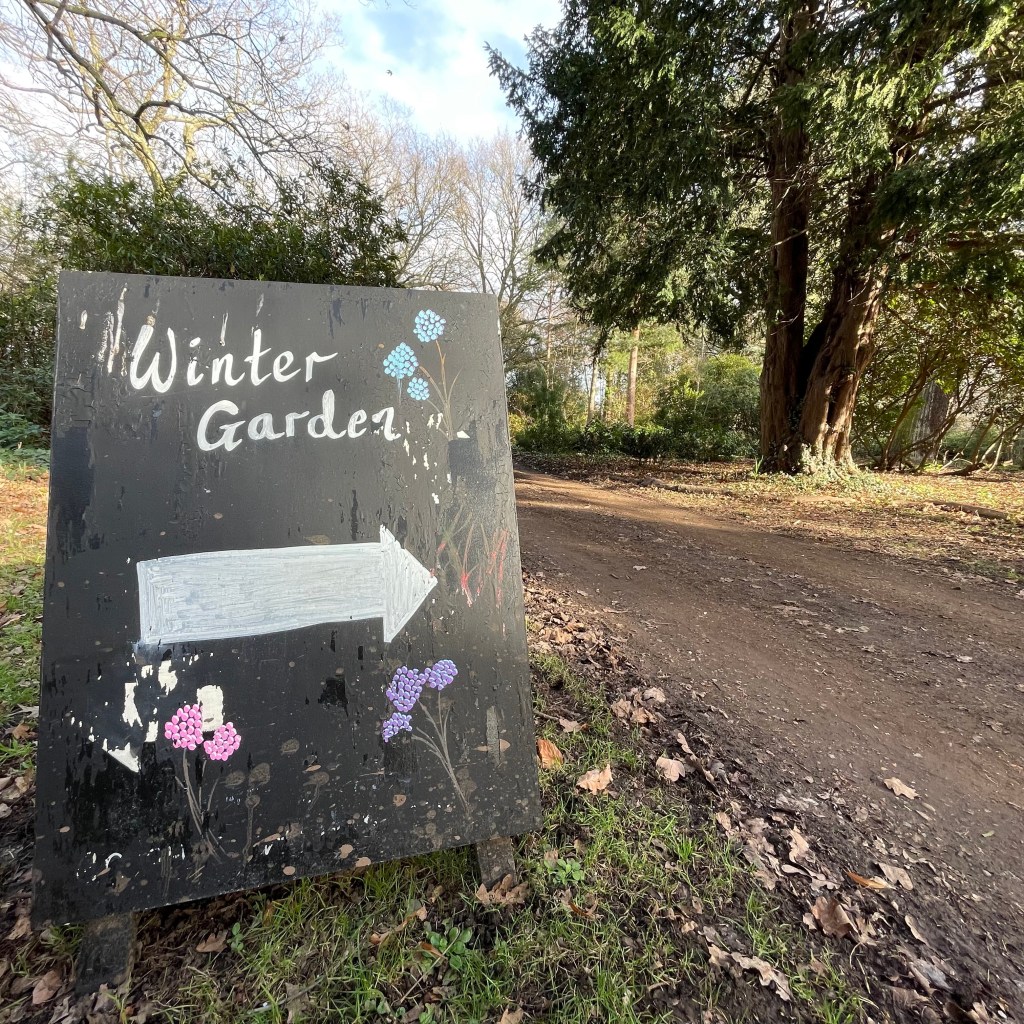
The winter garden I wrote about in my last blog post was planted over the course of the last couple of years. That at Osterley House and Garden is about 10 to 15 years old, but already has an air of maturity. In contrast to the symmetry of the layout of Mrs Child’s flower garden and the floral exuberance of the cutting garden, the winter garden feels more informal. The winter garden is located between the Long Walk (which skirts the gardens themselves and the perimeter of the park towards the lake) and the grassy slope opposite the American Border which is beginning to colour up at this time of year with hundreds of bulbs (narcissus, crocus and later on Camassia).

The wood chip surface path through Osterley’s winter garden is interrupted by a generous circular lawn in the sunniest part of this garden: a peaceful area to sit and listen to the birdsong and admire the winter flowering shrubs, colourful stemmed dogwoods and willows, and ground cover planting.

The season starts with the bright purple berries of the Beauty Berry (Callicarpa bodinieri) which complement the aqua tones of a Euphorbia. Scent arrives next in the clustered tubular flowers of Viburnum bodnantense Dawn and V. Charles Lamont and the delicate cream flowers of winter honeysuckle Lonicera fragrantissima. My favourite plant in the winter garden is the large paper bush (Edgeworthia chrysantha) whose silky flower buds open in February into tiny trumpets each lined in vivid yellow, gathered into neat hemispheres suspended from the generously spreading branches of this graceful shrub.

Like so many winter flowering shrubs, Japanese quince flowers on bare stems, emphasising the purity of the form of the blooms. The elegant white form Chaenomeles speciosum Nivalis features repeatedly in the bed opposite the paper bush.

The loss of a large conifer in the last couple of years has created a space for new planting and we recently spent a morning, supervised by head gardener Andy Eddy, planting hellebores and witch hazel in one of the newly cleared areas. The planting scheme includes the striking combination of black Mondo grass (Ophiopogon planiscapus Nigrescens) and snowdrops which also features in Kew’s Winter Mound.

Marching forwards

Meteorological spring starts on 1 March heralding a new season in gardens. Bulbs which have been nosing through the soil for several weeks without progressing much have suddenly burst into life and the garden is full of tight clumps of Tete a Tete daffodils. The days are stretching out too and the prospect of visiting other gardens is very inviting.

I started the garden visiting season by going to Hinton Ampner in Hampshire ten days ago. Run by the National Trust, this largely formal garden near Cheriton in Hampshire occupies a magnificent position overlooking the South Downs. From the terrace nearest the house (largely rebuilt after a devastating fire in 1960) the view extends south across downland studded with copses of trees, sheep grazing peacefully in the fields. Yew hedging separates the garden from the adjoining farmland. The four rectangular beds which make up the Sunken Garden are punctuated with plump yew pepperpots, the immaculate topiary lending this part of the garden its character. Much of this section of the garden is currently roped off, to prevent the grass being damaged in the winter months. But it is still possible to steal tantalising glimpses along vistas such as the Long Walk, where huge Irish yews stand like a guard of honour either side of a grassy avenue leading from a sundial to a marble statue of the goddess Diana.

The Sunken Garden

We walked beyond the garden across the fields in bright sunshine, the sensation of the wide sky and open space exhilarating for me, so used to working in smaller gardens where borrowed landscape means a neighbour’s tree and where the horizon (glimpsed from the footbridge over the District Line tracks) features a disused brewery in one direction and the Kew Pagoda in the other. Admittedly not a bad view but lacking in sheep.

More clipped yew, fashioned into billowing clouds several metres tall

The outside wall of the large Walled Garden is intriguingly buttressed with clipped box, the spaces between filled with dense swirls of winter jasmine.

To one side of the Walled Garden stand several lean-to glasshouses, one a vinery where the vines are planted outside, like the venerable Black Hamburg vine at Hampton Court. The whitewashed far wall of a neighbouring house supports a beautifully trained peach or apricot (I was peering through the glass and couldn’t see a label) which basked happily in the sunshine. This walled garden is full of variety: vegetable beds at one end and a lawn into which sinuous beds of daffodils have been cut. A deep shrub border lines a path to the side of the garden, featuring winter interest plants such as Cornus Midwinter Fire and Daphne bholua Jacqueline Postill: the tallest I’ve seen outside Wakehurst Place. The scent of the Daphne stopped me in my tracks.

The church of All Saints stands a short distance from the house, beside an orchard. I was intrigued by the tiled roof of the bell-tower which I read in the guidebook was added in 1879 when the tower was added to the C13 church. Spring flowers stud the East Lawn beyond the church, the daffodils superseding the snowdrops.

I mentioned the track-stopping scent emanating from a Daphne at Hinton Ampner. This reminds me that it’s easy to overlook how fragrant another winter flowering shrub can be. Yesterday I was at North Hill Nurseries near Chobham, buying plants for clients. The shade tunnel which houses shrubs such as Pittosporum and hardy Fuchsia is home to a large number of Skimmias . Their sweet perfume was intensified by the warmth of the spring sunshine and the confined surroundings. These are such good plants for small gardens: their domed form never seems to get too dominant and as evergreens they look good all year. My favourite (which I have in my garden) is Skimmia x confusa Kew Green: its creamy green flowers have been flowering for months.

When not at Hinton Ampner or spending other people’s money at the nursery, I’ve been working hard to make clients’ gardens (and my own, when I’ve time) ready for the warmer days. I’ve applied mulches to most of them: some shredded horse manure, some composted bark. I’ve pruned roses tall and small, trained climbers and a few ramblers, and weeded and pruned like fury, producing enough green waste to fill a recycling centre skip. Thankfully many clients have their own green bins but I do tend to make at least two visits to the tip a week, bulging bags crammed into the car.

At Osterley over the last few Fridays we’ve been edging the beds in the Tudor Walled Garden, ridding a border to the south of the house of green alkanet, and picking up the dead wood sprinkled across the lawns by Storm Eunice. Sadly the storm brought down a number of trees in the wider park and tore off a branch of the enormous Cedar of Lebanon on the Temple Lawn. We’ve also taken time out to admire the beautiful display of winter shrubs and spring bulbs in the Garden House. More winter fragrance here, with sweetly scented Sarcococca confusa overpowered by Narcissus Paperwhite Ziva.

To round up this summary of recent activities, I have two other items to report:

  1. I picked the first rhubarb of the season in a client’s garden last week. It is a large mature crown and must be a particularly early variety. I rushed home to check progress of my now three year old crown, growing in a container. The leaves are stretching out from the creased buds but it’ll be several weeks before I can pick a stalk or two.
  2. A large clump of frogspawn has appeared in my pond this week. Frogs occupy the pond every summer but this is the first time I’ve seen frogspawn. I can’t wait to see the tadpoles develop and hope there are enough ponds in the vicinity to house what promises to be a large brood.

Colour Palettes and Wooden Pallets

One of the joys of the gradual easing of lockdown since June has been garden visiting. From The Newt in Somerset to Vann House in Surrey I’ve enjoyed several days off from a busy gardening schedule to explore some beautiful sites. At the start of August I went to The Savill Garden next to Windsor Great Park. Despite low clouds and fine rain my overall impression was of concentrations of vivid colours brightening dense ornamental woodland. Dazzling pinks and purples welcome you in the double borders leading from the visitor centre. Edged with pinky mauve Osteospermum, a block of warm pink Salvia microphylla is given an airy feel by clouds of Verbena bonariensis hovering overhead. Alongside are dark-leaved Dahlias bearing pom-pom flowers in puce, a shade which here looks better than it sounds. Puce is one of those words describing colour (heliotrope is another) which I associate with gloomy Victorian parlours.

In the Bog Garden I found more colour than I expected with the soft sky blue of bog sage (Salvia uligonosa) contrasting in both form and colour with the buttery yellow daisy flowers of Inula. I should mention that a welcome feature of this garden is the presence of plant labels. Spoilt by proximity to the world’s greatest botanic garden, I expect to find every plant clearly labelled in all gardens which are open to the public! But I accept the argument that whilst Kew is the repository of a priceless living collection of plants from across the world, the plants in many other gardens are to be enjoyed in their own right without a similar emphasis on identification.

The Summer Gardens consists of plantings of herbaceous perennials dedicated to individual colours. Some were vivid,  indeed ‘brash’ as the visitor map put it (yellows, reds, pinks) and some cooler (white and blue). Mauve Cleome blended with the furry pink tails of Sanguisorba and a tall stand of Phlox. 

2761F1B9-B39B-4A49-BD50-C875AFAB302F

In the blue border, alongside dainty Salvia ‘So Cool Blue’  with its almost black stems, I found a plant I’ve not heard of before, the blue lace flower, Trachymene coerulea. I mistook it at first as a form of Scabious, due to its plump lavender blue pin cushion flowerheads atop stiff stems. But the scale of the flowerhead (up to 5cm) prompted me to find the label. The RHS A-Z Encyclopaedia of Plants informs me that the plant is an annual or biennial from Western Australia, long-lasting when cut. The flowerheads are composed of tubular flowers which flare out into clusters of five petalled stars studded with anthers bearing white pollen, all supported by a claw of narrow sepals reminiscent of the setting for a large gemmed ring.

Echinacea purpurea ‘Virgin’ contributed its pearly white flowers to the green and white of another border, to one side of which Thalictrum ‘Splendide White’ was thrown into relief by the dark yew of an adjoining hedge. The mass of cup-shaped flowers resembled a 3m high swarm of white bees.

In another border red was represented by scarlet Dahlias with dark foliage (one of the bishop cultivars perhaps?), fronted by a profusion of red daisies which might be Echinacea ‘Hot Papaya’ although I cannot be sure as I failed to note the plant label.

1F034F97-9303-4148-B8E4-9C0F025FEBAA

That area of The Savill Garden called Summer Wood hosts a wonderful collection of Hydrangeas in muted pastels, a contrast to the primary colours of the Summer Gardens. There’s an excellent plant shop in the Visitor Centre where I bought a Bog Sage to use as a stock plant from which to take half a dozen stem cuttings. A week has passed and the cuttings remain perky, so I am keeping my fingers crossed for a success propagation. When they have taken and grown larger I shall pot them on ready to be planted out in a moist part of a garden next year.

On 7 August I did my third session this summer at Osterley on a day when the temperature reached 36.4% at Heathrow Airport 4 miles to the west. Gardener Ed thoughtfully deployed us to weed the shady cobbled courtyard outside the Study Base. After lunch we worked under the awnings over the tables outside the bothy, tidying the pots of plants stacked in the nursery area.

On the subject of propagation, at home this summer I have created a couple of shelving areas for young plants where they have grown enough to leave the protection of the glazed vertical cold frame which I use like a mini greenhouse in the summer months, leaving the lid permanently raised to ensure plenty of ventilation. The new shelves are simply upended wooden pallets: one from a bulk delivery of shredded horse manure in February and the other kindly donated by clients who were glad to find a home for it. Not only that but they drove it over to me when it was far too wide to fit in my car. I’ve attached the pallets to the outside of the fence where it faces east to the alley between my end of terrace house and the neighbouring terrace. Barely 15 cm deep they take up very little space and have created additional space just outside the garden.

F85FBD71-0E05-4B5F-9BE4-CBC8AC819229

I shall sign off with an image of the garden itself from a week or so ago, showing a palette of blue, white, pink and purple.

5071A2BA-F68D-4B3A-8E67-3228451F4DEE


In the Dock

Last Friday, after an absence of 127 days, I returned to volunteer in the garden at Osterley House. My last session was in early March when we spent the day in the sunshine clearing brambles from the margin of the Middle Lake.

Bramble clearing on 6 March 2020

In the photographs I took that day I see that the rosemary in the borders at the rear of the house was in full bloom, the grey green foliage complementing the clear blue flowers with their prominent lower petals. In the Cutting Garden I photographed the Anemone coronaria ‘St Brigid’s Series’ against a chrome yellow backdrop of daffodils. Little did I know when I took these images it would be four months until I was in the garden again.

Anemone coronaria ‘St Brigid’s Series’
Rosemary

It felt so good to be back, another step nearer normality in the gradual easing of lockdown. Naturally a new normal has had to be established. Flasks of tea brewed at home replace the lunchtime teapot ritual and the tool handles have to be disinfected when we finish for the day. Two of the five volunteers weeded in the Tudor Walled Garden and planted several new additions in one of the potager style beds. One of these plants was Viper’s Bugloss (Echium vulgare). Thankfully its appearance belies the slightly sinister sounding common name, the spires of rosemary blue flowers being a magnet for bees and other pollinators.

The rest of us trimmed the edges of the four rectangular beds in that area, moving via the Magnolia borders to work our way along the paths in Mrs Child’s Flower Garden, our razor sharp shears guided by the metal edging strips to create that crisp finish which instantly neatens a lawn. Head gardener Andy Eddy was mowing the lawns in ‘Mrs Child’s’ and stopped for a catch up. During lockdown he and his partner maintained the garden, enjoying the temporary lull from fewer planes heading to Heathrow and the vastly reduced traffic on the M4 which borders the parkland surrounding the garden. There was also the novelty of the presence of the neighbouring farmer’s Charollais cattle herd on the field immediately in front of the house.

We sat outside the bothy to eat lunch, the reduced number in the team making social distancing easy to achieve. Afterwards we worked in the cutting garden, keeping the bark topped paths clear of weeds and transplanting stray self-seeders such as geraniums into the relevant sections of the garden. I found that the portion of the border beside the wall where I was working was choked with docks (Rumex obtusifolius) and as I worried away at this patch with first a hand fork and then a border fork I realised that I haven’t had to clear these before and had no idea how difficult they are to tackle. To find out more about what I had hitherto assumed were innocuous weeds with the benefit of calming nettle stung skin, I consulted the RHS website which states ‘They are often difficult to eradicate as their deep tap root can regrow from the top section and they produce large amounts of seed.The tap root can be up to 90cm (3ft) in length.‘ A 3ft tap root: no wonder I struggled!

I did manage to clear a section of roughly a couple of feet square but confess that, with the permission of gardener Graham, I had to cut several of the most persistent plants down to ground level rather than rooting them up. It felt appropriate that almost my first task as a ‘re-opening volunteer’ was the clearance of stubborn weeds, just as that last pre-lockdown session had involved bramble eradication. Despite my emphasis in this post on weeds and weeding, the gardens at Osterley are looking stunning as the following photos attest.

The Cutting Garden 10 July 2020: Echinops and Alliums

Robert Adam’s Garden House
Fuchsia Thalia inside the Garden House
Crocosmia and Honey Spurge (Euphorbia mellifera) in the Tudor Walled Garden

Cutbacks and Restructuring

No, not financial restraints or a cabinet reshuffle, but the theme of most of the jobs I’m doing at this time of year. Before spring arrives in earnest it’s time to cut back herbaceous perennials, prune most roses and some species of shrubs, and restructure woody climbers or old shrubs needing renovation.

Recent cutbacks in my garden have been directed at the Japanese anemones and Hylotelephium (formerly Sedum). Using well-sharpened secateurs is essential, to avoid damaging the new growth already emerging from the crown of the plant at ground level. I support the vogue for keeping last year’s herbaceous perennials for as long as possible, particularly those with distinctive silhouettes, so as to provide structure in the garden in winter.  When Jack Frost visits, he deposits an icy halo around their seedheads or spent flowerheads and outlines any remaining leaves with a silver rim. Although in the mild winter we’ve had to date in south-west London, there have been few icy mornings, meaning fewer frosty photo opportunities and, thankfully, less windscreen scraping.

img_0703
Symphyotrichum (formerly Aster) in the Cutting Garden at Osterley on 7 February 2020 

In the Cutting Garden at Osterley, we have taken the name of the garden literally on February Fridays, by cutting to ground level the rows and rows of stems which didn’t make it last year into the 65 floral arrangements created for the house every week in spring, summer and early autumn.

We loaded barrow after barrow with sheaths of Verbena bonariensis, Shasta daisies (Leucanthemum x superbum), Veronicastrum virginicum ‘Fascination’, Echinops, Echinacea and Rudbeckia. In what might be deemed a botanical restructure by taxonomists, another of the plants we cut back, Michaelmas daisies,  have been reassigned from the genus Aster to the genus Symphyotrichum.

Among my gardening friends we generally agree that pruning is a favourite task. Not just because much of it can be done standing up, avoiding muddy knees and sore lower backs, but also because when done well, it results in a well-formed plant which enhances the overall appearance of a garden. For myself, I also enjoy the precision involved in identifying the stems to remove, i.e. those that are dead, diseased or dying (‘DDD‘), and those to shorten to an outward facing bud, ensuring the cut is angled downwards to avoid water resting on the bud. I even find chopping the cut branches and stems into smaller pieces to fit in the garden refuse sack satisfying. A fortnight ago I applied this treatment to the Wisteria which grows against the rear fence of my garden, cutting back the stems to a series of nobbly clusters bearing pairs of shiny black buds from which the flowers will appear in April.

img_0706
A recently pruned climbing rose framing a view of the cutback Cutting Garden

I wrote last winter about the benefits of training or restructuring climbing roses or rambler roses so as to bring stems as close to the horizontal as possible. This encourages bud break along the stems, resulting in more flowers at eye height and below. Left unchecked, roses grow upwards to find as much light as they can, giving the best view of their blooms to the birds and squirrels. To make this task more comfortable, I’ve invested in a pair of tough suede cuffed gauntlets and was very glad of them in a client’s garden last week when I tamed a very large and thorny climbing rose. Because ivy had entangled itself around the rose’s branches I had to remove as much of that as I could before pruning the rose and tying it into the trellis. One particularly stubborn section of ivy needed numerous cuts with the pruning saw before I was finally able to lift from the trellis post, Perseus style, a Medusa-like mass of several seasons’ growth of entwined woody stems.

IMG_0398
Perseus with the head of Medusa

Checking my diary for local gardening jobs scheduled for this week, I see that the cutbacks continue with herbaceous perennial trimming tomorrow and Hydrangea pruning later in the week.

Banks & Banking

In the spirit of stepping outside my comfort zone to do something I have not done before, I joined other volunteer gardeners at National Trust Osterley this summer to deliver guided tours of the gardens. Once, sometimes twice a week, two of us led a group of up to 15 visitors through gardens which reflect the history of the house, from its origins in Tudor times, through its elegant Robert Adam makeover in the eighteenth century to today’s innovations, pausing on the way to mention the garden’s role in the Second World War.

As the season changes and we plan to alter our itinerary to take in parts of the garden designed to look at their best in the winter and early spring, I invite you to join me in this post on a virtual early autumn walk through Osterley’s gardens. You start your tour at the rear of the house, at the top of the elegantly curving double staircase facing the park beyond the garden, which Henry James (a weekend guest at the house in the late nineteenth century) describes in the opening passages of his novella, ‘The Lesson of the Master’. The hero Paul Overt, a writer, stands in the same position and observes that the steps ‘descended from a great height in two arms, with a circular sweep of the most charming effect’. He also commented on ‘the expanse of beautiful brickwork that showed for pink rather than red and that had been kept clear of messy creepers by the law under which a woman with a rare complexion disdains a veil’. From this vantage point you can see a classic feature of an eighteenth century landscape garden: bucolic pastureland framed by specimen trees, the pasture grazed by the neighbouring tenant farmer’s Charollais cattle. Before the scene we see today was created, John Roque’s immensely detailed map of London of 1741 showed three avenues of trees radiating from both the front and back of the house. This device is known as a ‘patte d’oie’  or goosefoot. The avenues have long gone save for two oak trees which once formed part of one such avenue.

IMG_9164
The rear of the house and the double staircase

IMG_9163
The Charolais cattle

Trees feature throughout our tour. Let’s descend the steps and head to the shade of the Oriental Plane tree which was planted in 1755. One of my fellow guides describes this huge tree as a grand old lady resting on her elbows, a reference to the gnarled limbs which swoop down to the ground to shade the path to one side. Look up into the leaf canopy and spare a thought for we volunteer gardeners when over the next couple of months we shall sweep up and gather the leaves to deposit in the leaf pile on the boundary of the garden. In a couple of years time we shall use the ensuing leaf mould as a winter mulch to the beds and borders in the garden so as to maintain moisture and improve the texture of the soil.

IMG_9166
The Oriental Plane

Come with me now to ‘Dickie’s Border’, the symmetrically arranged three layered shrub border named after Dickie Denton, the last Head Gardener before the property was gifted to the National Trust in 1949. His nickname was ‘TickTock’ because he was tasked with winding the clock in the Stable Block each morning. In the middle layer of planting compare the red dimpled globular fruits of the Strawberry Trees (Arbutus unedo) with the developing catkins of the Silk Tassel Bushes (Garrya elliptica). A variegated form of Rhamnus alaternus is the third shrub at this level. Alternating Magnolia grandiflora and Loquat trees (Eriobotrya japonica) provide a dark evergreen backdrop, whilst at waist height you can see shrub roses, rosemary and the gold margined leaves of Daphne Odorata aureomarginata. 

IMG_9165
Dickie’s Border

Our next stop is Mrs Child’s Flower Garden where you have a perfect view of Robert Adam’s recently restored white stucco decorated Garden House which stands at the heart of the ranks of curved flowerbeds planted for spring and summer interest. Here tall Verbascum tower candelabra-like over Salvia sclarea, Maltese cross (Lychnis chalcedonica), Centaurea Montana to name only a few of the intriguing plants to be found in these beds.  The grounds here were used at the beginning of the Second World War for training the forerunners of the British Home Guard in guerrilla tactics and house to house fighting. Led by a left-wing writer, Tom Wintringham, they were described by MI5 as ‘the bunch of socialist revolutionaries at the end of the Piccadilly Line’ and soon afterwards the operation was closed down and the park used for food production as part of the war effort.

IMG_9160
The Garden House with Mrs Child’s Flower Garden to the right

As we walk towards our next stop please take a look at the four beautiful and unusual trees near the brick wall: Foxglove trees, Pawlonia tomentosa, and do mind your head on their low-hanging seed cases which develop from the spires of bluish mauve bell-shaped flowers which the trees bear in April. Other trees to note here include weeping limes and a Tulip Tree (Liriodendron tulipifera) and nearest the path take a look at the unusually lobed leaves of the Sassafras albidum, whose roots flavour Root Beer, and which this week is glowing with a rainbow of autumn shades.

Let’s proceed to the Picking Garden, where the flowers are grown for the 65 floral arrangements which decorate the house each week. As well as several members of the Daisy family: Heleniums, Shasta daisies and Cosmos, you can also see a row of Pot Marigolds (Calendula). These are the symbol of Childs Bank, associated with the family which owned Osterley. The variety chosen this year is Calendula ‘Radio’. You can tell from its name that this is a modern cultivar. Whilst the species of plants in this part of the garden are era authentic and would have been available to an eighteenth century gardener, their cultivars tend to be more modern and are chosen for reliability and resilience to pests and diseases.

Now we move to the main section of the Tudor Walled Garden which is laid out into four large central beds. In the bed devoted to brassicas you can see the latest member of the garden team, Harry the Hawk, whose job it is to scare pigeons from the cabbages. The next two beds are planted potager style with both ornamental and edible plants and are designed to look at their best in late summer and early autumn. Dahlias feature strongly as do Cleome (the Spider Flower), gladioli and nicotiana. Chard and amaranthus provide the edible element of these beds and at the corners of the beds you can see pyramid shaped supports to which cling the deep purple morning glory, Ipomaea ‘Grandpa Ott’. In the centre of the beds look out for the tall Castor Oil plants, Ricinus communis,  with their spiky pink flowers and large hand-shaped leaves. This plant played a key role in a tale of international espionage from 1978 when the Bulgarian dissident Georgy Markov was murdered in London with an umbrella the tip of which contained a pellet of the deadly poison Ricin which is derived from this plant. The fourth bed is planted almost exclusively with vegetables and salads. At this late stage in the season the various beans have been harvested and their supports removed, but turnips and beetroot (both red and golden) abound as do aubergines and salad leaves.

IMG_9147
Harry the hawk scaring pigeons from the brassica bed

IMG_9157
Amaranthus, Spanish Flag, cannas, dahlias and the Shoofly plant in one of the mixed beds in the Tudor Walled Garden

Our virtual tour is almost over. I shall leave you at the far side of the walled garden, beside the Long Border and point out to you the enormous specimen of the climbing rose Rosa banksiae and ask you to imagine a curtain of pale yellow blooms in April: it is one of the earliest roses to flower. It is named for Joseph Banks, who accompanied Captain Cook on the Endeavour, and on his return advised George III on the creation of a botanic garden at Kew. There is a local connection too, as Banks lived at Spring Grove House about half a mile to the south of Osterley. What remains of his house now forms part of West Thames College. Before we part, consider this: the Osterley site was once slated as a possible site for a national exhibition centre. Thankfully a site near Birmingham was chosen for the NEC enabling us to enjoy the gardens as they exist today. Thank you for joining me today and do come back on another occasion to see the American Border and the Winter Garden.

IMG_9158
Salvia microphylla with fragrant scented leaves in the foreground with Euphorbia mellifera, the Honey Spurge and Stipa gigantea, Elephant Grass behind: the planting beside the last stop on the tour.


Sub-Lime

Step out onto any suburban street from mid June to early July and the pervading scent will be that of lime tree blossom. I do not mean the citrus  limes whose juice graces a Mojito cocktail. I’m referring to the flowers which, when dried, become the ’tilleul’ infusion popular in France. Before it became a familiar high street brand, no day trip to Calais or Boulogne was complete without a visit to L’Occitane to buy the delicately perfumed lime flower soap. These last couple of weeks the lime trees have been at the height of their intoxicating power, pumping forth the freshly sweet perfume which to me epitomises early summer.

Close examination reveals that the yellow green clusters hanging below the heart-shaped leaves of Tilia cordata (Small-leaved lime) and the roundly oval leaves of Tilia platyphyllos (Broad-leaved lime) consist of downward facing bunches of four or five stems. These are attached to a wing-shaped bract which aids seed dispersal and each stem terminates in a cluster of yellow pollen-tipped stamens surrounded by five outer sepals, the central core of each of which ripens into a small spherical fruit. The fruit or ‘nutlet’ as I have read it is called, is covered in fine down lending them a whitish grey appearance.


On warm days, lime tree flowers attract many pollinators, and an odd phenomenon has been observed with the Silver leaved lime, Tilia tomentosa, which is pollinated by honeybees. The trees’ nectar appears to have a narcotic effect on the bees, with dead or dying bees found under the trees each year. A team at Royal Botanic Gardens, Kew is investigating the issue and there is an interesting article on the Kew website entitled ‘Do Lime trees kill bees?’

I haven’t reported recently upon my Friday stints as a member of the team of garden volunteers at the National Trust’s Osterley Park. For the past two Fridays we have concentrated our efforts in the Tudor Walled Garden, preparing it for its annual colourful impact in late summer and early autumn. In fact, thanks to a myriad of self-sown poppies, two of the quadrant beds have exploded into sheets of mauve, pink and red. In the bed where the green manure was sown earlier this year, (see my blog from this March, Rolling along within the walls), the crimson clover blends beautifully with the poppies.

IMG_8391

Last week, in the bed closest to the gate leading to the gardener’s bothy, we planted a mixture of four Gladioli cultivars: Roma, Indian summer, Espresso and Purple Flora. I’m looking forward to seeing their blend of colours later this summer. Meanwhile, our colleague Tracey has worked tirelessly to sow, plant and harvest produce on the third bed. Where possible the rest of the team help her with weeding and some planting, as well as harvesting early crops for the coach house cafe. A gentle job I was assigned last week involved deadheading the sweet peas which grow up obelisks at the corner of the plots, the variety this year being ‘Beaujolais’. Removing the seed pods which develop so swiftly after the  flowers have faded encourages more flowers by preventing the plant from expending energy on seed production.


Whilst weeding the edge of one of the plots we found two self-sown members of the Nightshade family, Solanaceae, to which potatoes, tomatoes and aubergines belong. The pioneers we found are the Shoofly plant, Nicandra physaloides, and the Thornapple, Datura stramonium. We left the former in place as its pretty mauve flowers are attractive but the latter will be removed as it doesn’t form part of the planting scheme as well as being poisonous.

IMG_8397
Nicandra physaloides: the Shoofly plant

This Friday saw us working on the five round beds  alongside the wall which divides the Tudor Walled Garden from the picking garden (which is bursting with colourful flowers at the moment). A small fruit tree is planted in the centre of each round bed, and is underplanted for spring and early summer impact with Doronicum, Irises, Papaver somniferum (Opium poppies) and Love in a Mist (Nigella damascena). Sadly the plants have finished flowering and our task was to remove the poppies and Nigella (both annuals) and to reduce the iris leaves by 2/3rds and cut their flower stalks to ground level. We had an hour left in the afternoon to begin a similar task on the long border of the Tudor Walled Garden where a repeating planting scheme of Salvias, honey scented Honey spurge (Euphorbia mellifera), Plume poppy (Macleaya macrocarpa) and Foxtail lily, (Eremurus), is bestowed a sprinkling of gold dust by the shimmering stems and flowers of Elephant grass (Stipa gigantea).


Thinking of taller plants growing through lower growing plants, in my own garden I’ve been admiring the delicate yet long lasting flowers of Chinese meadow rue, Thalictrum delavayi, for about three weeks. At a height of about two metres they hover gracefully above the nearby Astrantia major ‘Abbey Road’, a burgundy Heuchera and Houttynia cordata. Like the small leaved lime mentioned above, another plant named for its heart-shaped leaves.