Rousham: Arcadia in Oxfordshire

Classical cascade landscape feature

In 2021, when we were still in recovery from the pandemic and growing accustomed to both socialising and learning online, I undertook a course with Oxford Continuing Education on the subject of English Landscape Gardens 1650 to the present day. We were tasked with writing two assignments, the shorter of which was an account of an C18 landscape garden. I chose a garden in Oxfordshire which many people had recommended to me as unlike anything I would have seen anywhere else. The garden was Rousham, near Bicester, which I visited a few days after my birthday in early September 2017. The garden is indeed unique, not least for banning children under 15 and dogs!

In his recent British Gardens series for the BBC, Monty Don included Rousham in his seemingly helter skelter tour of gardens across England, Wales, Scotland and Northern Ireland. He clearly holds it in great affection and highlighted many of the same features which I highlighted in my essay, which follows.

Begun by Charles Bridgeman in the 1720s for Colonel Robert Dormer, the landscape at Rousham was further developed by William Kent for his brother General James Dormer (along with the house itself) from 1737. Kent retained much of Bridgeman’s layout such as the bowling green and riverside terrace, but he softened the outlines of the amphitheatre and transformed a series of descending formal pools into a cascade, the Vale of Venus.

Figure 1 The Vale of Venus 2 Sept 2017
Figure 2 Woodland edge, Rousham. 2 Sept 2017

Solitary classical statues (Apollo, Pan, Bacchus, Ceres, Mercury) at the edges of woodland beckon the visitor to the next episode in the garden, helping to create a mysterious atmosphere of a mythical realm at one remove from the world outside.

Well-lit lawns give way to shaded groves, the progression from light through shade to light again lending an air of drama to the landscape. A channelled rill snakes through the garden to the cascade, its route interrupted by a hexagonal plunge pool.

Kent borrowed neighbouring landscape by installing an eye-catcher on a hill visible from the bowling green at the rear of the house, emphasising the attractive view of the countryside beyond the estate. This feature consists of three arches in Gothick style. He continued this theme for Cuttle Mill, a building in the middle distance, which he fitted with a Gothick gable end.

Figure 3 The Praeneste 2 Sept 2017

Along a ridge overlooking the curve of the River Cherwell, stands a seven-arched arcade containing a shaded walkway, the Praeneste. General Dormer installed statue busts of his Roman heroes in the Praeneste, the only hint of a political message in this otherwise escapist garden. Many Whigs opposed to Sir Robert Walpole, prime minister from 1721 to 1742, installed pantheons or obelisks honouring classical heroes in their gardens, to contrast these ideal leadership figures with the, in their opinion, less than satisfactory current regime.

Nowhere in Kent’s Rousham is there a trace of the parterres which featured so strongly in the Baroque gardens of the previous century. Nor the serpentine walks through woodland which developed as the seventeenth century wore on. At Rousham there is no defined ‘landscape circuit’ as described by Uglow[1]. Most of the episodes in the garden can be entered and exited via different routes.

Like the early Hanoverian gardens of the first decades of the Eighteenth century, Rousham has elements of the naturalistic landscape design in vogue at that time. But what distinguishes it from those gardens is the dramatic flair introduced by William Kent who had first experimented with re-creating a classical landscape in his work for Lord Burlington at Chiswick House. At Rousham he succeeded in developing the conceit that when in residence the gentleman landowner is pursuing a rural idyll of the kind advocated by Virgil and Horace.

Within thirty years of its creation, the landscape at Rousham attracted the approval of Sir Horace Walpole, who described it in a letter to George Montagu as having

the sweetest little groves, streams, glades, porticoes, cascades, and river, imaginable; all the scenes are perfectly classic.[2]

We are fortunate that the early Eighteenth century garden at Rousham survives intact, as an example of Kent’s unique ability, described by Richardson, to combine designing ‘architectural caprices’ with ‘moulding physical space’. [3]

Footnotes

[1] Uglow J. (2004) A Little History of British Gardening p.131

[2] Wikipedia entry on Rousham. Letter from Walpole to George Montagu 19 July 1760

[3] Richardson T. (2007) The Arcadian Friends p.290

Bibliography

National Heritage List for England [Online] available at  https://historicengland.org.uk/listing/the-list/list-entry/1000107, (Accessed 21 March 2021)

Richardson T. (2007) The Arcadian Friends, Bantam Press, London.

Wikipedia entry for Rousham [Online] https://www.google.com/search?client=safari&rls=en&q=rousham+wiki&ie=UTF-8&oe=UTF-8, (Accessed 21 March 2021)

Uglow J. (2004) A Little History of British Gardening, Chatto & Windus, London.

Postcript

To one side of the landscaped gardens at Rousham, sits a large walled garden, complete with dovecote. My images of that section of the garden follow.

Kew Gardens, 20 February 2025

Denmans

A pair of Adirondack chairs painted a deep blue stand either side of a table on which is a bottle of Famous Goose Scotch whisky. Tumblers of the spirit balance on one of the wide flat arms of each chair. To one side there is a tall terracotta oil jar. In the corner behind one of the chairs the tall stems of Agapanthus complement the bluish grey of the flint walls of the house. Slate paving slabs edge up against a gravel filled bed planted in a limited palette of purple, lime green and grey. Through the glass of the patio doors I see a figure sitting at a table lit by a desk lamp. He appears to be making notes with one hand and leafing through a large book with the other. A Matisse cut out figure print in the same blue as the chairs hangs on the wall beside him, alongside a painting of a plump ginger and white cat.

Joyce Robinson and John Brookes’ portraits hang in the cafe at Denmans

Let’s return to that scene later. In late April 2024 I went to Denmans Garden, the creation of two far-sighted garden makers. Denmans is situated between the westbound carriage of the A27 and the foot of the South Downs, roughly halfway between Arundel and Chichester in West Sussex. It’s a garden that feels very contemporary so it comes as something of a surprise to learn that the garden was started 70 years ago. Joyce Robinson and her husband Hugh built a house and operated a market garden at Denmans after buying the land in 1946. A few years later Mrs Robinson began to plant an ornamental garden alongside the productive part of the site. After a visit to the Greek island of Delos in May 1969 where she was charmed by the sight of flowers growing everywhere in the island’s gravel, she resolved to use gravel as a growing medium. Ten years later she extended the garden into an area that had been a cattle paddock, and made two dry riverbeds. Enter modernist garden designer John Brookes (1933-2018) who in 1979 converted the stable block into his home calling it Clock House and set up a school of garden design. In 1984 Mrs Robinson retired and John Brookes took over management of the garden.

Mrs Robinson herself called her planting style ‘glorious disarray’ and when John Brookes arrived he introduced a more disciplined structure in layout and planting by reshaping some beds and adding clipped topiary features, all the while retaining the curving contours of the garden. He referred to his planting style as ‘controlled disarray’. The garden feels informal, with spaces flowing naturally from one to the next. John Brookes wrote:

I often see people going round the garden here at Denmans with their noses almost amongst the planting, and while I can understand their interest in individual plants, I long to say to them: ‘Now stand back and look at the associations and contrasts between individual masses and then see the plants individually up close, afterwards’.

John Brookes A Landcape Legacy

I confess to being one of those garden visitors who focus on plants first, but there is something about Denmans which makes you slow down to appreciate the unpretentious elegance of the garden which I hope some of the images which follow illustrate.

Now let me share some of those plants which I had my ‘nose amongst’. I’m afraid I’ve not been able to identify all of them.

But what of the scene I described at the beginning of this blog? In July last year I was delighted that Denmans was one of the RHS Partner Gardens featured in the Hampton Court Palace Garden Festival. Denmans Garden: Room Outside cleverly incorporated many of the elements of this Sussex garden and paid homage to its late custodian, John Brookes by showing him working on one of his many books, perhaps about to finish work for the day and enjoy a sundowner with a friend on the patio. The blue painted furniture and Mediterranean oil jar are trademark features of the garden, seen below in the garden itself. I shall certainly return to Denmans, where the joint legacy of Joyce Robinson and John Brookes is being lovingly maintained.

Kew Gardens 5 January 2025

A very special trip to Sainsbury’s

Woolbeding Gardens and West Dean Gardens in West Sussex

In this ‘Twixtmas’ period of short dark days with the promise of lengthening days around the corner, it’s a good time to reflect on garden visits this past year. Despite all good intentions, the number of blogs I write by no means reflects the number of gardens I visit. Inevitably some go unrecorded, save for a clutch of digital images, secured on the cloud but destined for obscurity unless I wrangle them into a blog such as that to follow here.

In late April I was on the road to West Sussex with a friend and colleague from Kew days, who is as comprehensive in her exploration of a new garden as am I. Not a plant or design detail goes unheeded or commented upon, meaning that visits take as long as necessary for us to feel we’ve not missed an important feature or tree! That’s not to say we don’t factor coffee, lunch and tea into the itinerary. These form an important part of the day and all the better if available in the garden to be visited.

We ambitiously plotted a course to two gardens near Midhurst, a stay in an Air BnB within a stone’s throw of Chichester Cathedral, and two gardens to the east of Chichester. In this and the next blog I’ll try to do justice to the gardens we explored. The first stop on the tour was the National Trust’s Woolbeding Gardens.

Because there is no parking at Woolbeding, a minibus picks you up in the car park of the Midhurst leisure centre. The jolly driver advised us that we were in good time for the opening of the glasshouse. As veterans of Kew’s visitor services team, and used to tracking the opening times of visitor attractions in the Gardens, we noted this and didn’t ask for further particulars. On having our membership cards scanned on arrival, we were again reminded of the glasshouse opening time and yet again in the cafe where we planned to orient ourselves over a coffee before setting off around the garden. We finally twigged that this wasn’t any old glasshouse, and that something rather special was about to happen. Trying not to be distracted by tempting borders to either side, we walked down to find a small cluster of people looking expectantly at a tall diamond-shaped glasshouse. Murmuring conversations petered away and above the sound of birdsong, we could hear a low mechanical hum whilst ten isosceles triangled panes of glass forming the upper section of the house slowly opened outwards, like the petals of a giant flower responding to the sun’s rays. After the process which took about three minutes in complete silence, it felt as though we’d taken part in some form of special ceremony.

Woolbeding is a curious blend of formal, landscape and contemporary gardens. At its heart is a C17 house which was leased to Simon Sainsbury in 1972, after being given to the National Trust in 1957 by the Lascelles family.

It is difficult to believe that the garden is barely 50 years old, especially the pleasure garden area called the Longwalk alongside the River Rother, which emulates the atmosphere and style of an C18 landscape garden, complete with ruined abbey, hermit’s hut, Chinese bridge, river god and gothic summerhouse. The abbey ruins were so authentic that it came as a shock to find they dated from the late 1990s! When I read the Longwalk was designed by Julian and Isabel Bannerman, I began to recognise their trademark theatricality, as exemplified in the Collector Earl’s garden at Arundel Castle. Yellow skunk cabbage (Lysichiton americanus) and globeflower (Trollius europaeus) were echoed in the colour of the painted Chinese bridge. A gnarly rustic fountain in The Four Seasons garden stands within a flint edged circular pool fed by a deep rill whose banks are planted with ferns and primroses.

We doubled back to designer Lanning Roper’s formal garden rooms, several of which are created around water features. High yew and hornbeam hedging divide the rooms within the old walled garden. The Fountain Garden’s centrepiece is a Renaissance style octagonal fountain surmounted by a figure of Neptune and dolphins. The original C16 Italian statue is on loan to the V&A. Trellised trained fruit trees adorn a brick wall on one side of the Vegetable Garden. The topiary and abundant greenery in that garden give way to an austere symmetry in The Swimming Pool garden.

A striking polished steel sculpture/water feature designed by William Pye dominates the elevation of the house facing the formal garden rooms. Again, this reminded me of a garden elsewhere: the eight water sculptures in the Serpent Garden at Alnwick are the work of Pye. One of these, ‘Coanda’, resembles that at Woolbeding:

THIS SCULPTURE SHOWS THE COANDA EFFECT WHICH MAKES WATER CLING TO THE UNDERSIDE OF SMOOTH OVERHANGING SURFACES, APPEARING TO DEFY GRAVITY. THE COANDA EFFECT WAS DISCOVERED BY HENRI COANDA, A FAMOUS AERONAUTICAL ENGINEER WHO WENT ON TO DEVELOP A FLYING SAUCER. HE STUDIED SCULPTURE WITH RODIN AND ENGINEERING WITH ALEXANDRE EIFFEL.

Extract from the Alnwick Gardens website

Leaving the classical formality of the garden rooms, we crossed an expansive lawn dominated by an eye-catcher, the circular Tulip Folly atop a low mound.

The garden zones of the Silk Route garden emulate the habitats of the ancient trade route from Asia to Europe, taking in the Mediterranean climate of the Istanbul region, the alpine environment of the Anatolian Plateau, followed by Iran represented by old roses and onwards to the Himalayas. Then come plants typical of Central Asia before arriving in the Chinese temperate region. Varying substrates distinguish one zone from the next, with rocks and gravel reflecting the geology of the regions along the route. The planting and landscaping throughout the Silk Route garden appear resilient to climate change: good drainage to cope with heavy downpours and a choice of species that might withstand droughty conditions without additional irrigation. In concluding my current talk to garden clubs on the topic of resilient gardening, I suggest a few gardens to visit where this kind of gardening can be seen in practice. Naturally the Silk Route garden features in my list.

The Silk Route ‘s destination is China’s sub-tropical zone inside the Heatherwick Studio’s glasshouse, designed to resemble an Edwardian terrarium, its glass ‘sepals’ opening and closing to maintain the correct temperature and climatic conditions for plants such as bananas and tender gingers.

April showers somewhat marred the afternoon visit to West Dean Gardens, a garden that I visited frequently when my parents were alive, as it was easily accessible from Petersfield where they lived after retirement. It is beautifully set, with views across the River Rother to sheep-grazed meadows at the foot of the South Downs and the St Roche’s Arboretum beyond.

The imposing flint built mansion is home to the Sussex campus of the West Dean College of Arts, Design, Craft and Conservation. The extensive walled gardens contain many restored Victorian glasshouses as well as a cutting garden area planted with dozens of tulips. I was disappointed to find that the 100m plus long Edwardian pergola was undergoing restoration, but the water gardens welcomed the damp conditions and the woodland planting was as varied as I had remembered. There’s an excellent cafe and shop at West Dean and I confess we retreated there for an hour or so to escape the elements.

We arrived in Chichester in the rain to plan the next day’s garden touring. The apartment block we stayed in was beside the multi-storey where I always parked on trips to Chichester with my parents! The apartment itself overlooked the elegant spire of the cathedral and the Downs in the distance.

Kew, 28 December 2024

Lutyens in Dublin

Featured

This morning London was enveloped in dank drizzle but I flew into a Dublin enjoying dazzling sunshine on the first day of October. I dumped my luggage at the hotel and set off to the west of the city to Islandbridge, Dublin 8. My walk took me along the quays on the south side of the River Liffey, with wonderful views across to the Custom House and the Four Courts, not to mention historic bridges like the Halfpenny Bridge footbridge. This was my Dublin born mother’s favourite landmark in the city and I was so happy to see it on a fine autumn afternoon.

Past Guinness’s vast St James’s Gate brewery I walked, then crossed the river and followed the road to the south of Phoenix Park, until I reached my destination, the Irish National War Memorial Gardens. I wasn’t prepared for the scale and grandeur of the place. The Gardens form the centrepiece of a peaceful park beside the river. The appoach is dotted with Lutyens’ distinctive wave-backed benches. Each bench is painted red, which lends the place an almost Japanese garden air, save for a circular domed temple in classical style. In 1929 Sir Edwin Lutyens was commissioned by the Irish Government to design a Garden of Remembrance and a War Memorial. Ironically, the project was completed in 1939 on the eve of WW2. The Gardens are dedicated to Irish soldiers who died during the First World War.

This aerial view of the Gardens conveys the symmetrical design adopted by Lutyens, each ‘wing’ of the design occupied by identical sunken rose gardens and pillared colonnades entwined with vines and wisteria linking granite ‘book rooms’. Sadly locked this afternoon, I’ve read that the rooms house Ireland’s Memorial Records, eight volumes listing the names of Irish soldiers who died in the Great War. From the photographs I’ve seen of these beautifully illuminated books, they are truly beautiful objects. The artist was Harry Clarke, whose usual medium was stained glass.

Irish National War Memorial Gardens

An expanse of lawn lies between the book rooms, two large circular pools containing obelisk fountains lie to either side of a low and very plain rectangular monument. Beyond this wide shallow steps lead to a simple stone cross. The exquisitely carved inscriptions on the walls around the cross, in Gaelic and English, refer to the 49,400 Irish soldiers lost between 1914 and 1918.

My maternal great grandfather, Edward O’Leary, and paternal grandfather, James Roche, Irish men both, fought in the First World War. Thankfully both survived, although Grandad Roche as I called him, was wounded on the Somme. But I can’t help thinking that they must have known some of the men listed in the books housed in the book rooms of the memorial.

The calm elegance of Lutyens’ Gardens and monuments provide a peaceful oasis on the outskirts of a busy city. But also serve to remind us of the scale of the losses of the First World War. How sad to think that WW1 was not the war to end all wars and that so many parts of the world are still mired in bloody conflicts.

Mark Street, Dublin 1 October 2024

The herbaceous borders around the perimeters of the rose gardens are going strong. Including the Romneya coulteri, this one looking for all the world like a crinkly fried egg.

Round-up of 2023: part 2 July to December

Featured

Reviewing last year through images of the gardens I visited and worked in has emphasised to me how much of my life is occupied with gardens and gardening. And how uplifting it is to be involved in the gardening world on a day to day basis. I’m excited about the year to come, which I plan to make as fulfilling as the one that has just finished. Here’s a summary of the last six months of 2023.

July

Seamus luxuriated on the garden bench in the summer sun whilst at NT Osterley the produce was fattening up beautifully in the vegetable plot in the walled garden. I went to the RHS Hampton Court Palace Garden Festival for the first time in several years to enjoy the show gardens and displays in the marquees. One highlight was the RHS Wildlife Garden designed by Jo Thompson, where the presence of dozens of small skipper butterflies was a testament to the wildlife friendly planting scheme. The assistance dog I captured in the photo was very taken with them too! At Pensford Field the wildflowers flourished and the trustees arranged summer activities including a butterfly talk and a summer picnic, the latter captured by a drone-borne camera. The daylilies and white Verbascums (V. chaixii Album) in the large herbaceous border in my Richmond client’s garden were a joyful sight. Hydrangeas and star jasmine attracted attention away from the parched lawn in another garden, which despite my best efforts has always struggled because of the shade cast and moisture taken by the mature trees in the neighbouring gardens.

August

Extreme heat then a damp start to the month saw off the sweetpeas with powdery mildew, but the rain freshened up the garden and turned it into something of a jungle for Seamus whose obsession with the residents of the pond intensified. My plant of the month was a tall intensely blue salvia (S. patens Guanajuato) which went on to flower well into November, despite an inauspicious start on the sale bench at North Hill Nurseries. Astrantia major also thrived, a seedling from a client’s garden the year before. I saved, then sowed, its seeds at the end of August and now have a dozen or so small plants which I hope will form part of the stock at a client’s charity plant sale in April.

A kind friend took me for a picnic tea at Highclere Castle, the location for Downton Abbey. The towers and turrets of the house rise dramatically from the surrounding parkland and meadows. Like many grand estates, the walled garden is located at some distance from the house. Here the dark greens of the parkland trees give way to colourful herbaceous borders.

From High Victorian style to the simplicity of the Arts & Crafts movement later in the month when I went to Rodmarton Manor and Kelmscott Manor. Inspired by a visit to the Emery Walker House in June, where I noticed a watercolour of Rodmarton, both the house and the garden are elegantly spare in style and very beautiful. William Morris’s spirit pervades Kelmscott Manor which has been lovingly restored by the Society of Antiquaries of London. The house dates from the C16 and is a treasure trove of furniture and textiles collected or designed and made by Morris and his family. This exercise of reviewing the past year has reminded me that both these properties deserve a separate blog post. Watch this space.

I entered some exhibits into The Kew Horticultural Society’s annual Flower & Produce Show on the Bank Holiday weekend and was delighted to receive two second prizes and one third for, respectively, a selection of herbaceous perennials, a single Annabelle hydrangea head and a vase of cup & saucer vine flowers. I’m afraid the produce from the allotment plot did not warrant competition with the high standard of the entries to the show.

September

Audley End in Essex was the venue for BBC Gardeners’ World Autumn fair and the first of these fairs I’ve attended. I went with a fellow freelance local gardener, Liz, and we had a great day chatting to the exhibitors. The palatial mansion formed an elegant backdrop to the show and I particularly liked a ‘dry’ show garden where sun-loving plants were planted into a substrate topped with pebbles, larger rounded stones providing variation in height and texture. Back at the allotment, my plot yielded a good crop of potatoes and in a client’s garden I was very happy to see how well my pot planting scheme had turned out. Zonal pelargoniums, Mexican fleabane (Erigeron karvinskianus), purple nemesia and Senecio cineraria ‘Silver Dust’ made for a generous and colourful display. At the rear of the same garden, Rudbeckia Goldsturm fulfilled the client’s brief for a bright colour scheme.

The splendid Lords’ Robing Room in the Palace of Westminster was the location for a recording of Radio 4’s Gardeners’ Question Time for which I was fortunate to get free tickets through BBC shows and tours. The show was eventually aired in November, to coincide with the publication of a report into the state of the UK’s horticulture industry by the House of Lords’ Horticultural Sector Committee. It was fascinating to see the show being recorded and to hear the answers by the panel (Matthew Wilson, Dr Chris Thorogood and Christine Walkden) to the audience questions. At home, the China rose Rosa mutabilis which I’d planted in a large pot earlier in the summer, was awash with flowers, the lax petals ranging from pale lemon to watery pink. Caryopteris clandonensis proved once again to be the best flowering shrub at this time of year for attracting pollinators. We revelled in Tom Hart Dyke’s zest for the exotic specimens in his care in The World Garden at Lullingstone Castle when he welcomed a group of us from the Garden Media Guild.

Having heard Xa Tollemache speak at the Garden Museum in 2022 about A Garden Well Placed, her account of creating the garden at Helmingham Hall near Woodbridge in Suffolk, and how doing so inspired to become a professional garden designer, it was good to visit the place where her career began. The exuberantly planted walled garden complements the moated Elizabethan house which resembles something from a fairytale.

October

Giving a talk about wildlife gardening to the friends of Pensford Field conservation area was great fun and I’ve recently been invited back (in May) when I’ll be taking about adapting our gardens and gardening practices to the changing climate. Reading the biography of Ellen Willmott led to visiting Kingston Water Gardens when they opened for the NGS.

On the last day of the month I went to Leonardslee Lakes & Gardens in West Sussex to admire the autumn foliage reflected in the seven lakes which run through the landscaped estate. Sitting in the bird hide beside one of the lakes, we saw a female Sika deer and her fawn tread gently in front of us whilst we held our breath and savoured the magical experience. I was charmed too by the delightful scenes of Edwardian country life in the village and at the big house, captured in the 1:12 scale models in the ‘Beyond the Dolls’ House’ exhibition. The dense tapestry of planting almost obscures the Pulhamite stone structures which form the basis of the Rock Garden created in 1900. I was particularly interested to see this artificial material again, having so recently been to the Kingston Water Gardens where it was used for the area around the Fernery. Leonardslee is one of the three Sussex gardens associated with the Loder family.

The Loder family boasted many gifted gardeners. Combined, they founded three significant gardens in Sussex, passing down a love of plants and botany throughout generations.

Royal Botanic Gardens, Kew website

Leonardslee is the creation of Sir Edmund Loder. His father Sir Robert started the garden at High Beeches which was further developed by brother Wilfrid and his son Giles. Another brother, Sir Edmund Loder, bought the Wakehurst estate in 1902, administered by Royal Botanic Gardens, Kew and home to part of its living collection of rare plants.

November

As we hurtled towards Christmas, there was still a surprising amount of colour evident in the garden at NT Osterley, due no doubt to the mild weather which characterised last autumn. On 17 November, two salvias shone out in the long border of the walled garden: Salvia Amistad and S. confertiflora. Earlier in the month the alluring but poisonous Aconitum napellus dominated a bed near the Garden House in Mrs Child’s Flower Garden. Visiting a friend in Oundle, Northants I couldn’t resist being photographed outside a houseplant shop whose strapline echoes my own sentiments. At home, Rosa Sceptr’d Isle flowered until late in the month and one afternoon the garden was illuminated by a rainbow which arced over the scarlet hips of Rosa Rambling Rector. We spent a morning planting bulbs in Pensford Field (snowdrops, native daffodils, snakehead fritillaries, wood anemones) and admired the autumnal tints ringing the wildlife pond.

December

Visiting family in south Somerset, I went to NT Montacute House and marvelled at the monumental cloud-pruned yews. As ever, the final garden visit of the year was to Christmas at Kew, where the lit trail didn’t disappoint.

With the start of the year dominated by domestic issues around a boiler failure and kitchen refurbishment, publication of this blog has taken far longer than intended. As I write this on a chilly February evening, I know that in the darkness outside, spring bulbs are nosing yup through the soil. Late last evening, I opened the back door and beyond the welcome sound of heavy rain (it’s been bone dry for a few weeks), I detected frogs croaking their welcome to the season to come.

Kew Gardens 7 February 2024

World Class

Featured

The World Garden at Lullingstone Castle

We humans like sorting things into categories: even when doing the laundry and the washing up. We separate socks from T-shirts and put knives, forks & spoons into the correct compartments of the cutlery drawer. I guess it’s our way of exerting some control in what sometimes feels like a chaotic world. Horticulture and botany excel in sorting. Botanists classify plants into families, genuses (genii?) and species. Gardeners divide them into trees, shrubs, herbaceous perennials, biennials and annuals, with sub-categories for plants thriving in particular soils or in certain aspects: sunny or shaded, dry or boggy. I could go on ad infinitum: herbs, grasses, succulents…..

Nowhere is the horticultural imperative to sort plants into categories more manifest than in a botanical garden. Traditionally these consist of sometimes dozens of rectangular order beds where plants of a particular family or genus are massed together forming a living textbook for study by professional and amateurs alike. I’m thinking here of the botanical gardens in Edinburgh, Oxford, Cambridge and the Chelsea Physic Garden. And, until a few years ago, The Royal Botanic Gardens, Kew. The Order Beds in the northern section of the Gardens were replaced in 2019 by the Agius Evolution Garden, where those rectangles were transformed into sinuous curved ‘rooms’ containing plants of species and families linked by evolutionary connections revealed by DNA research.

On 14 September this year I went with other members of the Garden Media Guild to a botanical garden in Kent created less than 25 years ago, where a map of the world informs the horticultural sorting. This is the World Garden at Lullingstone Garden near Eynsford in Kent, the creation of plant explorer Tom Hart Dyke within an existing one acre walled garden* and one acre of polytunnels. A world map is set into the walled garden, the continents containing ‘phyto-geographically’ categorised species, the borders against each perimeter wall housing hybrids and cultivars. Tom was our hugely enthusiastic guide around this unique garden, generously spending the morning with us and regaling us with fascinating facts about the many rare species featured in the garden.

This is a remarkable garden for many reasons. It’s been made with a small budget, 92% of the plant material having been donated, often raised from cuttings and small plants. The ‘continents’ are landscaped with rocks from the British Isles, but chosen because their geology mirrors that of the continent featured. Where appropriate, Lullingstone’s flinty alkaline soil has been replaced with acidic soil sourced from glacial deposits near Wisley in Surrey.

But perhaps the most remarkable fact about the World Garden is that when Tom had the idea for it he didn’t know if he would live to see his beloved Lullingstone Castle again let alone make the garden of his dreams there. In 2000, whilst on a orchid hunting trip to Central America, he and fellow adventurer Paul Winder were kidnapped and imprisoned by guerillas when crossing the notorious Darien Gap between Panama and Colombia. Tom made very light of his ordeal in the introduction to his tour, but I’ve been reading The Cloud Garden (2003), his and Paul’s account of their 9 month captivity, which reveals the desperately dangerous and terrifying nature of their situation during that period.

After being kidnapped a day or so after beginning their 66 mile trek to the Colombian border, they were forced to move between several encampments, trekking many miles through the thickly forested mountain terrain. They often spent several weeks in each camp, some of which were located in the cloud forest where Tom found relief from the oppression of his circumstances when he found immensely rare orchids growing in profusion. Bizarrely his captors would occasionally allow him to wander from the camp to collect these epiphytic plants which he brought back to camp and displayed on a makeshift luggage rack he had fashioned out of cut branches. When the time came to decamp, he was forced to abandon his living collection of rare species which would have been the envy of many an orchid specialist.

Their captors changed leader several times during the nine months, as did the armed guards in the camps, some reappearing after a few weeks. Despite their protestations, the kidnappers believed that the pair came from wealthy families able to afford million dollar ransoms for their release. Or that they were CIA operatives intent on foiling the exploits of the drug cartels operating in the area. Between gruelling interrogations, Tom and Paul found solace in playing draughts with pieces hand carved by Paul or teaching the guards to sing ‘Always Look on the Bright Side of Life’! Their good humour and resilience saw them through dark times of illness induced by poor food and parasites, as well as the terrifying uncertainty of their circumstances.

The pair were held from February until being freed shortly before Christmas 2000, having endured many months of deprivation. They never established for certain who their captors were, though they were thought to be guerrillas belonging to FARC, the anti-government armed militia with whom the Colombian government reached a peace deal in 2016. Tom has written about the building of the World Garden and his plant-hunting exploits in An Englishman’s Home: Adventures of an Eccentric Gardener (2007).

Starting his tour near the crenellated gatehouse built in 1493, Tom introduced us to the rare conifers planted between the house itself and the walled garden. I think this photograph captures something of his infectious enthusiasm for the plants in his care. In all there are 450 different species of tree at Lullingstone.

A series of island beds, approximately 3m across, planted with about 500 dahlia cultivars, draw the visitor towards the moon gated entrance to the World Garden.

Our first stop in the World Garden was Asia where we saw species from across the continent, before moving to Australia to admire a Eucalyptus volcanica, one of the specimens which make up the National Collection of Eucalyptus of which Tom is the registered curator. Mexican plants, including a tree Dahlia from the cloud forest region, enjoy a south-facing aspect. Protection against winter cold takes the form of a polytunnel about 18 metres long and over a metre wide.

I was fascinated by the use of a coal mulch on the South American bed to protect many tender plants from slugs and snails. I’ve not come across this material being used in this way before.

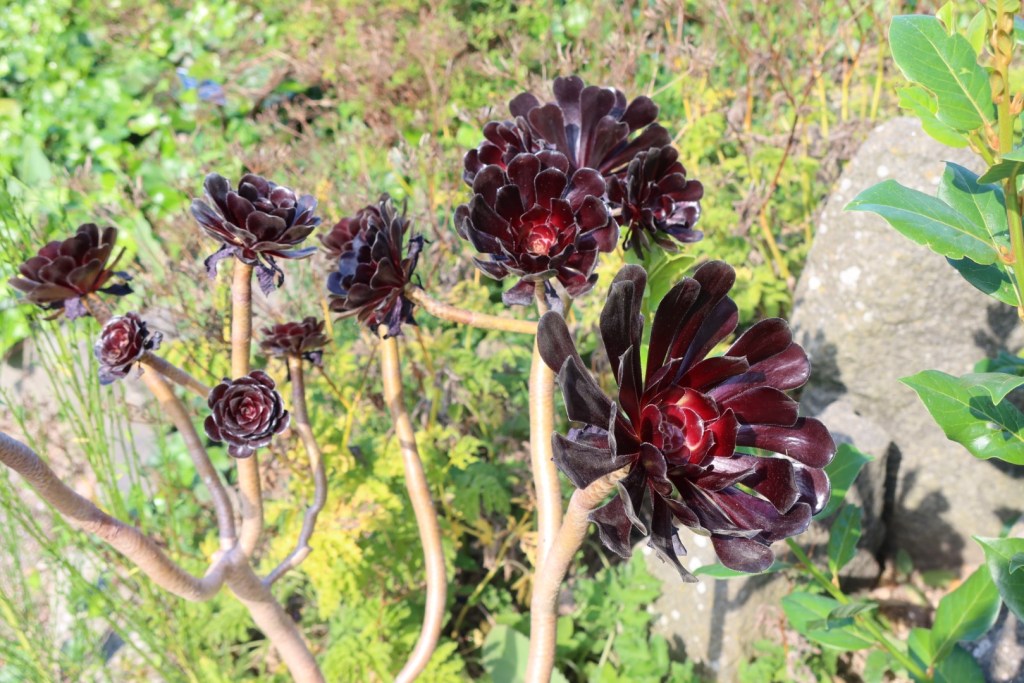
Pots of aeoniums are embedded into soil and dug up and protected under cover during the winter. The south-facing border provides the right place for numerous salvias, Helianthus, and South American Dahlias such as species Dahlia Dahlia merkii.

I am now going to let the photographs do the talking. Sadly I didn’t photograph all the plant names so a few of the plants featured are unidentifiable.

The anti-burglar plant Colletia histrix, also hails from South America.

The following images of a Begonia, Pelargonium and spectacular cacti were taken in the polytunnels.

Tom and his small team run a nursery shop stocked with plants raised at Lullingstone. A beautiful garden in its own right, few of us could resist the temptation of buying a souvenir of a memorable visit to this unique place. I treated myself to a pretty light purple Salvia Lavender Dilly Dilly, destined for new resilient planting in the front garden, a project I plan to progress and document here in the coming months. Also a green tinged Aeonium Velour, now getting VIP over-wintering treatment on the shelf in the spare bedroom. I feel a responsibility to nurture these two plants, given that Tom mentioned them both when signing my copy of his book!

How much the poorer the horticultural world would be had the kidnappers not freed their prisoners 23 years ago. Tom Hart Dyke’s vision of a garden encompassing unique specimens from across the globe would never have seen the light of day, a garden which has put Lullingstone Castle well and truly on the map for all plant lovers.

Kew Gardens, 3 December 2023

*The walled garden was formerly home to the white mulberry bushes (Morus alba) for the Lullingstone Silk Farm set up by Tom’s grandmother Lady Zoe Hart Dyke. Silk produced by the farm was used for the late Queen’s wedding dress in 1947 and her coronation dress in 1953. I love the fact that until the operation of the farm moved to Hertfordshire in 1956, hundreds of thousands of silkworms were bred in 30 rooms in the house where they grazed on the leaves of the mulberries.

A Portrait of a Garden

Featured

Long Barn: Vita and Harold’s garden before Sissinghurst

Most people, when they move to a new property, make some changes, perhaps a new kitchen or bathroom, or even an extension. When in 1913 Vita Sackville-West and Harold Nicolson, home from a diplomatic posting in Constantinople, bought two farm labourers’ cottages and adjoining land in the village of Sevenoaks Weald in Kent, they went a step further and moved a mediaeval barn from the bottom of the hill joining it to the cottages to create a large house. Their radical approach to property renovation extended to garden-making, culminating years later in the creation of the unique gardens at Sissinghurst. 

I visited Long Barn on a blistering hot day in early June. Organised by the WGFA, the visit consisted of an introduction to the property by the owner Rebecca Lemonius, followed by a tutorial in plant sketching by head gardener Anna Ribo. It was a very memorable and rewarding day in a fascinating garden. The link with one of the twentieth century’s most celebrated gardeners and garden writers made it all the more special. As for the art element, Anna’s non-judgmental approach gave this non-artist the space and freedom to have a go at drawing the bold planting combinations without feeling daunted. 

Having grown up only 1.5 miles away, in her ancestral home Knole (nicknamed ‘the calendar house’ because of its reputed 365 rooms), it was important for Vita to live somewhere with an intriguing history. Long Barn was reputed to have been occupied at one time by the founder of the printing press, William Caxton. The house went on to develop more history when in the 1930s, after Vita and Harold had decamped to Sissinghurst, it was let to aviator Charles Lindbergh and his wife when they sought solitude and privacy from the press intrusion following the kidnapping of their infant son in 1932. During the 2WW the house was used as a nursery by the NSPCC to accommodate children affected by air raids. Rebecca told a touching story of her correspondence with a gentleman who had lived at Long Barn during this period. Following his recent death, his ashes are to be scattered in the garden. 

In developing a new garden at Long Barn, Vita and Harold addressed the property’s sloping site by installing a terrace. Architect Edwin Lutyens, a lover of Vita’s mother Victoria, the spirited Baroness Sackville, advised on the construction of a series of raised beds at the foot of the garden (now the Dutch Garden) and the planting of a long row of clipped yew columns across the middle of the main lawn, but is not known to have been involved elsewhere in either the remodelling of the house or development of the garden. 

Vita and Harold made a good team when it came to making gardens. His strength was in the vision to create the structure and hard landscaping, whilst Vita’s talent was in choosing the planting, informed by her admiration for the writings of William Robinson, pioneer of the wild gardening style, a reaction to the rigidly formal bedding fashion of the Victoria era. The garden was said to be the glue which held their marriage together. When it was rumoured that a chicken farm was to be built on adjoining land, the Nicolsons looked for another property, a blank canvas on which to create a garden. And so they arrived at Sissinghurst which has of course come to be known as one of the great gardens of the world. They moved there in 1932 but didn’t sell Long Barn until 1945.

In terms of gardening partnerships, it’s clear that Rebecca and her head gardener Anna share a similar vision for the atmosphere they want the garden to evoke, their philosophy being that the design is led by their choice of plants. Anna explained that her approach to gardening at Long Barn (she has been there five years) is to be sympathetic to what is already there. A gardener has to approach a garden with a degree of humility, get a feel for the soil and condtions and get to know the client. The soil here is Weald Clay which is rock hard in summer and sticky and claggy in winter: they improve it as far as possible by mulching it with organic matter such as composted bark and spent mushroom compost which help to break up the clay. The only place they use grit is in the Cretean Bed, a narrow south-facing border running parallel to the Box Parterre where the plants are reminiscent of the Mediterranean style planting at Delos at Sissinghurst, with a limited colour palette accented by handsome multi-headed Aeoniums.

This large site consisting of several different areas or ‘rooms’ is maintained by what amounts to seven man days a week, and Rebecca and Anna recognise that ‘everywhere doesn’t have to be perfect all the time’. After an area has gone over, it is allowed to be quiet. With such a small team, there has to be a realistic view of what can be achieved in terms of maintenance. There is an irrigation system in place in the Dutch Garden, but everywhere else is watered by hand. A further challenge is posed by the rest of the village’s surface water draining down towards Long Barn. On the site of an old tennis court, they are developing the ‘Rose Meadow’ where roses are encouraged to be as tall as possible, interplanted with grasses and wild flowers such as cow parsley and buttercups.

Head gardener Anna is also a garden designer with a fine art background, and prefers to hand draw her designs rather than using a computer programme. When sketching a plant she told us you should look at the character of the plant and ask yourself is it, for example, upright, frothy, strong, structural? If you spent ten minutes a day on sketching the plants in your garden you would soon see progress. After these words of encouragement we were free to draw plants in the Dutch Garden which was a joyful experience. We hunkered down in the shade on the cool grass between the raised beds and drew the plants at close range, considering how one plant relates to its neighbours and trying to capture something of the sheer exuberance of the planting here. Since the day at Long Barn I have sketched in my garden for a few minutes but haven’t devoted enough time to it to see such progress. I certainly find it a mindful experience regardless of the results my concentration produces.

Anna shared some useful design tips for planning planting schemes. When assembling a choice of plants for a border you should introduce lots of different flower shapes. Umbels, the flattish umbrella-like flowerheads of plants such as Valerian officinalis, will attract beneficial insects like hoverflies which eat aphids. Heavily edit self-seeders when they have finished flowering, but don’t remove them altogether. For example bright cerise Gladiolus byzantina, itself a self-seeder, was lighting up the beds in the lower part of the garden with vibrant spires of flowers. In a large herbaceous border like those in the Dutch Garden, maintain planting pockets which carry a quiet period, during which you can introduce annual plants such as Ammi majus (more umbels!) Anna’s plant descriptions were wonderfully lively: she pointed out zesty euphorias and described small flowered, low growing plants as ditsy.

There was something of Great Dixter about the garden at Long Barn. I think it’s the handsome and weathered old house rearing up amidst a sea of bold colours and diverse flower shapes and leaf textures. The team at Long Barn have certainly honoured Vita and Harold’s horticultural legacy by maintaining the unique structure of a historic garden but within that framework experimenting and playing with scale and colour.

Here are some more of my images of the three acre site.

Hampton Court Palace Garden Festival 2023

5 July 2023

The designers of the show gardens in this year’s festival successfully conveyed the message that we gardeners cannot ignore the fact that our climate is becoming dryer and hotter. We need to put sustainability into practice by making our outside spaces resilient to such changes. Alongside this, and often as a consequence of gardening in this manner, we can attract and sustain the wildlife which would otherwise fall prey to climate change, pollution, the indiscriminate use of pesticides and the mania for covering our domestic open spaces with artificial grass or impermeable hard landscaping.

Tom Massey’s RHS Resilient Garden contained clever solutions to some of these threats. In the sunny front garden area, freshly dug gravel was replaced with recycled aggregate made from construction waste. ‘Rubblazzo’ paving made with such waste also featured. Rather than excess water produced by heavy rain storms overwhelming the sewage system, run-off was reduced by gathering the water into a wide shallow pool spanned by a boardwalk constructed from reclaimed timer. Day lilies, Agapanthus and (I think) Origanum vulgare contributed to a predominantly yellow, blue and mauve colour palette. To coincide with the unveiling of this inspirational garden, Tom Massey has penned a book for the RHS, Resilient Garden: Sustainable Gardening for a Changing Climate.

Unlike the Chelsea Flower Show where only invited guests get to step onto the show gardens, many of the Hampton Court gardens encouraged you to walk through them, a far more immersive experience than standing behind a rope and craning your neck to see the furthermost corners of the exhibit. The path in the RHS Wildlife Garden designed by Jo Thompson and Kate Bradbury replicated an old railway track with disused industrial land on one side (suggested by rusting machinery) and the rear portions of urban gardens on the other. If proof were needed that the clever planting in this garden was specifically designed to attract pollinators, the flowers of purple orchids and bergamot (Monarda didyma) were being mobbed by small skipper butterflies. The planting scheme included the native hawthorn, Crataegus monogyna, often cited as one of the best species for providing a food source for wildlife: nectar rich flowers in spring for invertebrates and juicy berries in the autumn for birds.

The winding path in Carol Klein’s RHS Iconic Horticultural Hero Garden passed six habitats: a bog garden representing wetlands, a small wood planted with beech trees, a native species rich hedgerow, a meadow blending grass and perennials, a rocky mountainside area for alpine species which merged into a shingly beach. The variety of species and cultivars used throughout was hugely impressive, as you’d expect from an expert plantswoman like Carol Klein, exemplified by these purple, mauve and silver shades in differing flower forms creating an exquisite painterly effect. There was even a vegetable patch and a greenhouse in which Carol could be seen sharing propagation technique tips with visitors. The plants used in the gravelly seaside garden were raised for the show by Beth Chatto’s Plants and Gardens. I loved the blend of mauves and deep pinks of Verbena officinalis var. grandiflora â€˜Bampton’ and Allium sphaerocephalon punctuated occasionally with pops of yellow and flowing Stipa tenuissima.

A restful pool sat at the heart of the Cancer Research UK Legacy Garden designed by Paul Hervey-Brookes. Looking at the photographs now, it is hard to imagine that a month earlier this tranquil space would have been a construction site. The willows and hostas sprouting between the massive rocks edging the pool gave the garden an air of permanence and screened visitors onto the garden from the show hubbub a few metres away.

I enjoyed the theatricality of the Oregon Garden, where a mini vineyard sat alongside a colourful meadow bordering a miniature lake. White corncockle (Agrostemma githago) shone out alongside pink and yellow Achillea, the overall palette deepened by burgundy Hylotelephium (formerly Sedum).

The key components for attracting and protecting wildlife (food, water and shelter) could be seen in a couple of the smaller show gardens. In the Nurturing Nature in the City garden by Viriditas, the walls created from stone-filled gabions would provide ideal homes for solitary bumble-bees as well as cover for small mammals. Ponds in rectangular boxes made from scaffolding boards made habitats for amphibians and invertebrates and drought tolerant and nectar rich flowers such as Achillea and Salvia nemorosa Caradonna were attractive for bees and butterflies. I liked the free-standing vertical garden idea where climbers like honeysuckle (a favourite for night-flying insects like moths) were being encouraged to grow up railway sleepers and along strainer wire fitted between the sleepers.

More wildlife friendly and sustainable ideas were included in The Wildlife Trusts: Renters’ Retreat designed by Zoe Claymore. This was full of clever solutions for making a garden which might have to be packed up and moved to a new space: a mini-pond in a pot; steel raised beds that can be dismantled and moved elsewhere, a tree planted in a container. The densely planted ferns and Lady’s mantle (Alchemilla mollis) supplied cover for insects and small mammals whilst bees and hoverflies would be drawn to the nectar in the foxgloves (Digitalis purpurea).

Hedges make wonderful habitats for wildlife. The Traditional Townhouse Garden designed by Lucy Taylor Garden Design was surrounded by copper beech hedging, with the burgundy colour scheme repeated in the bark of Tibetan cherry trees planted into huge pale green containers, underplanted with Lady’s mantle. Oversized chairs of green metal picked up the colour of the containers. A shallow circular pond accessible for amphibians was set within a sedum filled square. A ‘black’ and white planting scheme framed a large bronze apple: the bright white of Gaura lindheimeri ‘Snowbird’ contrasting with the dark petals of Viola cornuta ‘Molly Sanderson’ and Cosmos atrosanguineus.

I believe I am right in saying that ever since the first RHS Hampton Court 30 years ago, rose growers have exhibited in their own marquee, rather than the enormously long Floral Marquee. This makes for a wonderfully concentrated experience of exquisite flowers and fragrance.

There are another two ways in which Hampton Court contrasts with Chelsea: dogs on leads are permitted and you can buy plants at the show as well as all manner of horticultural accoutrements. Many visitors arrive armed with plastic crate trolleys to accommodate their purchases. I bought a beautiful purple flowered Streptocarpus from Dibbeys of North Wales for a friend’s birthday. It was lovely to chat with Lincolnshire Pond plants who were awarded a gold medal for their display (as they had been in May at Chelsea). In an effort to minimise blanket weed in my pond, I bought oxygenator water shamrock (Marsilea quadrifolia) which I was interested to learn is an underwater fern. I also stocked up on allium bulbs to plant in the autumn from WS Warmenhoven: more Purple Sensation to bulk up those already in the garden. Their display of numerous cultivars arranged against a black background was stunning. Having reviewed my photos, I’m now wishing I had also bought Allium sphaerocephalon which also popped up in several of the show gardens.

This brief account of the day inevitably cannot do justice to a fantastic show which I so enjoyed returning to after an absence of several years. I’ll leave you with a few more images from the day.

Kew Gardens, 22 July 2023

Our Friend in the North: Tom Stuart-Smith at RHS Bridgewater and Trentham Gardens

Tom Stuart-Smith has put his mark as a landscape architect on numerous gardens across the country. I’ve seen his planting at Chatsworth House in Derbyshire and in July 2021 was fortunate to go to the inspiring garden at his home, Serge Hill at Abbots Langley in Hertfordshire. This last weekend gave me the opportunity to compare two more of his creations: the new Royal Horticultural Society garden, Bridgewater, south of Manchester and the Italian Garden at Trentham Gardens, Staffordshire.

Steady rain fell throughout the afternoon at RHS Bridgewater but it meant that the gardens were very quiet enabling us to see the structure of the garden for which Tom Stuart-Smith created the masterplan for the development of the site as a centre of excellence for horticulture in the north-west. He also designed the layout and planting of the Paradise Garden which forms one half of the restored 11 acre Weston Walled Garden, a major feature of the new garden, as well as the Worsley Welcome Garden located close to the Welcome Building.

The joy of a RHS garden (like RBG Kew and other botanical gardens) is that all plants are labelled, so you start learning as soon as you step outside into the garden. A perennial honesty (Lunaria rediviva) soon caught my eye. In borders between the outer and inner walls of the walled garden, massed plantings of tulips and daffodils lit up the gloom of the rainy afternoon. Terracotta rhubarb forcers nestle amongst the bulbs, a clue to the presence at Bridgewater of the National Collection of rhubarb, with 100 cultivars having recently been moved from RHS Wisley. I also liked the gnarly branches (driftwood?) which accent the border every so often, resembling abstract sculptures.

I love to see show gardens from flower shows re-purposed, and the high brick wall of the Weston Walled Garden provided a perfect backdrop for Windrush Garden from RHS Flower Show Tatton Park, 2021, designed by Dawn Evans.

The Weston Walled Garden is divided into two equal halves: the Paradise Garden and the Kitchen Garden. High metal obelisks, designed to resemble the chimney of the original boiler room which heated the glasshouses which served Worsley New Hall, punctuate the enormous Kitchen Garden which contains more than 100 planting beds! Unobtrusive strainer wires are fitted along the walls. to support an impressive collection of wall-trained fruit, including heritage pears.

The heart of the Paradise Garden is a very large body of water, the Lily Pond, fed by two rills which intersect the garden. Partially covered by a decorative grill in a geometric design, the rills are just one example of the wonderful attention to detail manifest throughout Bridgewater. At this time of year and on a wet afternoon, the colours were muted: greens and the reddish brown of the beech columns planted around the Lily Pond. From photographs in the guide book and having seen Serge Hill* in high summer, I can imagine just how colourful the Paradise Garden must be later in the season. One of the features of Serge Hill which impressed me was the Plant Library, trial beds laid out in a numbered grid, designed as an open resource for garden design students to see how plants behave and move, featuring many drought tolerant plants. I’m imagining that some of the species in the Plant Library are also planted into some of the Paradise Garden’s 80 planting beds.

Two new glasshouses in Victorian style have been built along the southern wall of the Paradise Garden, to house tender specimens such as Aeonium. On the opposite side of this wall stands the Old Frameyard, home to the boiler room and its chimney, as well as potting sheds (now an exhibition space), a brand new Propagation House, and beds laid out for plant trials. Near here we spotted another show garden, the Blue Peter Discover Soil Garden designed by Juliet Sargent for the Chelsea Flower Show in 2022.

Just beyond the walled garden stands the restored Garden Cottage, once home to the the head gardener of Worsley New Hall. The cottage is surrounded by an immaculately mowed, semi-circular lawn.

Heading into the wooded area of Bridgewater we found a friendly ent, and in the fields beyond the woodland, the Pig Pen for the black Berkshire pigs which have been used throughout the creation of Bridgewater to act as ‘biological ploughs’ and clear the ground in various parts of the garden before planting. Here and there in the woodland, are remnants of the original gardens and to the north of Ellesmere Lake, the remains of the terraces which stood in front of Worsley New Hall, the large Victorian House which was demolished after the Second World War.

Flowing from Ellesmere Lake down the hill to Moon Bridge Water, the new body of water next to the Welcome Building, is the Chinese Streamside Garden, which is intersected with a series of small pools and crossed by a series of wooden bridges. The planting is designed to reflect the numerous Chinese native plants which are now favourite shrubs and trees in the west: acers, magnolias, primulas included.

Thankfully the weather improved for the second garden visit of the weekend: Trentham Gardens near Stoke-On-Trent, Staffordshire. Here three eminent contemporary garden designers have made their mark on a garden which has its origins as an eighteenth century landscape garden (the lake around which the garden and parkland are located was designed by Capability Brown). Piet Oudolf designed the Floral Labyrinth which stands beside the River Trent at the eastern end of the garden, near the ruins of the Italianate Victorian house: 32 beds of herbaceous perennials in the Dutch designer’s trademark prairie style. The beds were just beginning to spring to life, with tantalising crowns of greenery promising a lush summer display. Snakeshead fritillaries (Fritillaria meleagris) nodded gracefully in several beds.

The Perennial Meadow Garden along the edges of the lake was designed by Professor Nigel Dunnett (Tower of London Superbloom, Gold Meadows London Olympic Park and the Barbican). The third of the designers to shape this garden in the 21st century is Tom Stuart-Smith. When she showed us around her own garden at Serge Hill in July 2021, his sister Kate Stuart-Smith told us her brother’s nickname in the family was GAT, Great Arbiter of Taste! The Italian Garden at Trentham is certainly a class act. Like Bridgewater’s Paradise Garden, it is on a grand scale, a formal parterre style layout of symmetrical beds, some edged with low hedges arranged around low walled formal pools, centred with fountains. The Italian theme is reinforced with classical statuary, monumental urns and slim columns of Irish yew standing in for cypresses. The simplicity of the planting prevents the space from seeming unduly elaborate. One set of beds is planted with white flowers and silver-leaved plants: tulips, narcissus and a white-flowered Brunnera with silver-veined leaves, possibly B. macrophylla Mr Morse.

Low evergreen domes and similarly scaled stands of grasses planted into lawned areas echo the yew domes dotted on the lawn alongside the Worsley Welcome Garden at Bridgewater.

The Italian Garden is divided from the Floral Labyrinth by an arched pergola running its entire length, entwined with climbing roses and Wisteria, yet to bloom. Running alongside the pergola is the David Austin Rose Border, designed by Michael Marriott. I can only imagine how fragrant and beautiful this must be when in flower. The roses were certainly looking wonderfully healthy last Saturday.

Whilst brief, my 36 hour trip to the north west was enormously satisfying, and it was a joy to see Tom Stuart-Smith’s work in both gardens.

20 April 2023, Kew

*Here are some of my images of Tom Stuart-Smith’s garden at Serge Hill, taken in July 2021.

The Plant Library