Shortcuts to Idents

In our busy lives, with so much information being flung at us all the time, anything that helps us to remember useful facts without immediately resorting to Dr Google is valuable. For example, Every Good Boy Deserves Favour spells out the five lines of the treble clef. And I have a friend who can recite the whole of the rhyme reciting the royal monarchs starting Willy, Willy, Harry, Ste,
Harry, Dick, John, Harry three,
One, two, three Neds, Richard two
….

The botanical world is not immune from mnemonics of this kind. Ed, a volunteer colleague at NT Osterley House and Garden, recently taught me this rhyme:

Sedges have edges, rushes are round, grasses have knees that bend to the ground.

Sure enough, sedges have triangular stems and a mature grass stem is jointed with a series of nodes along its length.

During our Friday volunteer stints we chat a great deal about plants and try our best to name what we’re weeding out or trimming back. Coincidentally on the same day that I learnt the rhyme, Jasper, assistant gardener, showed us a quick method of identifying a couple of shrubs and trees when they are not in flower. He demonstrated that dogwoods (Cornus) have ‘elasticated’ leaves. If you tear the leaf in half across the way, you can gently stretch the central rib so that the two halves of the leaf remain connected by the stretched rib. And he pointed out that cherry leaves have nectaries at the place where the leaf stalk joins the branch. Sure enough, when I got home I checked my Snow Goose cherry tree and there they were: little nodes at the base of every leaf. Intrigued as to their purpose, I found this theory on the website of the Oxford University Herbarium:

At the base of the blade of a cherry leaf there are two extrafloral nectaries, which are thought to protect the plant’s leaves from damage by herbivorous insects. The nectaries attract ants by producing small quantities of sugar-rich nectar, which appears to encourage additional patrolling by ants. If the ants encounter any caterpillars they aggressively defend the leaf, even carrying the offending animal back to their nests.

I can’t help considering the irony of the caterpillars I’m so keen to attract to the garden being prey to marauding ants. No ant activity on the tree to report to date!

Cherry leaves and nectaries

Whilst writing the notes for a recent talk I gave about planting wildflowers in the garden to attract butterflies and moths, the mint family came up several times. I was reminded that a shortcut to identifying members of this large plant family, which are also called the dead-nettles (Lamiaceae), is that they have square stems. Just a light touch of the thumb and forefinger around the stem reveals the stem’s angled sides. By the way, red dead-nettle, water mint, betony and selfheal are all well-behaved wildflowers to introduce into the garden. The first two are caterpillar food plants for several species of moth, and the flowers of the last two are rich in nectar for butterflies and other pollinators.

Mint moth on Water mint

Another gardening friend of mine distinguishes beech and hornbeam by noting that hornbeam leaves have toothed edges and beech leaves have wavy edges. When I visited Kathy Brown’s Stevington Manor Garden near Bedford yesterday, I asked Kathy if she had any quick routes to plant identification. She opened up a whole new dimension to the topic by introducing the element of light: how it plays upon a leaf or indeed the whole plant. For example, hornbeam leaves are matte and beech leaves shiny. And pointing towards tall grasses in a nearby border she showed me that light reflects off the graceful Miscanthus making it shimmer, whilst the nearby Calamagrostis overdam absorbs the sunlight and appears more solid and blocky.

I referred to the mint family earlier, one member of which is lavender. I can’t mention to the visit to Kathy Brown’s Garden without praising her fabulous edible flower cakes, not least the lavender and lemon drizzle cake. The lavender is harvested from the borders in front of the topiary jury scene in the Formal Garden. The 4.5 acre garden beside the meadows of the Great Ouse is a joy, with ‘rooms’ inspired not only by historic gardens but also great works of art. The ‘Art Gardens’ include two purple beech and Berberis lined chambers evoking Mark Rothko’s Seagram Murals. With not a drop of water in sight, Kathy and her husband Simon have recreated Claude Monet’s Water Lilies using grasses, Echinacea and Geranium Rozanne to emulate the muted shades of gold, white and violet in the paintings. There is great deal more to this garden than this and I strongly recommend a visit there this summer: details of opening times are on the website, linked above.

Kathy Brown leading the tour with Jessica in tow
Looking from the fountain towards the gazebo

Do you have quick, non-digital ways to identify plants? I’d love to hear about them. As I write this it’s 28°C in the shade, so I shall sign off for now and retreat to a cool spot to ponder the endless variations in form, texture, colour we find in plants.

Kew Gardens, 11 July 2025

In search of Richard Turner

Victorian glasshouse with curved roofs against a blue sky

Curvilinear glasshouses at two Irish botanic gardens and the Palm House at Kew

Engineer and iron founder Richard Turner (1798–1881) built glasshouses in two Irish botanic gardens before collaborating with Decimus Burton in the construction of the Palm House in Royal Botanic Gardens, Kew. The first to be built was the Palm House at the Belfast Botanic Gardens completed in 1840. 1848 saw the completion of both the Curvilinear Range at the National Botanic Gardens in Dublin and the Palm House at Kew.

In early October I visited both the Irish gardens and was intrigued to observe how Turner’s glasshouses compared with Kew Gardens’ own Palm House. I had always understood there to be an Irish connection with the distinctive building at Kew that is often preceded by the adjective ‘iconic’, and erroneously thought that Decimus Burton was Irish. But a quick consultation with Wikipedia before my trip revealed that it was Dublin-born Turner who had mastered the art of creating curvilinear glasshouses through the use of wrought iron ribs linked with cast iron tubes. These glazing bars were light enough to support curving glass structures often likened in shape to the upturned hull of a ship.

Having used this innovative technology for a conservatory at a private estate in Fermanagh, Turner was engaged to build the Palm House at the Botanic Gardens, Belfast to a design by Charles Lanyon, and it was completed in 1840. The Curvilinear Range at the National Botanic Gardens of Ireland and the Palm House at Kew followed in 1848. According to historian of Kew, Ray Desmond, the collaborative relationship between Burton and Turner which resulted in Palm House at Kew was not without some tensions and once the glasshouse was completed, Turner’s role was relegated to ‘the subordinate role of a builder who had merely followed his architect’s plans’. This was despite his having devised a way to span 50 feet using the strength of wrought iron, meaning the central area was unimpeded by supporting columns. But Ray Desmond concludes that

an examination of all relevant archives reveals how much Burton was indebted to Turner’s engineering skills and ingenuity. Burton exercised a classical restraint on Turner’s tendency to decorative excess but, thankfully, did not entirely inhibit him. His scrolls and plant forms and the ubiquitous sunflower motif endow the ironwork with vivacity, even frivolity. The puritanical proclivities of Burton were counterpoised by Turner’s instinctive ebullience.

Because I started my Irish sojourn in Dublin, I’m going to take you first to the National Botanic Gardens of Ireland. Turner’s Curvilinear Range of intersecting glasshouses is located a short distance from the visitor centre and it didn’t take long to find some of Turner’s scrolls and plant forms both inside and outside the building. It’s one of two glasshouses open to the public, the other being the Palm House which dates from 1880 and, like the Tropical Ravine at Belfast (see below), is distinguished from its namesake at Kew by having a solid rather than glass rear wall.

The Curvilinear Range

The Palm House

There are many elements to Dublin’s botanic garden which occupies a relatively small area alongside historic Glasnevin Cemetery, and is intersected by the River Tolka, tributary of the Liffey. Those individual areas include a sloping walled garden with lean-to glasshouse and bothy linked by an intricate knot garden of box. Neat vegetable beds occupy the centre of the garden interspersed with handsome terracotta rhubarb forcers and pots stamped with the name Kiltrea of Enniscorthy in County Wexford. I was sad to read on Facebook that the pottery’s kilns are no longer firing and the potter’s wheel has stopped turning here at Kiltrea, the owners having retired.

On this side of the garden, which runs alongside the walls of Glasnevin Cemetery, and indeed includes a gateway into it, glimpses of the cemetery’s round tower appear through the trees. It was fascinating to explore Wild Ireland, where a range of natural areas have been replicated using characteristic soils and plants, including the distinctive limestone pavement of the Burren in County Clare, coastal habitat, various woodland habitats and a wetland area. Some of the 940 species endemic to Ireland are represented, including the strawberry tree, Arbutus unedo, which is such a feature of the woodlands around Killarney in County Kerry. Passing a colourful salvia border, I found the reconstruction of a Viking thatched hut, a reminder of early invaders of the country.

A steel sculpture looked familiar and I realised it resembled the Bootstrapping DNA sculpture outside the Jodrell Laboratory in Kew, the work of Charles Jencks, American landscape designer and architectural historian. The sculpture is called ?What is Life? and was installed to celebrate the 60th anniversary of the discovery of The Double Helix by James Watson and Francis Crick in 1953.

After four days in Dublin, I headed north to Belfast to spend time with friends from northern Virginia, London and Northamptonshire. Naturally the itinerary for this reunion visit had to include Belfast’s Botanic Gardens in the University Quarter. I visited the Botanic Gardens on a dank, drizzly morning, reassured to know that the impressive Ulster Museum is located within the Gardens, offering a cosy retreat should the rain intensify. The curving silhouette and decorative ironwork of the building indicated Richard Turner’s role in its construction. Like Kew’s Palm House it is betraying signs of age. Turner’s Palm House consists of two wings, the cool wing and the tropical wing.

By contrast to the jelly-moulded shape of the Palm House, the facade of the evocatively named Tropical Ravine across the way, looks so solid and Victorian in style that it’s a surprise to find a two storey glasshouse located behind the brickwork. The ground floor is the preserve of the horticultural team and steps lead up to the first floor (with a lift making it accessible for everyone). The perimeter walkway allows you to gaze across and down into both tropical and temperate zones and to appreciate the architectural structure of the plants featured. There’s a corner devoted to ferns, which must have appreciated the moisture generated by the misting system which operated every so often. Every day’s a school day as they say and here I learnt for the first time of John Templeton (1766-1825) known as The Father of Irish Botany.

Before I leave Ireland and return to Kew Gardens, allow me to take you on a detour to the north west of Belfast. Having revelled in the geological phenomenon of the Giant’s Causeway on the Antrim coast we returned to the city via the grounds of Gracehill House to see the avenue of beech trees planted by the Stuart family in the eighteenth century to impress visitors as they approached the entrance to their Georgian mansion. Known as the Dark Hedges, the highest branches of the trees entwine to form a tunnel almost perpendicular in form. The location was used in Game of Thrones in which it was called the King’s Road.

Knowing I was going to write this post this evening, I took several photographs of the inside of the Palm House at Kew yesterday, paying particular attention to Turner’s decorative ironwork. I suppose what strikes you with this extraordinary building is its scale, both in height and length. The building is shortly to undergo a major refurbishment, with the preparation for closure already underway.

Two ‘decant’ glasshouses are being built to house the plants from the Palm House while restoration works take place over the next several years. One is being built near the house itself and the other behind the scenes near the Tropical Nursery site.

My close-up of one of the sunflower motifs shows why the refurbishment project is necessary. Having worked at Kew while the Temperate House project took place, in the visitor information team, I fielded many comments expressing disappointment at the house being closed, and no doubt my successors will experience similar complaints about the Palm House in the months to come. But the years of negativity were forgotten when the building was re-opened in May 2018 to reveal the sparkling glasswork and paintwork of what was described in a song written to celebrate the re-opening as a ‘cathedral of light’. Roll on the day when the same can be said of a refurbished Palm House and the combined genius of Decimus Burton and Richard Turner can be admired once again.

Kew Gardens, 8 November 2024.

Postscript

Richard Turner’s ironworks in Ballsbridge in south Dublin produced not only the materials for the historic glasshouses I’ve written about in this post, but the decorative ironwork for the fanlights which adorn the front doors of the Georgian houses on Dublin’s Leeson Street. When I first started visiting Dublin with my family in the 1960s and 1970s, the tourist board produced a striking poster featuring the Georgian doors of Dublin and I’d like to think that one of them at least might have featured a fanlight made at the Turner ironworks. Here is my tribute to that classic poster.

Piers, Popes and Palaces

An evening visit to Hampton Court Palace

Cardinal Wolsey

Had I been asked a fortnight ago to explain what links Hampton Court Palace and the Vatican, I would no doubt have trotted out some facts learnt long ago in A Level history about Henry VIII’s break from Rome, the falling out of favour of Cardinal Wolsey and rise of Thomas Cromwell, and Wolsey’s giving his grand palace beside the River Thames to the king to postpone his disgrace. But since 18 July, I’ve identified a personal connection between these mighty edifices.

The story starts in October 2021 when I went to Rome with a couple of friends. One friend’s sister’s Sicilian mother-in-law happened to be staying in the city at the same time with a friend whose friend (stick with me, it’s a bit convoluted) was a guide at the Vatican museums. She kindly offered to take us to see the Sistine Chapel before it opened to the public! We met her early one morning and were led swiftly through chamber after cavernous chamber of treasures (the Gallery of Geographical Maps in particular stays in my memory) until we reached the door to the chapel. There we remained for over an hour, our necks craning to study every detail in Michelangelo’s ceiling. After a few minutes a small party of German clerics arrived, awed into silence like ourselves. Then, almost imperceptibly, the chapel filled with people, murmuring softly then rising in volume to the brink of excited chatter, until a diminutive monk tolled a handbell and silence was restored. Surrounded by now with many dozens of fellow tourists we realised just how privileged we’d been to experience being almost the only people in that unique space only an hour before.

The week before last, with a group of friends, I joined about 16 other garden lovers for an after hours tour of the gardens at Hampton Court Palace, led by head gardener and estate manager Graham Dillamore, organised by the National Gardens Scheme. Although I’ve visited Hampton Court Palace on several occasions, the gardens and palace have always been thronged with visitors. We arrived at Hampton Court Palace in style, on the riverboat from Kingston Pier. It felt apt to travel to the palace by water, as Henry and his retinue would have done 500 years ago.

When Graham led us past the entrance to the palace out onto the towpath and after a short walk, opened a door leading directly into the gardens, I recalled that unforgettable Roman morning. We entered a silent garden, the day’s visitors had departed and we had the gardens to ourselves. To our left was the glasshouse which protects the Great Vine, the roots of which extend beneath the expanse of bare earth in front of us, its surface cracked following a few days of hot dry weather. We entered the glasshouse to admire the Black Hamburg grapevine trained high above us. Amidst the dahlia border which surrounds this corner of the garden, a life-size figure fashioned from bark leans on his spade, and shields his eyes from the sun. The high perimeter walls which once separated the palace grounds from the path along the Thames, were punctuated with arched openings in the C18, and are now decorated with handsome terracotta urns made by Whichford Pottery, planted with pelargoniums. Fruit trees are trained against the wall between the openings.

The tour progressed to two sunken pond gardens, both designed to be viewed from above. The first features elaborate knot parterres set in a hedged rectangle, a circular lily pond at its centre. Other than the deep pink roses planted within the knot garden, greens and whites predominate, with a few touches of pale mauve, the outer borders containing Veronicastrum, Acanthus and Hydrangeas. We were allowed to walk around the second sunken garden, its lower borders planted with a formal annual bedding scheme of silver-leaved Senecio, red pelargoniums and bushy sunflower plants. Graham explained that they are transitioning to more sustainable planting in the upper borders, with hardy cannas and bananas, Fatsia and Crocosmia. The mid-level is fringed with Heliotropium, part of Hampton Court’s collection of about 20 cultivars, one of its three National Plant Collections. The warm evening sun amplified the sweet cherry pie scent of the prolific purple flowers.

The next ‘compartment’ we reached was a narrow rectangular ‘orchard’ separated by a stone wall from a strip of ground which was planted earlier in the year with Phacelia as a green manure. It’s blue flowers of June, a magnet for bees, were now shrivelled and about to be hoed out. Next year Graham plans to introduce sunflowers into this space.

I loved the looser planting of Penstemon in shades of pink and mauve within the lavender and Santolina compartments of the knot garden. A warm breeze stirred the colourful blooms, the movement a contrast to the formality of the preceding sunken gardens.

Lantana: close-up of a specimen in a pot beside the Privy Garden.

I mentioned that Hampton Court holds three National Plant Collections, the others being of Lantana and the wonderfully named Queen Mary II Exoticks Collection. The latter represents the plants amassed by Queen Mary, who reigned with King William III from 1689-1694, for display at Hampton Court Palace, at the time one of the largest private collections of plants in the world. Many of them we saw planted in colourful pots on wooden boarding outside the Orangery, as shown here in an image from the Plant Heritage website.

Queen Mary II Exoticks Collection 
© Hampton Court Palace
The Privy Garden: image courtesy of Historic Royal Palaces website

The enclosed ‘rooms’ of the tour to this point now gave way to the elegant expanse of the Privy Garden. Elements from three countries were reflected in the design of this garden made for William III in 1702, which was reconstructed in 1995. Italian sculptures and Dutch plants decorate the areas surrounding the intricate gravelled patterns in the French style. The narrow yew obelisks are 2m tall, demonstrating the vast scale of the Privy Garden. The original yews grew out of shape when the formality of the Privy Garden fell out of fashion, and were re-planted in the Great Fountain Garden opposite the eastern facade of the palace, where they were clipped into their now distinctive mushroom forms. They are clearly visible from the Long Water, the huge rectangular pond on either side of which the RHS show is staged.

From the Privy Garden, Graham guided us away from the gardens through the palace building, sunlit courtyards giving way to dimly lit interiors, shadowy stairwells looming overhead: a walk back through time from the 18th to the 16th century as we approached the earliest part of the building. En route, we lingered in Fountain Court to admire the baroque architecture, decorated with masks of mythical characters such as Bacchus and Medusa. We learnt that no mains water is used in the gardens at Hampton Court, instead the water features are fed from the Longford River, an artificial watercourse 12 miles long leading from the River Colne near Heathrow.

Fountain Court. Image courtesy of Eric Farnworth

I went yesterday to the National Portrait Gallery to see Six Lives, an exhibition about Henry VIII’s six wives and their influence upon popular culture. Frequent mention was made of Hampton Court. Third wife Jane Seymour died at the palace shortly after giving birth to Prince Edward. Fifth wife Katherine Howard was arrested there after discovery of her infidelity. Here are a couple of the exhibits: a transport poster from 1922 and a fragment of a heraldic shield depicting Jane Seymour’s emblem, a phoenix rising out of a castle from which Tudor roses and a crowned hawthorn tree bloom. It was originally set in the bridge at the west front of Hampton Court.

Our evening tour concentrated on the south eastern corner of the site. I shall return as soon as I can to explore the rest of the gardens. In the meantime, thank you to the National Gardens Scheme for arranging the tour and Graham Dillamore for sharing his knowledge and time and guiding us through these world famous gardens.

Kew Gardens, 2 August 2024

World Class

Featured

The World Garden at Lullingstone Castle

We humans like sorting things into categories: even when doing the laundry and the washing up. We separate socks from T-shirts and put knives, forks & spoons into the correct compartments of the cutlery drawer. I guess it’s our way of exerting some control in what sometimes feels like a chaotic world. Horticulture and botany excel in sorting. Botanists classify plants into families, genuses (genii?) and species. Gardeners divide them into trees, shrubs, herbaceous perennials, biennials and annuals, with sub-categories for plants thriving in particular soils or in certain aspects: sunny or shaded, dry or boggy. I could go on ad infinitum: herbs, grasses, succulents…..

Nowhere is the horticultural imperative to sort plants into categories more manifest than in a botanical garden. Traditionally these consist of sometimes dozens of rectangular order beds where plants of a particular family or genus are massed together forming a living textbook for study by professional and amateurs alike. I’m thinking here of the botanical gardens in Edinburgh, Oxford, Cambridge and the Chelsea Physic Garden. And, until a few years ago, The Royal Botanic Gardens, Kew. The Order Beds in the northern section of the Gardens were replaced in 2019 by the Agius Evolution Garden, where those rectangles were transformed into sinuous curved ‘rooms’ containing plants of species and families linked by evolutionary connections revealed by DNA research.

On 14 September this year I went with other members of the Garden Media Guild to a botanical garden in Kent created less than 25 years ago, where a map of the world informs the horticultural sorting. This is the World Garden at Lullingstone Garden near Eynsford in Kent, the creation of plant explorer Tom Hart Dyke within an existing one acre walled garden* and one acre of polytunnels. A world map is set into the walled garden, the continents containing ‘phyto-geographically’ categorised species, the borders against each perimeter wall housing hybrids and cultivars. Tom was our hugely enthusiastic guide around this unique garden, generously spending the morning with us and regaling us with fascinating facts about the many rare species featured in the garden.

This is a remarkable garden for many reasons. It’s been made with a small budget, 92% of the plant material having been donated, often raised from cuttings and small plants. The ‘continents’ are landscaped with rocks from the British Isles, but chosen because their geology mirrors that of the continent featured. Where appropriate, Lullingstone’s flinty alkaline soil has been replaced with acidic soil sourced from glacial deposits near Wisley in Surrey.

But perhaps the most remarkable fact about the World Garden is that when Tom had the idea for it he didn’t know if he would live to see his beloved Lullingstone Castle again let alone make the garden of his dreams there. In 2000, whilst on a orchid hunting trip to Central America, he and fellow adventurer Paul Winder were kidnapped and imprisoned by guerillas when crossing the notorious Darien Gap between Panama and Colombia. Tom made very light of his ordeal in the introduction to his tour, but I’ve been reading The Cloud Garden (2003), his and Paul’s account of their 9 month captivity, which reveals the desperately dangerous and terrifying nature of their situation during that period.

After being kidnapped a day or so after beginning their 66 mile trek to the Colombian border, they were forced to move between several encampments, trekking many miles through the thickly forested mountain terrain. They often spent several weeks in each camp, some of which were located in the cloud forest where Tom found relief from the oppression of his circumstances when he found immensely rare orchids growing in profusion. Bizarrely his captors would occasionally allow him to wander from the camp to collect these epiphytic plants which he brought back to camp and displayed on a makeshift luggage rack he had fashioned out of cut branches. When the time came to decamp, he was forced to abandon his living collection of rare species which would have been the envy of many an orchid specialist.

Their captors changed leader several times during the nine months, as did the armed guards in the camps, some reappearing after a few weeks. Despite their protestations, the kidnappers believed that the pair came from wealthy families able to afford million dollar ransoms for their release. Or that they were CIA operatives intent on foiling the exploits of the drug cartels operating in the area. Between gruelling interrogations, Tom and Paul found solace in playing draughts with pieces hand carved by Paul or teaching the guards to sing ‘Always Look on the Bright Side of Life’! Their good humour and resilience saw them through dark times of illness induced by poor food and parasites, as well as the terrifying uncertainty of their circumstances.

The pair were held from February until being freed shortly before Christmas 2000, having endured many months of deprivation. They never established for certain who their captors were, though they were thought to be guerrillas belonging to FARC, the anti-government armed militia with whom the Colombian government reached a peace deal in 2016. Tom has written about the building of the World Garden and his plant-hunting exploits in An Englishman’s Home: Adventures of an Eccentric Gardener (2007).

Starting his tour near the crenellated gatehouse built in 1493, Tom introduced us to the rare conifers planted between the house itself and the walled garden. I think this photograph captures something of his infectious enthusiasm for the plants in his care. In all there are 450 different species of tree at Lullingstone.

A series of island beds, approximately 3m across, planted with about 500 dahlia cultivars, draw the visitor towards the moon gated entrance to the World Garden.

Our first stop in the World Garden was Asia where we saw species from across the continent, before moving to Australia to admire a Eucalyptus volcanica, one of the specimens which make up the National Collection of Eucalyptus of which Tom is the registered curator. Mexican plants, including a tree Dahlia from the cloud forest region, enjoy a south-facing aspect. Protection against winter cold takes the form of a polytunnel about 18 metres long and over a metre wide.

I was fascinated by the use of a coal mulch on the South American bed to protect many tender plants from slugs and snails. I’ve not come across this material being used in this way before.

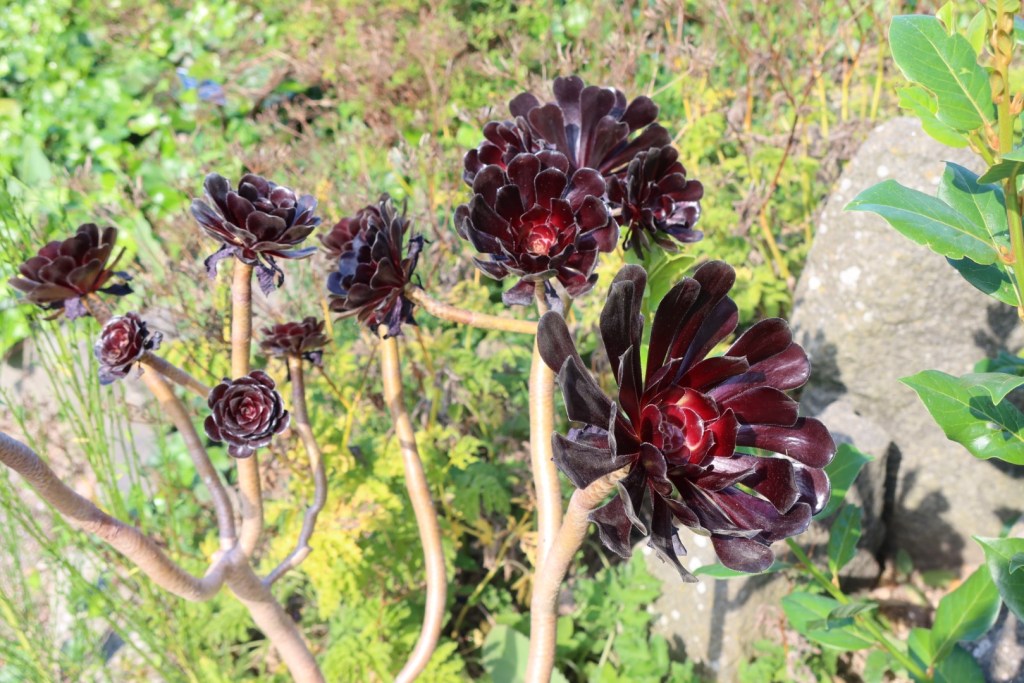
Pots of aeoniums are embedded into soil and dug up and protected under cover during the winter. The south-facing border provides the right place for numerous salvias, Helianthus, and South American Dahlias such as species Dahlia Dahlia merkii.

I am now going to let the photographs do the talking. Sadly I didn’t photograph all the plant names so a few of the plants featured are unidentifiable.

The anti-burglar plant Colletia histrix, also hails from South America.

The following images of a Begonia, Pelargonium and spectacular cacti were taken in the polytunnels.

Tom and his small team run a nursery shop stocked with plants raised at Lullingstone. A beautiful garden in its own right, few of us could resist the temptation of buying a souvenir of a memorable visit to this unique place. I treated myself to a pretty light purple Salvia Lavender Dilly Dilly, destined for new resilient planting in the front garden, a project I plan to progress and document here in the coming months. Also a green tinged Aeonium Velour, now getting VIP over-wintering treatment on the shelf in the spare bedroom. I feel a responsibility to nurture these two plants, given that Tom mentioned them both when signing my copy of his book!

How much the poorer the horticultural world would be had the kidnappers not freed their prisoners 23 years ago. Tom Hart Dyke’s vision of a garden encompassing unique specimens from across the globe would never have seen the light of day, a garden which has put Lullingstone Castle well and truly on the map for all plant lovers.

Kew Gardens, 3 December 2023

*The walled garden was formerly home to the white mulberry bushes (Morus alba) for the Lullingstone Silk Farm set up by Tom’s grandmother Lady Zoe Hart Dyke. Silk produced by the farm was used for the late Queen’s wedding dress in 1947 and her coronation dress in 1953. I love the fact that until the operation of the farm moved to Hertfordshire in 1956, hundreds of thousands of silkworms were bred in 30 rooms in the house where they grazed on the leaves of the mulberries.

A Portrait of a Garden

Featured

Long Barn: Vita and Harold’s garden before Sissinghurst

Most people, when they move to a new property, make some changes, perhaps a new kitchen or bathroom, or even an extension. When in 1913 Vita Sackville-West and Harold Nicolson, home from a diplomatic posting in Constantinople, bought two farm labourers’ cottages and adjoining land in the village of Sevenoaks Weald in Kent, they went a step further and moved a mediaeval barn from the bottom of the hill joining it to the cottages to create a large house. Their radical approach to property renovation extended to garden-making, culminating years later in the creation of the unique gardens at Sissinghurst. 

I visited Long Barn on a blistering hot day in early June. Organised by the WGFA, the visit consisted of an introduction to the property by the owner Rebecca Lemonius, followed by a tutorial in plant sketching by head gardener Anna Ribo. It was a very memorable and rewarding day in a fascinating garden. The link with one of the twentieth century’s most celebrated gardeners and garden writers made it all the more special. As for the art element, Anna’s non-judgmental approach gave this non-artist the space and freedom to have a go at drawing the bold planting combinations without feeling daunted. 

Having grown up only 1.5 miles away, in her ancestral home Knole (nicknamed ‘the calendar house’ because of its reputed 365 rooms), it was important for Vita to live somewhere with an intriguing history. Long Barn was reputed to have been occupied at one time by the founder of the printing press, William Caxton. The house went on to develop more history when in the 1930s, after Vita and Harold had decamped to Sissinghurst, it was let to aviator Charles Lindbergh and his wife when they sought solitude and privacy from the press intrusion following the kidnapping of their infant son in 1932. During the 2WW the house was used as a nursery by the NSPCC to accommodate children affected by air raids. Rebecca told a touching story of her correspondence with a gentleman who had lived at Long Barn during this period. Following his recent death, his ashes are to be scattered in the garden. 

In developing a new garden at Long Barn, Vita and Harold addressed the property’s sloping site by installing a terrace. Architect Edwin Lutyens, a lover of Vita’s mother Victoria, the spirited Baroness Sackville, advised on the construction of a series of raised beds at the foot of the garden (now the Dutch Garden) and the planting of a long row of clipped yew columns across the middle of the main lawn, but is not known to have been involved elsewhere in either the remodelling of the house or development of the garden. 

Vita and Harold made a good team when it came to making gardens. His strength was in the vision to create the structure and hard landscaping, whilst Vita’s talent was in choosing the planting, informed by her admiration for the writings of William Robinson, pioneer of the wild gardening style, a reaction to the rigidly formal bedding fashion of the Victoria era. The garden was said to be the glue which held their marriage together. When it was rumoured that a chicken farm was to be built on adjoining land, the Nicolsons looked for another property, a blank canvas on which to create a garden. And so they arrived at Sissinghurst which has of course come to be known as one of the great gardens of the world. They moved there in 1932 but didn’t sell Long Barn until 1945.

In terms of gardening partnerships, it’s clear that Rebecca and her head gardener Anna share a similar vision for the atmosphere they want the garden to evoke, their philosophy being that the design is led by their choice of plants. Anna explained that her approach to gardening at Long Barn (she has been there five years) is to be sympathetic to what is already there. A gardener has to approach a garden with a degree of humility, get a feel for the soil and condtions and get to know the client. The soil here is Weald Clay which is rock hard in summer and sticky and claggy in winter: they improve it as far as possible by mulching it with organic matter such as composted bark and spent mushroom compost which help to break up the clay. The only place they use grit is in the Cretean Bed, a narrow south-facing border running parallel to the Box Parterre where the plants are reminiscent of the Mediterranean style planting at Delos at Sissinghurst, with a limited colour palette accented by handsome multi-headed Aeoniums.

This large site consisting of several different areas or ‘rooms’ is maintained by what amounts to seven man days a week, and Rebecca and Anna recognise that ‘everywhere doesn’t have to be perfect all the time’. After an area has gone over, it is allowed to be quiet. With such a small team, there has to be a realistic view of what can be achieved in terms of maintenance. There is an irrigation system in place in the Dutch Garden, but everywhere else is watered by hand. A further challenge is posed by the rest of the village’s surface water draining down towards Long Barn. On the site of an old tennis court, they are developing the ‘Rose Meadow’ where roses are encouraged to be as tall as possible, interplanted with grasses and wild flowers such as cow parsley and buttercups.

Head gardener Anna is also a garden designer with a fine art background, and prefers to hand draw her designs rather than using a computer programme. When sketching a plant she told us you should look at the character of the plant and ask yourself is it, for example, upright, frothy, strong, structural? If you spent ten minutes a day on sketching the plants in your garden you would soon see progress. After these words of encouragement we were free to draw plants in the Dutch Garden which was a joyful experience. We hunkered down in the shade on the cool grass between the raised beds and drew the plants at close range, considering how one plant relates to its neighbours and trying to capture something of the sheer exuberance of the planting here. Since the day at Long Barn I have sketched in my garden for a few minutes but haven’t devoted enough time to it to see such progress. I certainly find it a mindful experience regardless of the results my concentration produces.

Anna shared some useful design tips for planning planting schemes. When assembling a choice of plants for a border you should introduce lots of different flower shapes. Umbels, the flattish umbrella-like flowerheads of plants such as Valerian officinalis, will attract beneficial insects like hoverflies which eat aphids. Heavily edit self-seeders when they have finished flowering, but don’t remove them altogether. For example bright cerise Gladiolus byzantina, itself a self-seeder, was lighting up the beds in the lower part of the garden with vibrant spires of flowers. In a large herbaceous border like those in the Dutch Garden, maintain planting pockets which carry a quiet period, during which you can introduce annual plants such as Ammi majus (more umbels!) Anna’s plant descriptions were wonderfully lively: she pointed out zesty euphorias and described small flowered, low growing plants as ditsy.

There was something of Great Dixter about the garden at Long Barn. I think it’s the handsome and weathered old house rearing up amidst a sea of bold colours and diverse flower shapes and leaf textures. The team at Long Barn have certainly honoured Vita and Harold’s horticultural legacy by maintaining the unique structure of a historic garden but within that framework experimenting and playing with scale and colour.

Here are some more of my images of the three acre site.

Our Friend in the North: Tom Stuart-Smith at RHS Bridgewater and Trentham Gardens

Tom Stuart-Smith has put his mark as a landscape architect on numerous gardens across the country. I’ve seen his planting at Chatsworth House in Derbyshire and in July 2021 was fortunate to go to the inspiring garden at his home, Serge Hill at Abbots Langley in Hertfordshire. This last weekend gave me the opportunity to compare two more of his creations: the new Royal Horticultural Society garden, Bridgewater, south of Manchester and the Italian Garden at Trentham Gardens, Staffordshire.

Steady rain fell throughout the afternoon at RHS Bridgewater but it meant that the gardens were very quiet enabling us to see the structure of the garden for which Tom Stuart-Smith created the masterplan for the development of the site as a centre of excellence for horticulture in the north-west. He also designed the layout and planting of the Paradise Garden which forms one half of the restored 11 acre Weston Walled Garden, a major feature of the new garden, as well as the Worsley Welcome Garden located close to the Welcome Building.

The joy of a RHS garden (like RBG Kew and other botanical gardens) is that all plants are labelled, so you start learning as soon as you step outside into the garden. A perennial honesty (Lunaria rediviva) soon caught my eye. In borders between the outer and inner walls of the walled garden, massed plantings of tulips and daffodils lit up the gloom of the rainy afternoon. Terracotta rhubarb forcers nestle amongst the bulbs, a clue to the presence at Bridgewater of the National Collection of rhubarb, with 100 cultivars having recently been moved from RHS Wisley. I also liked the gnarly branches (driftwood?) which accent the border every so often, resembling abstract sculptures.

I love to see show gardens from flower shows re-purposed, and the high brick wall of the Weston Walled Garden provided a perfect backdrop for Windrush Garden from RHS Flower Show Tatton Park, 2021, designed by Dawn Evans.

The Weston Walled Garden is divided into two equal halves: the Paradise Garden and the Kitchen Garden. High metal obelisks, designed to resemble the chimney of the original boiler room which heated the glasshouses which served Worsley New Hall, punctuate the enormous Kitchen Garden which contains more than 100 planting beds! Unobtrusive strainer wires are fitted along the walls. to support an impressive collection of wall-trained fruit, including heritage pears.

The heart of the Paradise Garden is a very large body of water, the Lily Pond, fed by two rills which intersect the garden. Partially covered by a decorative grill in a geometric design, the rills are just one example of the wonderful attention to detail manifest throughout Bridgewater. At this time of year and on a wet afternoon, the colours were muted: greens and the reddish brown of the beech columns planted around the Lily Pond. From photographs in the guide book and having seen Serge Hill* in high summer, I can imagine just how colourful the Paradise Garden must be later in the season. One of the features of Serge Hill which impressed me was the Plant Library, trial beds laid out in a numbered grid, designed as an open resource for garden design students to see how plants behave and move, featuring many drought tolerant plants. I’m imagining that some of the species in the Plant Library are also planted into some of the Paradise Garden’s 80 planting beds.

Two new glasshouses in Victorian style have been built along the southern wall of the Paradise Garden, to house tender specimens such as Aeonium. On the opposite side of this wall stands the Old Frameyard, home to the boiler room and its chimney, as well as potting sheds (now an exhibition space), a brand new Propagation House, and beds laid out for plant trials. Near here we spotted another show garden, the Blue Peter Discover Soil Garden designed by Juliet Sargent for the Chelsea Flower Show in 2022.

Just beyond the walled garden stands the restored Garden Cottage, once home to the the head gardener of Worsley New Hall. The cottage is surrounded by an immaculately mowed, semi-circular lawn.

Heading into the wooded area of Bridgewater we found a friendly ent, and in the fields beyond the woodland, the Pig Pen for the black Berkshire pigs which have been used throughout the creation of Bridgewater to act as ‘biological ploughs’ and clear the ground in various parts of the garden before planting. Here and there in the woodland, are remnants of the original gardens and to the north of Ellesmere Lake, the remains of the terraces which stood in front of Worsley New Hall, the large Victorian House which was demolished after the Second World War.

Flowing from Ellesmere Lake down the hill to Moon Bridge Water, the new body of water next to the Welcome Building, is the Chinese Streamside Garden, which is intersected with a series of small pools and crossed by a series of wooden bridges. The planting is designed to reflect the numerous Chinese native plants which are now favourite shrubs and trees in the west: acers, magnolias, primulas included.

Thankfully the weather improved for the second garden visit of the weekend: Trentham Gardens near Stoke-On-Trent, Staffordshire. Here three eminent contemporary garden designers have made their mark on a garden which has its origins as an eighteenth century landscape garden (the lake around which the garden and parkland are located was designed by Capability Brown). Piet Oudolf designed the Floral Labyrinth which stands beside the River Trent at the eastern end of the garden, near the ruins of the Italianate Victorian house: 32 beds of herbaceous perennials in the Dutch designer’s trademark prairie style. The beds were just beginning to spring to life, with tantalising crowns of greenery promising a lush summer display. Snakeshead fritillaries (Fritillaria meleagris) nodded gracefully in several beds.

The Perennial Meadow Garden along the edges of the lake was designed by Professor Nigel Dunnett (Tower of London Superbloom, Gold Meadows London Olympic Park and the Barbican). The third of the designers to shape this garden in the 21st century is Tom Stuart-Smith. When she showed us around her own garden at Serge Hill in July 2021, his sister Kate Stuart-Smith told us her brother’s nickname in the family was GAT, Great Arbiter of Taste! The Italian Garden at Trentham is certainly a class act. Like Bridgewater’s Paradise Garden, it is on a grand scale, a formal parterre style layout of symmetrical beds, some edged with low hedges arranged around low walled formal pools, centred with fountains. The Italian theme is reinforced with classical statuary, monumental urns and slim columns of Irish yew standing in for cypresses. The simplicity of the planting prevents the space from seeming unduly elaborate. One set of beds is planted with white flowers and silver-leaved plants: tulips, narcissus and a white-flowered Brunnera with silver-veined leaves, possibly B. macrophylla Mr Morse.

Low evergreen domes and similarly scaled stands of grasses planted into lawned areas echo the yew domes dotted on the lawn alongside the Worsley Welcome Garden at Bridgewater.

The Italian Garden is divided from the Floral Labyrinth by an arched pergola running its entire length, entwined with climbing roses and Wisteria, yet to bloom. Running alongside the pergola is the David Austin Rose Border, designed by Michael Marriott. I can only imagine how fragrant and beautiful this must be when in flower. The roses were certainly looking wonderfully healthy last Saturday.

Whilst brief, my 36 hour trip to the north west was enormously satisfying, and it was a joy to see Tom Stuart-Smith’s work in both gardens.

20 April 2023, Kew

*Here are some of my images of Tom Stuart-Smith’s garden at Serge Hill, taken in July 2021.

The Plant Library

Return to East Lambrook Manor Gardens

In my last blog post I featured an image of an unusual bell-shaped snowdrop, Galanthus Phil Cornish. I took the photograph in February on a Sunday afternoon visit to East Lambrook Manor Gardens, near South Petherton in Somerset, the creation of garden writer Margery Fish. I first went to this fascinating garden in May 2021 and vowed to return during another season. In winter you can see the bones of a garden without the distraction of abundant foliage and flowers.

Galanthus Phil Cornish

In this case the skeleton consists of narrow paths between cottage garden borders, a mini avenue of curvaceous yews and the ditch which Margery Fish cleverly incorporated into the heart of the garden. In the winter months these elements are embellished with a splendid display of snowdrops: in pots lining the paths, in borders and on the banks of the ditch. This Festival of Snowdrops takes place every February.

Naturally snowdrops were the main attraction in the plant nursery which adjoins the garden. Here they were set out on tables for sale with some of the price tags reflecting the rarity of the specimens displayed. Examples of each of the cultivars grown at East Lambrook were arrayed on the long stone shelves which on my last visit featured the hardy geraniums loved by the garden’s creator.

I chatted to the gentleman operating the till at the nursery who told me that he had worked with several members of staff who had known Margery Fish until her death in 1969. He told me a story which summed up her passion for her garden. During a trip away from home, a fire broke out and badly damaged the Malthouse (which now houses a cafe and gallery). When she was called to be told the bad news, Margery Fish’s first reaction was to ask if the garden had been damaged in any way. It had not, she expressed her relief and only then enquired about the state of the smouldering building.

Here are some of my photos of the garden in February, which as I write this on a very chilly April evening, doesn’t seem so very far away.

The Professionals

Part 1 Inner Temple Garden

An aerial view of London shows plenty of green space amidst the urban layout of streets, shops and offices. The expansive royal parks account for much of those spaces- Hyde Park, The Green Park, St James’s Park and The Regent’s Park- as do squares (both public and private), churchyards, private gardens and the gardens attached to some professional bodies. In this and my next post I explore two of the latter: the Inner Temple (commonly known as The Honourable Society of the Inner Temple) and The Royal College of Physicians.

Occupying a site beside the River Thames, from which it is separated by the Victoria Embankment, the three acres of the Inner Temple Garden are surrounded to the west, north and east by the buildings of the Inn, housing barristers’ chambers, judges’ lodgings as well as Inner Temple Hall and the offices of this ancient Inn of Court, one of the four located in this area of London, between the theatres and shops of the West End and the banks and financial institutions of the City of London.

In early September, a kind friend who works for the Inn arranged for me to meet Sean Harkin, the Inn’s head gardener. During lockdown I had watched Sean give an online lecture to the Kew Mutual Improvement Society about Inner Temple Garden and was struck by his enthusiasm for plants and for his work in this unique sanctuary in the heart of the busy city. Sean’s CV is impressive: RHS Wisley, the National Trust’s gardener in residence for the city of Manchester and head gardener at Kensington Palace where he created the white garden in memory of Princess Diana. My friend and Sean took time out of their busy schedules to meet me on a rather overcast and damp day, a contrast to the extreme heat of only a week or so before. Sean explained that over the last couple of years, he and his small team of three gardeners had created a new meadow on part of the lawn in the centre of the garden. Now mown, I can imagine that the meadow added a very natural and contemporary aspect to what might otherwise be expected to be a rather conventional space. But Sean’s vision is for bold planting in scale, form and colour. And this is most evident in the deep herbaceous border along the garden’s northern side where tall grasses and cardoon seedheads jostle alongside blowsy pink dahlias, Salvia Amistad, giant fennel and rudbeckias. A broad-leaved plant I didn’t recognise (resembling a very tall canna lily or a banana) added an exotic accent. It reminded me of the long border at Great Dixter where what at first glance seems informal planting is in fact a carefully woven tapestry of textures and hues. Sean told me the garden is at its best in April and May, and I shall certainly return then, but I loved the late summer colour scheme of pink and gold and was impressed at how well the plants had fared in the recent drought.

Sean reminded me that until 1911, the Royal Horticultural society staged its annual spring show in the garden, before moving to its current venue, the Royal Hospital in Chelsea. The border I have just described was turned over to allotments in WW2 and blitz spoil lies beneath much of the soil of upper part of the garden. A magnificent avenue of London plane trees (Platanus x hispanica) runs parallel with the Victoria Embankment, screening the Inn from traffic and filtering the fumes. In a peaceful spot alongside the avenue stands a large circular lily pond, raised above ground and screened from the surrounding lawn by a recently planted hedge.

Elsewhere pillowy yew topiary forms settle plumply at the corners of a shady lawn. Silvery hued plants such as Mexican fleabane (Erigeron karvinskianus) and a Euphorbia echo the pale stone of an elaborate pillar supporting a sundial.

Tucked to the east of the garden are steps lined with pots containing tender plants including a flamboyant Brugmansia and Cobaea scandens, the cup and saucer vine. A nearby lean-to greenhouse is full of succulents and cacti.

As well as the planes, the garden is home to some other beautiful trees including a Magnolia soulangeana and a dawn redwood (Metasequoia glyptostroboides). And to some wonderful roses: tall China rose shrubs smothered in loose-petalled blooms.

Inner Temple Garden might be located in the heart of an ancient institution but thanks to the head gardener’s vision and flair, it’s a garden for the twenty first century.

The Inner Temple Garden is usually open to the public on weekdays (excluding bank holidays) from 12.30-3pm. Access is via the main gate opposite the Treasury Office on Crown Office Row, London EC4Y 7HL.

More images from the garden:

Hardy’s and Hillier’s in Hampshire

This is a longer version of an article published last week in GMG News, the publication of the Garden Media Guild, the trade organisation of which I’m proud to be a member, for writers, photographers and all communicators in the gardening realm.

In my last post I promised to report upon the first part of my early June road trip which started with two memorable visits in Hampshire. Days out arranged by the Garden Media Guild are always special, with owners or head gardeners sharing their time and expertise whilst guiding Guild members around the gardens in their care. The two visits on 1 June 2022 were no exception, and for reasons that will become clear, were indeed exceptional. As I turned into the lane leading to Hardy’s Cottage Garden Plants in the village of Freefolk on the outskirts of Whitchurch, I noticed that the pub on the corner was called the Watership Down Inn after Richard Adams’ wonderful book and had a feeling that this was going to be a memorable day. 

We were greeted in the building housing the potting machine by Rosy and Rob Hardy. Whilst swallows swooped overhead to feed their young in numerous nests in the rafters, Rosy and Rob led us across to the propagation house, the first of the nursery’s three multi-span tunnels. The design of this house reflects their almost 35 years of experience as growers, with its three heated benches at chest level for ease of working and to provide storage beneath, an even airflow to protect young plants and two fridges for those seeds needing a drop in temperature to break dormancy. It also boasts a light sensitive automatic watering system. Peat free compost is used for the modules in which seedlings and cuttings are raised, with a top dressing of milled Portuguese cork. Rosy explained they recently started using this environmentally friendly material instead of vermiculite and are finding that it stops algae forming and they hope it will reduce fungus gnat infestations. Stock plants occupy the floor on either side of the central benches from which cuttings will be taken and seed collected. 

Stock material is propagated in the neighbouring tunnel where we learnt that the new stock plants are allowed to flower to check that they have grown true to type. Hardy’s have licences to propagate a number of cultivars including Geum Totally Tangerine and Rosy succinctly explained the intricacies of plant breeders’ rights and their obligation to pay a royalty on each plant sold to the breeder’s agent. 

To the rear of the houses we were shown the show stock for Chelsea, Gardeners’ World Live and Hampton Court. Although Hardy’s no longer exhibits at Chelsea, the nursery supplied plants to several of this year’s show gardens including that of Sarah Eberle. They stand the plants outside so that they experience the variety of weather conditions they are likely to encounter at the shows. The nursery is relatively high up (350 feet) on quite a windy site beside the North Wessex Downs. The night before our visit they recorded a frost. A shade shelter protects shade lovers like Hosta, Polygonatum, Rodgersia and various ferns. 

Few chemicals are used. The slug population is controlled by birds, voles and frogs. Ladybird and hoverfly larvae keep down aphids. A twice yearly spray against pests and diseases has been replaced with biological controls such as Encarsia wasps. It was interesting to hear Rosy’s views on climate change: ‘March is May now’. She showed us the extensive outside nursery area where plants are tagged with yellow for mail order plants and red for plants destined for the plant sales area. 

It was inspiring to hear how this large nursery started life in Roy and Rob’s back garden in Camberley with weekly car boot sales, progressing through a rented walled garden to today’s impressive organisation. Back in the potting shed (where sadly the potting machine was not in operation on the day of out visit- I’d love to see it in action), Rosy told us that milled cork is also used to top dress newly planted material. I doubt that few of us left without a purchase or three from the extensive plant sales area. My souvenir of the day is a very healthy looking Anthriscus sylvestris Ravenswing. 

The Sir Harold Hillier Gardens are 20 miles south of Hardys and we mustered there early in the afternoon to be shown around by the curator, David Jewell. While we chatted before setting off, a smiling gentleman with a shock of white hair came over to join us and it’s no exaggeration to say we were all starstruck at meeting Roy Lancaster. Having already met two gardening heroes that day, it was a wonderful surprise to find out that Roy was joining our tour. He was the first curator of what was then known as the Hillier Arboretum and shared tales of his plant hunting exploits as we progressed through the garden. David was a superb guide and his route through the 180 acre site took in several of the 600 champion trees for which the gardens are famous. He recommends that when visiting a garden one should always ‘look up and look back’ so as to see vistas from every angle. On the day of our visit the peony display was looking superb and we were told that many of them were donated by Kelways Plants, whose Somerset HQ is only a few miles from my niece’s home. We were all very taken with the wisteria collection where 20 plants are trained up posts approx.2.5 metres high, an ingenious way to display a range of cultivars in a modest space.

Next came the Centenary Border, a spectacular double perennial border created to celebrate the first 100 years of the Hillier Nurseries. David is passionate about making the gardens as accessible as possible and pointed out the paved paths in front of each border to accommodate wheelchairs. The borders are studded with rare shrubs including one collected by Roy in Iran, the name of which I’m afraid I failed to write down correctly. 

Sir Harold Hillier died in 1985 but in this garden, as at Great Dixter and Beth Chatto’s Plants & Gardens, the signature of the garden’s creator is reflected in the planting, notably in the extensive collection of oaks, one of his favourite plant groups. The great man’s portrait sculpture has been placed near his home, Jermyn’s House, facing a specimen of Quercus macranthera.

David took us to the site of a new garden to be designed by Tom Stuart Smith to spread the footfall of the rising number of visitors (250,000 a year, an increase of 100,000 in ten years). Influenced by Beth Chatto’s Gravel Garden, the beds of the provisionally named Frontier Garden will be back-filled with crushed stone and planted with species from South Africa and the Mediterranean which once in the ground will not be watered again. David showed us the low slate roofed building where Roy Lancaster wrote the first Hillier Manual of Trees and Shrubs. It is hoped to redevelop the building as a library and archive. The finale to the afternoon was a splendid cream tea in The Garden Restaurant where I was thrilled to sit at Roy’s table where he chatted about his garden which he describes so vividly in his monthly column ‘A plantsman’s notebook’ in The Garden magazine. 

From left: David Jewell (current curator), Roy Lancaster (former curator), Gordon Rae (Director General of RHS from 1993-1999 & joint patron of the Garden Media Guild) and Mike Palmer (Chair of the Garden Media Guild)

Last time I mentioned the imminent arrival of a certain ginger and white kitten called Seamus. I brought him home on Sunday and he has settled in very happily. As I write this he is curled up on my lap, purring contentedly. Expect some tales in the months to come of the challenges of gardening with a cat in residence. For the time being I leave you with the translation by my kitten’s namesake Séamus Heaney, of Pangur Bán (White Pangur) an anonymous poem written in Old Irish around the 9th century. So far any rodent hunting has involved a little fabric toy mouse but I love the sentiment of the writer and the cat, each plying their trade, content in one another’s company.

Pangur Bán and I at work,

Adepts, equals, cat and clerk:

 His whole instinct is to hunt,

 Mine to free the meaning pent.

More than loud acclaim, I love

Books, silence, thought, my alcove.

 Happy for me, Pangur Bán

 Child-plays round some mouse’s den.

Truth to tell, just being here,

Housed alone, housed together,

 Adds up to its own reward:

 Concentration, stealthy art.

Next thing an unwary mouse

Bares his flank: Pangur pounces.

 Next thing lines that held and held

 Meaning back begin to yield.

All the while, his round bright eye

Fixes on the wall, while I

 Focus my less piercing gaze

 On the challenge of the page.

With his unsheathed, perfect nails

Pangur springs, exults and kills.

 When the longed-for, difficult

 Answers come, I too exult.

So it goes. To each his own.

No vying. No vexation.

 Taking pleasure, taking pains,

 Kindred spirits, veterans.

Day and night, soft purr, soft pad,

Pangur Bán has learned his trade.

 Day and night, my own hard work

 Solves the cruxes, makes a mark.

Séamus Heaney

Hever Castle & Gardens revisited

My last blog post about the gardens at Hever Castle was in July 2019. I had the good fortune to return to Hever last Monday with a great group from the Garden Media Guild. Head gardener Neil Miller lead a tour of the garden. Our visit coincided with peak season for the 40,000 tulips planted at Hever. Neil demonstrated throughout the tour that in a garden nothing stands still, it’s an ever changing space. Plants outgrow their site, new areas are cleared and planted, Yew topiary is cut back to the bone and re-shaped.

Despite being a listed garden there is scope for experimentation and innovative practices at Hever. With a third of a million visitors a year compaction is a problem in the Yew Maze so the opportunity was taken when the garden closed during the first lockdown in spring 2020 to revitalise the yews. Terrain Aeration was engaged to pump air and dried seaweed one metre below the compacted soil. Elsewhere in the garden digestate (the odourless by-product of anaerobic digestion of e.g. sewage sludge) is used to enrich the soil around established plants. In an area known as the Acer Dell a swathe of red and white tulips (a tribute to the Tudor Rose) was created last year using a bulb planting machine operated by Dutch firm Lubbe & Sons. The tines of the machine act as ‘dibbers’ to create the planting holes, the machine drops the bulbs into place and then backfills the holes.

No garden is immune from the ravages of the weather and Neil showed us a 120 year old poplar tree near the drawbridge across the moat which was blown down by Storm Eunice in February this year. Its rootball was winched back into position and it is hoped it will regenerate. Beside the Italian Garden it was sad to see that the severe frost about four weeks ago had taken out most of the flower buds of the Wisteria trained over the pergola*.

Neil explained that the herbaceous border alongside Two Sisters’ Lawn, named for Ann and Mary Boleyn who were raised at Hever, is planted in the style of Edwardian garden designer Gertrude Jekyll. In the summer, cool shades of white and silver will progress through the colour spectrum to warm reds and golds. The opposite border is punctuated with dainty standard forms of the earliest flowering rose, Rosa xanthina Canary Bird.

Beyond the Festival Theatre, a curving raised bed (the dahlia border) is graced with 3,500 tulips all of which are planted into crates as is done in the Keukenhof gardens in the Netherlands. Not only does this make it easier to remove the bulbs in time for planting dahlias in June, it avoids a rogue cultivar finding its way into the scheme. The theme changes each year, this year’s being cream (Tulipa Avant Garde), red (Tulipa Red Wing) and purple (Tulipa Purple Flag). The tulips from this area and those in the Italian Garden are lifted later in May and planted in less formal areas of the garden.

Neil introduced us to the six acre Italian Garden by telling us that it was designed to house the huge collection of ancient and renaissance statuary collected by William Waldorf Astor while US ambassador to Rome. Individual garden ‘rooms’ occupy the niches along the south facing border inspired by the ruins of Pompeii. These have been planted with tulips and complementary spring flowers. I was struck by the unusual Evergreen tulips underplanted with wallflowers, the fringed purple tulips interspersed with blue pansies.

One of the garden ‘rooms’ in the Italian Garden
Ditto

The south-facing border is also a perfect site for exotic shrubs like pomegranates, pistachio (mastic) and olives, the latter wall-trained so immaculately it resembles a trompe l’oeil painting. A fig and a loquat have been trained in a similar fashion against the wall opposite the Pavilion Cafe.

Espaliered olive tree in the Italian Garden

The long border on the other side of the Italian Garden, at the foot of the colonnade, is ablaze with the scarlet, orange and yellow of Olympic Flame and Apeldoorn Elite tulips.

Venerable camellias occupy the shady side of the colonnade. They are pruned back after flowering to keep them from growing too far across the pathway and pressure washing is used to treat those specimens affected by sooty mould. In the rose garden no insecticides are used, any aphids on the 4,000 roses are soon consumed by visiting blackbirds and invertebrates like ladybirds and hoverflies. Because the roses are planted very close together in a walled garden, airflow is impeded and blackspot can be a problem from July onwards, causing defoliation. To prevent this, the roses are sprayed fortnightly from the end of April until late September. A foliar feed is also added to the spray to encourage healthy growth. Deadheading is carried out throughout the flowering season. Neil’s pruning regime is to reduce the roses by one third in November to prevent windrock and in March to cut stems to three or five buds (hybrid tea roses) and five or seven buds (floribunda roses).

The Rose Garden in April

After a very sociable lunch we were taken to a newly planted woodland area of the garden: Church Gill where, seven years ago, long-forgotten stone steps and a pathway were uncovered when laurels and bracken was being removed from the top of the stream-side Sunday Walk, along which the Astor family would have made their way to the Hever parish church. Over the last three years the area has been revitalised with a scheme of shade-loving woodland and alpine plants designed by Graham Gunn and Monica Wylie of Kevock Garden Plants in Edinburgh. The steep sides of the valley through which the stream flows must have made planting very challenging.

The natural atmosphere of this part of the garden is a complete contrast to the colour and formality of the Italian Garden but it’s a beautifully realised example of how Neil Miller and his team of 10 gardeners develop new projects as well as maintaining the highest standards of horticulture throughout the gardens at Hever.

Kew, 1 May 2022

*In my own garden about 50% of the buds were checked by that frost but happily the rest have flowered successfully and it is currently looking and smelling divine.

Some more photographs of the gardens at Hever follow: