Wild geraniums and their cultivated cousins
I deliberately allow some wildflowers to naturalise around the pond, providing shelter for frogs and softening the brick edging. Last month, while peering into the water to see what the frogs were up to, I noticed two similar pink flowers, one larger than the other. Glancing quickly, I’d assumed the dominant plant in this area was Herb-Robert (Geranium robertianum), but closer inspection revealed very different leaf shapes. The edges of the leaves of the plant with the larger flowers are deeply cut, almost ferny, emitting a strong vegetative smell evocative of lettuces, even if just lightly touched. This is Herb-Robert and in common with all the geranium family, the seed heads comprise an elongated ovary out of which extends a long beak, hence the common name for the genus, cranesbill.


I consulted the wildflower oracle, Francis Rose’s The Wild Flower Key, to find that the roundly lobed leaves of the smaller flowered plant belong to Shining Crane’s-bill (Geranium lucidum). True to its name the leaves do indeed gleam and some are tinged red, a feature shared with Herb-Robert.


The profusion of both species of Crane’s-bill in May and into June has made me look more closely at the cultivated forms of geranium, which so usefully bridge the gap between the spring bulbs and the flowers more associated with high summer such as salvias. They are perfect ground cover plants and their almost always open-petalled flowers attract flying pollinators in droves.

Geranium macrorrhizum is the first to flower in my garden, its white, slightly reflexed petals off-set by distinctive inflated rosy coloured calyces. This image clearly shows its prominent white stamens fading to pink and tipped with black pollen-bearing anthers, and a longer ‘beak’ or style, topped with five stigmas, primed to receive pollen from another flower.
Bees and hoverflies flock to Geranium Phaeum with its small flat dark maroon flowers which account for its common name of dusky cranesbill. The leaves increase in size as the as the summer progresses, as do their purplish brown markings. Cutting the growth back after flowering in late June encourages a second flush of flowers later in summer. The clear pink flowers of Rosa Gertrude Jekyll combine well with the darker red of Geranium phaeum.


Last year I planted Geranium nodosum in a client’s garden in the dry soil and dry shade of several silver birches which occupy the rear of a long plot. I’ve been establishing an understorey of woodland perennials and this cranesbill has established perfectly. The plants are about 50cm high with mauve open flowers and quite large bright green leaves.
So far, the species geraniums I’ve mentioned have somewhat muted flowers, but G. Ann Folkard and G. Patricia have bold magenta flowers. I’ve included three images, that on the left in my garden, that in the centre growing in the borders of the pretty garden at Ardoch the Loch Lomond venue where I spent last weekend on a wonderful yoga retreat arranged by EmYoga and the image with several flowers taken at NT Osterley. Which is Ann Folkard and which Patricia I’ve not been able to distinguish, but they all share that vibrant colour which contrasts so well with the bright green of the leaves.


A quarter turn around the colour wheel brings us from purplish red through purple and mauve to the blues. Here are a couple of examples I’ve photographed in the last few weeks.


Returning to pastel shades, the white markings on the large pale blue flowers of Geranium pratense Mrs Kendall Clark always remind me of pyjama fabric. There are a couple growing in Mrs Child’s Flower Garden at NT Osterley and the petal colours are variable, perhaps fading with age?


All the examples I’ve photographed have had single flowers, giving easy access to foraging pollinators, but a client drew my attention last week to this pretty double flowered geranium she brought from her previous garden, in Somerset. A quick consultation with Dr Google reveals it might be Geranium pratense Summer Skies.
I shall round off with what must be one of the most reliable hardy geraniums, Rozanne, photographed on 3 October last year at North Hill Nurseries still flowering its socks off. Its shorter cousin Azure Rush, is another good ‘doer’ and I’ve used this successfully in containers also planted with mint (confined to a buried pot) and chives.

Hardy geraniums: good ground cover, a great range of colours and leaf forms, attractive to pollinators and not demanding too much moisture: they get my vote!
Kew Gardens, 16 June 2024


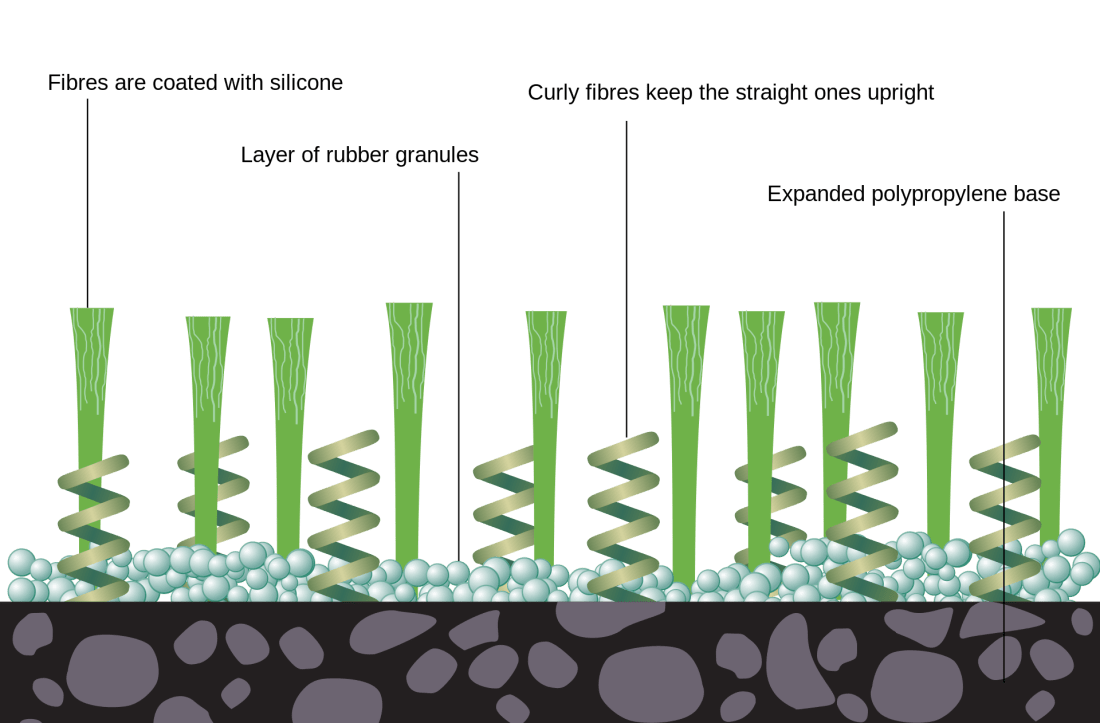
 I was surprised to see that even an artificial lawn can host weeds but the weeds I removed were ephemeral weeds like groundsel (Senecio vulgaris) and hairy bittercress (Cardamina hirsuta). No ‘lawn spoiler’* to worry about here like greater plantain (Plantago major) . And I suppose that is the merit of an artificial lawn: even if some enterprising little weeds manage to embed themselves into the surface of the material, the long-rooted perennial weeds cannot penetrate the thick polypropylene base.