

RHS Wisley: where science meets horticulture
I had the privilege last Thursday to tour RHS Wisley with other members of the Garden Media Guild and meet members of the Wisley team to learn more about the garden and the fascinating work of the Royal Horticultural Society. It’s a garden I’ve visited many times but never felt I knew well enough so this was my opportunity to discover more. And thanks to the generous time given by the team I left feeling not only better informed but hugely impressed by the horticultural and scientific work carried out at Wisley.
Sandwiched between the River Wey and the A3 London to Portsmouth road, Wisley has seen some challenges in the last few years due to major roadworks on its doorstep, when the M25/A3 junction was improved. The massive delays in all directions had a very negative effect on visitor numbers but that is now history and access to the garden by car is far easier.
We began in front of the spectacular display of tulips on either side of the Jellicoe Canal which is overlooked by the Arts & Crafts style Old Laboratory. RHS Chief Horticultural Advisor, Guy Barter, who leads the organisation’s RHS Members’ Advisory service, gave us a brief introduction. The half-timbered laboratory building dates from 1915 and also housed the lecture theatre for students studying horticulture at Wisley. Before the canal was created in 1969-70, this part of the site housed propagation and potting sheds, now relocated to a state of the art facility in nearby Wisley Village. RHS Wisley is supported by a cohort of 700 volunteers, spread between the garden, front of house and education.


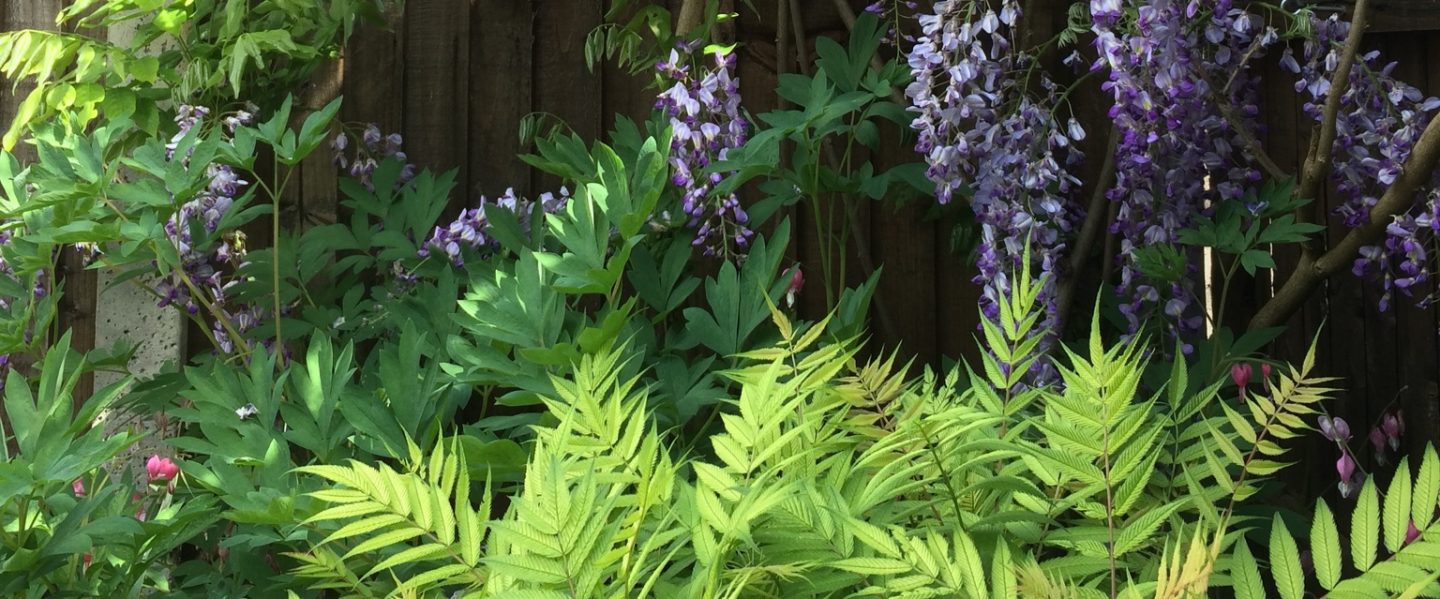
Mark Tuson, one of Wisley’s four Garden Managers, led the first tour of the day. He highlighted the mass tulip plantings which are attracting the crowds leading to the busiest Easter since 2023. He guided us past the Walled Garden to Oakwood, a low-lying area which a former owner of the garden, George Ferguson Wilson, treated as an experimental garden in which to grow plants that could cope with the standing water and frosty conditions. From 1878 he had channels built to drain the acidic greensand soil. Several of the Rhododendrons in Oakwood date were planted by Wilson between the mature oaks which still stand. Wisteria grows many metres high into the canopy of some of the oaks: emulating wild Wisteria plants in China and Japan. Influenced by the wilder, more natural style pioneered by garden makers and plants people William Robinson and Ellen Willmott, Wilson introduced many woodland edge plants into Oakwood.
Oakwood was filled with birdsong while we were there and Mark reported that the RHS is undertaking a biodiversity audit at Wisley to measure how many species the garden supports. His team is engaged in creating as much wildlife habitat as possible, including ‘stick stacks’ where spent stems and branches are piled into wigwams. He recently examined a hollow stem to find it housed the larvae of a solitary wasp. Low-lying Oakwood sits in a frost pocket criss-crossed with drainage channels and Mark has found that the later flowering yellow flowered Magnolias do well in this challenging site, with Battleston Hill on the other side of the garden hosting the early flowering species such as Magnolia campbelii. Another project in this area designed to make the site resilient to climate change is the creation of ephemeral ponds known as ‘swales’ to capture rainwater. After several dry April weeks, most were empty last week.
Mark moved us through to the Oudolf Landscape, where Dutch plantsman Piet Oudolf redesigned the beds and planting in the ‘Glasshouse Borders’ a couple of years ago. in 2024 Mark and his team planted 30,000 perennials all in 9cm pots! These plants were contract grown by nurseries in Holland before being subjected to up to three months’ quarantine where they were monitored for pests and diseases. In 2025 a bulb layer of 6,000 bulbs was added. The cutback of the ‘5th season’ growth has just finished, a reference to the stems and seedheads left standing throughout the winter to support wildlife and provide a dramatic structure when little else as apparent in these herbaceous perennial borders. During the cutting back process they have to take care not to tread on the emerging growth of bulbs like Muscari. They use the ‘chop and drop’ technique of leaving the cut stems in situ, sometimes moving them around the beds a little for even distribution. This feeds the soil, suppresses weed growth and saves having to mulch. One unforeseen maintenance task which the team deals with is a phenomenon he calls ‘gravel will travel’: where gravel from the paths which wind through the beds on the sloping site of the Landscape migrates into the beds below.

50% of the plants at Wisley are propagated in-house. There are a staggering 25,000 species of plant throughout Wisley garden. Mark listed some of the challenges faced by his team including having to redevelop the Heather Landscape after the surface rooting plants suffered in recent hot summers. There is a proposal under consideration to relocate the collection to RHS Harlow Carr in Yorkshire.

Mark led us through to the Alpine Display Houses where we admired the array of colourful specimens thriving there before being led to the Trials Garden to meet Rosalyn Marshall, the Trials Project Manager. The Trials Garden is located on the site of Wisley’s old plant centre with soil introduced from the development of the build of Hilltop, the RHS Science Centre (of which more later). Here she and her team look after the beds in which several selections of the same plant or related groups of plants are grown side by side for comparison. Depending on the plant, trials last for one or between three to five years. The purpose of the trials is to identify the attributes which will help home gardeners choose the best examples of the plants under consideration. The trials are assessed by a judging panel made up of experts in that group of plants, during four sessions a year, before their findings are ratified by the relevant RHS Expert Group. The best performers might receive the accolade of ‘RHS Recommended: Award of Garden Merit’. Trialled plants face similar challenges to those in home gardens, including of course pests and diseases. The beds are mulched to suppress weeds and fed, with a shift towards organic feed. Watering depends on the plants being trialled but a couple of species in current trials, Baptisia and Helianthemum, were watered only once last year, so as to test for resilience.


Other plants undergoing trials at Wisley this year include Centaurea, Geranium, Nandina domestica, Philadelphus, Rosa persica and herbaceous Veronica. The Trials team work with the seven Expert Groups who advise on sourcing the plants as well as plant naming if this is unclear. The team consists of ten personnel: five in the office and five cultivating the beds. We learnt that the RHS began trials at their Chiswick site in the C19 with the first Award of Garden Merit given in 1922 for Crocus tommasianus. What appear to be empty beds are sown each year with a wildflower mix and one bed is devoted to examples of sweetpeas which have already achieved AGM status. Vegetables and fruit are trialled in a site near the Edible Landscape.
Rosalyn encouraged us to examine the plants in the one year trial of three groups of tulips: Viridiflora, late single and Darwin Hybrid. To avoid the danger of tulip fire, bulbs for tulip trials are planted in different beds each year. A future trial of perennial tulips is being considered. The tulips in the current trial were truly spectacular: serried ranks of intense colour. I was especially struck by the enormous flowers of Tulipa ‘Flaming Memory’.
During a break for lunch I walked to the northern end of the garden to see the Stone Pine building from the garden side. On the ground floor is a cafe which opens at the weekend and in the summer and the first floor houses the offices of the charity Plant Heritage. I had spent the day before at Plant Heritage with other volunteers where we labelled packets of seed for the forthcoming RHS shows. More about this and the Plant Heritage show garden at RHS Chelsea Flower Show in a separate blog. Stone Pine overlooks the recently established Resilience Garden. Pausing in the nearby Bird Hide to see a mute swan nesting, I walked back to the busier section of the garden alongside the River Wey. Apparently kingfishers can sometimes be spotted in this tranquil spot. Not on this occasion, but a confident fox trotted happily ahead of me for a couple of minutes.


Team leader in the 19 acre Edible Landscape, Sarah, met us for the next stage of our tour in the World Food Garden. Its one acre consists of three areas: the world food maze, ‘good to grow’ and herbs and flowers where all is edible. Nothing is sprayed and no chemicals are used. They operate a no dig approach and generate ten crops a year per bed. Growing is all year round. They are planting more and more perennials, to promote plant health and protect the soil. Most of the crops grown have received the Award of Garden Merit. The harvested crops (twice a week at present) are sold via the ‘donations’ stand to one side of the World Food Garden or donated to local community charity FairShare. Asparagus season has started and the recently appointed catering company, Restaurant Associates, is holding monthly lunches to highlight the produce from the garden. ‘Tickle your tastebuds’ tours will take place later in the year.


We were intrigued by the small upturned terracotta pots suspended in the espaliered apple displays around the World Food Garden. These have been filled with chickenwire and straw as refuges for earwigs which eat the aphids which can infest the plants. Throughout the Edible Landscape, dead hedges and log piles have been installed to provide habitat for wildlife. To withstand the challenge of the windy conditions at this hill top location they are installing a windbreak in the form of a 80m long ‘mega hedge’ in the orchard consisting of 30 different native species. Every Tuesday morning Sarah and her team of eight full time gardeners and 20 volunteers carry out a physical pest control exercise, which this week involved squishing any winter moth caterpillars found on the trained fruit. They place cardboard around the base of orchard trees to prevent caterpillars crawling up the trunks and have installed bird boxes to attract blue and great tits. Walking through the soft fruit garden, Sarah pointed out the interplanting of rhubarb and herbs and a couple of beds planted with ‘green manure’,Phacelia and green clover, which will be mown next week and forked into the bed to enrich the soil.

At RHS Hilltop, Professor Alistair Griffiths, Director of Science and Collections, kindly spent the next hour and a half enthusiastically taking us through the scientific work of the RHS in helping gardeners to garden. He has been at Wisley for 13 years after 14 years at the Eden Project. We began our tour with him in the Wellbeing Garden designed by Ann Marie Powell where he introduced us to the RHS Wellbeing Garden Blueprint which has drawn together research to demonstrate that gardens and gardening benefit our physical, mental and social health. In this vein, the RHS is advising on the development of a wellbeing garden at Lewisham Hospital.

Alistair pointed out two coniferous plants in the Wellbeing Garden, dwarf pine (Pinus mugo) and Hinoki cypress (Chamaecyparis obtusa) whose natural oils contain ‘phyto chemicals’: naturally occurring plant compounds which studies have found can enhance the immune system by boosting Natural Killer (NK) cells and thus recognise and eliminate cancer cells. He stressed the importance of gardens engendering a sense of awe through their colour and scent and cited research linking the colour yellow to joy and happiness. He noted that Ann Marie Powell’s designs for the garden ‘burst with saturation’. In his own garden he has two contrasting borders. One featuring brighter colours for uplift and another with muted shades for contemplation.

The atrium area in the Hilltop building exhibits examples of the research being conducted by the RHS’s 130 scientists including a hands on experiment collecting data about visitors’ emotional responses to different flower shapes, colour and scent. We were privileged to be shown into the RHS Herbarium which houses almost 100,000 specimens of cultivated ornamental plants in a surprisingly compact racking system. The plants stored here assist the scientists in the RHS Plants for Purpose projects. On display were a specimen of Madagascan periwinkle, now routinely used in chemotherapy treatment. And a western cedar, Thuja Occidentalis L.Dicksonii, whose scales have been found to capture pollution. Alistair was pleased to see a few of us ‘geeking out’ by poring over the specimen sheets. The team is working with Nottingham University to develop an AI tool which will comb through the characteristics of the plants stored in the Herbarium to identify those with scaly or hairy attributes which might make them resilient to the impact of climate change. Another area of study is water: which plants can best tolerate drought and flood?


Next port of call was the environmental horticulture laboratory which is researching the anticipated changes in our environment by 2050 caused by climate change. Alistair quoted the words of Scottish conservationist and town planner Sir Patrick Geddes, ‘by leaves we live’, when reporting upon the work of his team. Work is being carried out in conjunction with eight nurseries looking at potential changes in watering regimes with the use of peat free growing media. Another area of research is paludiculture, which I leant is the cultivation in peatlands of crops adapted to wet conditions such as Sphagnum moss as a sustainable alternative to draining land for conventional farming. This has lead to the production of a growing medium widely used by growers of carnivorous plants. It was fascinating to see a container of granulated cork from Portugal which is beginning to be used instead of perlite to improve the structure of growing media and as a substitute for vermiculite in topping trays of seedlings etc. Other work involves the addition to compost of cellulose made from nettles or hemp or grasses like Miscanthus. Work is also being done to measure carbon in cultivated landscapes, above and below ground, and it is anticipated that lawns may come out well in this study.


In the so-called ‘dirty lab’ where the team studies the 25,000 invertebrate species associated with garden health, Alistair advised us about the ‘Bringing Nature Home’ biodiversity themed display at Chelsea and other RHS shows this year, to celebrate how the diversity of plants and features in gardens support an important abundance of other life. He repeated the statistic quoted by Sir David Attenborough in the current BBC series Secret Garden that our gardens are a national nature reserve 3.1x larger than the size of UK National Nature Reserves. He praised the programmes but feels there is rather too much emphasis on ‘mega fauna’ at the expense of the wealth of invertebrate species which our gardens support. We were urged to help the RHS measure plant diversity in our gardens by recording the plants we grow in the RHS Grow App.
I came away from Wisley on Thursday afternoon with a far deeper understanding of the pioneering work carried out by the RHS both in the garden itself and behind the scenes in the science labs and offices. All of which will help us become better gardeners, equipped to tackle the challenges of a changing climate and as well as protecting and increasing the biodiversity in our gardens.
Kew 21 April 2026
Here are a few more images from Wisley last week.


