Mills, Moats & Monets

What links a grand house on the Strand, a textile town in Essex and a mansion in south east London? Answer: the Courtauld family. The weaving dynasty has left its mark on Somerset House, Halstead and Eltham Palace.

Halstead

In the 1820s Samuel Courtauld established Townsford Mill on the river Colne in Halstead, in north Essex, for the manufacture of silk crepe. Throughout the C19 and much of the C20, further textile factories were built in the town, but with manufacturing costs soaring, production moved abroad and those buildings have been re-purposed to accommodate, for example, the Co-op supermarket. When a friend and I visited Beth Chatto’s Garden and Hyde Hall last October, we stayed at a pub in Halstead. The names displayed on the front of the 1920s houses opposite the pub piqued our interest: Sense and Sensibility, Pride and Prejudice, Mansfield Park. Spotting a pattern, we soon found Northanger Abbey, Persuasion and Emma. Each house also bore the initials, SAC. A spot of googling revealed that these were built by Samuel Augustine Courtauld as homes for his workforce. Apparently, elsewhere in the town there are houses bearing the names of novels by Fanny Burney. I can find nothing to explain why the Arts and Crafts style houses were named after novels in this way. Unlike the Cadburys who built an entire community (Bournville) to accommodate their workers, the Courtaulds seem to have preferred building such homes throughout the town.

Townsford Mill with the River Colne in the foreground
‘Pride’
‘Prejudice’
‘Emma’

Eltham Palace

The Courtauld name reminded me of a of visit three years ago to Eltham Palace, the unique property now run by English Heritage. In 1933 Stephen Courtauld (1883 – 1967), younger brother of SAC, took out a 99 year lease of the site of the childhood home of Henry VIII. All that remained of the palace was the huge Great Hall built by Edward IV. Stephen and his wife Virginia built a luxurious home in the then fashionable Art Deco style, incorporating the hall into the design. The palace is surrounded by a moat which is an integral part of the garden. The moat is partly dry but this aerial view illustrates the extent of the water-filled section of the moat.

Much of this garden on two levels was laid out by Stephen and Virginia in the 1930s, and more recently English Heritage has developed it further. For example in 2000 they commissioned garden designer Isabelle van Groeningen to re-design the planting in the monumental herbaceous borders. When I was there in late August, these deep borders between brick buttresses were billowing with drifts of golden Achillea, bronze grasses, succulent Sedum (now Telephium) with their burgundy stems and leaves and pink flowers. Elsewhere a mass planting of creamy petalled roses made an impact. Irish yews fashioned into columns stood sentinel at each corner of a rectangular pond in the centre of the rose garden. A charming carving on the wall of the palace depicts Virginia ‘Ginny’ Courtauld in her wide-brimmed gardening hat, surrounded with a garland of flowers and leaves, a basket of fruit, the handle of a border fork and a long-spouted watering can completing the picture.

The Courtauld Gallery

When I began work in a small law practice in the City of London in 1980, there was a weekly run to the Stamp Office at Somerset House on the Strand, where, upon payment of the duty (with a banker’s draft: remember them?) the relevant deed was stamped using an archaic looking machine where the clerk operated a lever to press down on the document to emboss the stamp. I loved this weekly ritual which was a great opportunity to get out of the office for an hour or so and exchange the traffic on the Strand for the C18 elegance of Somerset House*. Now that stamp duty is paid electronically the practice of stamping a document with evidence of payment is no longer necessary. The Revenue (now HM Revenue & Customs) moved out of Somerset House in 2013. Gone are the black and gold stamp machines, to be replaced by a number of organisations associated with the arts including the Courtauld Gallery. This houses the world-famous art collection of Samuel Courtauld (1876 – 1947). The collection has recently been re-hung and I went to see it a week ago, my last visit having been about ten years ago. I concentrated on the top floor of the gallery where the Impressionist and Post-Impressionists are located.

La Montagne Sainte Victoire
Renoir: Spring, Chatou
Monet

Many of these paintings feel like old friends, the images are so familiar from reproductions. I’d forgotten how many of the paintings depict gardens and plants.

If the artworks are impressive, so is the room in which most of them are displayed. The Great Room as it is called hosted the annual Summer Exhibition of the Royal Academy from 1780 to 1837.

It’s quite an arc isn’t it, from a silk mill on a riverbank in Essex, via a medieval palace meets Art Deco mansion to a priceless art collection in one of the grandest buildings in London? I’ve enjoyed my visits to all three of these places associated with the formidable Courtaulds.

*There’s a connection here with Royal Botanic Gardens, Kew: the principal architect of Somerset House, from 1775, was Sir William Chambers, designer of the Pagoda in the southern section of the Gardens.

Sculptures and Serpents

In the garden at Chatsworth House: Part 2

Since visiting Chatsworth almost five weeks ago I have discovered the Channel 4 documentary Chatsworth House: A Great British Year. I’m glad not to have come across it before as it’s fun to see the house and garden again and learn how such a vast enterprise works. The kitchen garden featured in one of the shows and like everything at Chatsworth it is beautifully designed and cultivated. Even at the end of November when most of the crops had been harvested, there was plenty to see and interesting details to examine.

The kitchen garden occupies a sloping west-facing site of about three acres. A relatively new addition to the gardens, it was created in the early 1990s. As in the wider garden, water has been channelled from parkland behind the garden to feed rills and ponds. I was interested to see tulips being planted in handsome terracotta pots, tucked into a nook beside the cold frames. The lower boundary of the garden is formed by a tightly clipped beech hedge. Large golden stalks adorn a trio of metal frames fashioned into apples and a pear, each housing a yew shrub which in the years to come will fill out the frames to form topiary fruits at the entrance of the garden. Rhubarb forcers from Whichford Pottery in Warwickshire stand to attention like terracotta warriors. A couple of stone plaques caught my eye: a quirky mission statement for creativity from dress designer Paul Smith and a heart-shaped memorial to the late Duchess Deborah. Straight rows of chard and brassicas appear to radiate from the corner of the large plots in which they are planted.

Unmistakeable for their charred finish, David Nash’s sculptures look entirely at home in the Arboretum which occupies the upper slopes of the gardens. The gardens are separated from the surrounding parkland by a ha-ha, the eighteenth century innovation which enables a garden to blend seamlessly with the landscape beyond. Here the ha-ha is a stone retaining wall. I noticed that a meshwork fence has also been fitted near the top of the wall, presumably to deter deer from entering the garden and munching the rare specimen trees. On the subject of dry stone walling, an installation called ‘Emergence’ demonstrates the evolution of this ancient craft, fundamental to the rural landscape of not only Derbyshire but so many other areas of the country. It contains one giant rock, a reference to the practice of using naturally occurring boulders in field walls. The transition from the older random style of limestone dry stone walling to the more modern sandstone wall of shaped stones is marked by a giant pane of glass. The interpretation panel informed me that the glass also represents Joseph Paxton’s pioneering work on the Great Stove at Chatsworth which led to him designing the Crystal Palace for the Great Exhibition in 1851. Giant redwoods tower above the other conifers in the Pinetum, an echo for me of the area of Kew Gardens devoted to these majestic trees.

More nineteenth century technology features in much of the seating around the gardens at Chatsworth. Cast iron benches with a plant inspired designs are placed around the remains of the Great Stove and in the terrace beside the 3rd Duke’s greenhouse. I found nasturtiums, passionflowers and lilies of the valley, as well as a design showing gardeners sowing, raking, harvesting and scything.

The Serpentine Hedge separates the Maze from the woodland area beside the Canal Pond. A double row of symmetrically planted beech which curves in and out, this dates from 1953 and was inspired by the ‘crinkle-crankle’ walls found in many old gardens, the alternating concave and convex planes providing stability. Seeing the north face of the house reflected in the Canal Pond, the Emperor Fountain rising skywards in the centre, has to be one of my highlights of 2021. This end of the garden also contains more remarkable sculpture: a horse’s head by Nic Fiddian-Green

and Allen Jones’s Dejeuner sur L’Herbe, a 3D take on Edouard Manet’s famous painting. If asked to name a favourite work from the garden, I would choose Cornwall Slate Line by land artist Richard Long, which runs parallel with the Canal Pond. Not far away Dame Elisabeth Frink’s Walking Madonna strides through a grove of trees.

The family’s dogs appear in several sculptures nearer the house, faithful hounds keeping watch or assembling on the steps leading to the north front with its Ionic capitalised pilasters and windows framed in gold leaf. A frieze above the windows features coiled serpents, part of the Cavendish family crest. This motif is picked out in a pebble mosaic on the terrace near the 3rd Duke’s greenhouse, reminding me of the two dachshunds, Canna and Dahlia, immortalised in similar fashion in the Walled Garden at Great Dixter.

Classical statuary also abounds in the gardens, reminding me that this place has been a treasure house of art for many centuries. More mundane perhaps, but elegant in its own way, is the weather station on the Salisbury Lawns near the Broad Walk where temperature, rainfall and hours of sunshine are recorded and reported to the Met Office.

I shall leave you here with a final image from my memorable visit to Chatsworth, Flora’s Temple decorated for Christmas.

Well, not quite the last image. The finger post pointing the way to Chatsworth marked my exit in the early evening dark from the park into the village of Baslow where I was staying. It’s also inviting me back one spring or summer to explore further and to see Dan Pearson’s Trout Stream planting and Tom Stuart-Smith’s Arcadia in their full glory.

Kew, 29 December 2021

From Chiswick to Chatsworth

In the garden at Chatsworth House: Part 1

A garden in winter reveals its skeleton, shed of most of its green surface layer, enabling you to see the physical structure of the space. Happily heavy overnight rain washed away the blanket of snow which I’d encountered when visiting Chatsworth House the day before. The 100 acre site seems bigger, perhaps because of the terrain: wooded slopes rising from more formal areas either side of the Broad Walk, running parallel with the eastern elevation of the house. According to the health App. on my phone on the evening of my visit, I had climbed the equivalent of 35 storeys!

As you enter the garden, you see a series of garden buildings. I hesitate to call them glasshouses, because the grandest of them is more in the style of an orangery, and is called the 3rd Duke’s Greenhouse. Consisting of two growing spaces, separated by a columned loggia, it houses a collection of camellias, considered too tender for growing in the Derbyshire climate. It immediately reminded me of the Conservatory at Chiswick House (currently closed for renovation) but home to camellias first planted in the nineteenth century. It is perhaps no coincidence that comparisons can be drawn between Chatsworth and Chiswick.

First a little history: when the 4th Duke of Devonshire (1720 – 1764) married Lady Charlotte Boyle, the Cavendish family estates increased considerably for she was the only surviving child of Richard Boyle, 3rd Earl of Burlington. As well as an Irish castle (Lismore), two estates in Yorkshire and a house in London (Burlington House, now the home of the Royal Academy), the Earl’s legacy included Chiswick House, a couple of miles from where I sit typing this blog post. William Kent (1685-1748) (who with the Earl of Burlington transformed the gardens at Chiswick House and indeed the house itself) produced designs for remodelling the cascade at Chatsworth and is thought to have influenced the naturalisation of the garden.

As well as camellias, this greenhouse shelters tender climbers such as Lapageria rosea with its elongated bell-shaped flowers. In my last post I mentioned the influence of the late Deborah, Duchess of Devonshire (1920-2014), on the property. Amongst the many famous faces of the twentieth century she knew, was the 35th president of the USA, John Fitzgerald Kennedy. Indeed they were related by marriage as Jack Kennedy’s sister Kathleen (known as ‘Kick’) married her husband, Andrew Cavendish’s elder brother Billy Hartington in 1944. Billy was killed in Belgium later that year during the Allied advance after D-Day making Andrew heir to the Dukedom. Tragically Kick died in 1948 when the plane in which she was flying to the south of France from Paris crashed. Intrigued by two curvaceous silver chairs in the loggia between the two sections of the greenhouse, on closer inspection I found they were constructed from hundreds of half dollar pieces, all bearing the profile of JFK.

There are three other ‘glasshouses’ near the garden entrance, none of which was open on the day of my visit:

The Vinery and the Case were both designed by Joseph Paxton (1803-1865) who became head gardener at Chatsworth in 1826. As well as the surviving buildings, in 1836 he also built what was at the time the largest glass structure in the world, the Great Stove. His innovations at Chatsworth informed what was to become his masterpiece, the Crystal Palace, centrepiece of the Great Exhibition in Hyde Park of 1851. Sadly, Chatsworth’s Great Stove was demolished in the 1920s, but its stone perimeter wall remains, forming the boundary of a yew maze created in 1962. In the tradition of employing the most influential garden designers of the day, the planting in the borders of the Maze has been updated by Tom Stuart-Smith, the variety of grasses being particularly noteworthy on the day of my visit.

The perimeter wall of Paxton’s Conservatory (The Great Stove)

I chatted to a group of gardeners planting bulbs on the slope to the east of the Maze and learned they were planting Narcissus Mount Hood.

A climb of a hundred steps leads to the Arboretum, from which there is a spectacular view back to the Maze and the parkland beyond. The colours and textures of the planting either side of the steps are beautiful.

Garden designers at the top of their game, one from the 19th century and another from the 21st century, have created one of the central features of the gardens at Chatsworth. Joseph Paxton built the three acre Rock Garden starting in 1842, using stone from elsewhere on the Chatsworth estate. The rock formations are monumental and can seem overpowering, particularly in dull weather. Since 2018 Tom Stuart-Smith has been introducing naturalistic and ecologically inspired planting so as to

redefine the Rock Garden as a fantasy domain, full of variety, spontaneous naturalness and picturesque diversion; quite separate from the rest of the garden where openness, smoothness, and settled grandeur prevail.

Tom Stuart-Smith. Press release 9 December 2020.
Lunaria rediviva

Throughout the garden, as in the house, contemporary art is given equal weight with historic sculpture. In the Rock Garden, Emily Young’s Lion Woman blends perfectly with the surrounding rocks.

Tom Stuart-Smith is also transforming a a 15 acre site at the heart of the garden, Arcadia, by planting large trees and shrubs and extensive herbaceous perennials in a series of glades linked by woodland walks. Another eminent garden designer who is putting his stamp on Chatsworth is Dan Pearson who began to redevelop the Trout Stream in 2015. This narrow watercourse meanders close to the western boundary of the garden. The original concept for the new planting in this area was demonstrated in a garden created by the designer for the Chelsea Flower Show in 2015 which won Best in Show. A track runs alongside the stream, just wide enough for a couple of people, enabling you to see the plants at close quarters.

A few metres from the stream you can walk across to the pond which feeds the Cascade, and ultimately the Sea Horse Fountain in the south lawn beside the house. The original Cascade was completed in 1696 to a design by Louis IV’s hydraulics engineer, Grillet. Only a few years later, a steeper flight of steps was installed culminating in the Cascade House, from which the water dramatically gushes forth.

The Cascade

One of Barry Flanagan’s hare sculptures, Drummer, stands beside another body of water in the outer reaches of the garden, the Grotto Pond. The Grotto itself is a rustic timber building with a slate roof atop a mass of boulders.

One of my favourite spots in the garden for contemporary sculpture is the Angela Conner Grove, where various members of royalty as well as the artistic and literary worlds are portrayed. Chatsworth’s equivalent of the busts in William Kent’s Temple of British Worthies at Stowe in Buckinghamshire?

I can see that Chatsworth is a place that I could visit many times over and still find new aspects to enjoy. Next time: more Chatsworth sculptures feature and a very impressive Kitchen Garden.

Kew

4 December 2021

The Only Way is Essex: part 1

Beth Chatto Gardens

Writing about my gardening heroes and their gardens is like standing on the shoulders of giants. In this post I shall try to do justice to Beth Chatto (1923-2018) whose unique garden in Essex I visited a week ago today. In the same way that Christopher Lloyd stamped his personality and vision for his garden on Great Dixter (see my last blog post) the garden in Elmstead Market is redolent of its charismatic creator. You find yourself referring to ‘she’ and ‘her’ as you walk around the place, noticing details that she introduced, such as the three grass-covered bridges crossing the Water Garden and the pot garden in the courtyard close to the house, the displays changed according to the seasons. It was easy to imagine her walking around her domain chatting to visitors and inspecting the precious plants in the Stock Beds from which she and her team propagated the plants sold in The Nursery.

Reading Beth Chatto’s Garden Notebook and Dear Friend and Gardener, the latter a collection of letters between Beth and Christopher Lloyd, I’d already formed an impression of the garden itself and the daily influence Beth Chatto exerted on the Gardens that she and her husband Andrew began to create from an unprepossessing wasteland in 1960, the site ranging from ‘parched gravel’ to ‘boggy ditches’, according to the blurb on the visitor map. So when a conversation with a friend earlier in the summer revealed that we both wanted to see both Beth Chatto’s garden and RHS Hyde Hall near Chelmsford, a plan was hatched for a weekend trip to the county of my birth!

At this stage I shall digress to sing the praises of a much maligned county. Essex is far more scenic and interesting and indeed record-breaking than its detractors would have you believe. It boasts what has been described as the prettiest village in England (Finchingfield, also the home of Dodie Smith, of One Hundred & One Dalmations fame), the longest bar in England (in a pub in Southend, one of its several seaside resorts) and arguably the largest village green in the country in Great Bentley, a mile or so from Elmstead Market. And not forgetting two world class gardens: Beth Chatto’s and Hyde Hall. Once you travel beyond the commuter belt to the east of London, the countryside is dotted with picturesque villages and small towns, many with ancient churches and market halls built with the wealth generated by the wool trade in mediaeval times.

Essex also boasts a relatively low average rainfall in comparison to other parts of the country and this was a major preoccupation of Beth Chatto in her vision for her garden. Whilst the lower-lying, boggier parts of the site were excavated to create a water garden consisting of three elongated pools fed from the reservoir on neighbouring land, the dry upper section of the land, on which a car park was originally built, was transformed in 1991 into the Gravel Garden. As I write this in the week of COP 26, this garden is a pioneering example of one watered only by rainfall. In her book The Dry Garden, Beth reiterates her planting philosophy of ‘right plant, right place’, demonstrating that plants will grow in difficult places if you choose the species that will thrive in that location. In the third week of October, the Gravel Garden was as attractive as it would have been in high summer. The palette is beige and grey with occasional pops of purple. Felty silver-leafed plants from the Mediterranean form low mounds punctuated by dozens of swaying grasses, substantial lumps of Verbena bonariensis and related species tinting the aspect with deep mauve.

All plants are clearly labelled and I repeatedly noticed plants that have not crossed my radar before, such as the deeply veined, penny sized leaves of Marrubium ‘All Hallows Green’. This wasn’t the only hint of the Halloween season. Elsewhere in the garden the propagation manager has placed colourful displays of pumpkins and other decorative gourds, some carved, others displayed for their colour and shape. Rather than hollowing out the gourds, the designs have been executed on the surface of the skin, enabling the artist to create faces ranging from the comic to the macabre.

In the Water Garden the deciduous conifers, the swamp cypresses (Taxodium distichum) were just beginning to change colour, their emerging russet foliage echoing the woodwork of the little rowing boat moored alongside the Gunnera. Elsewhere the still pools reflect the lush planting on the banks. And again, more unusual plants such as the pretty mauve pom-pom flowered Succisella inflexa.

Beyond the Water Garden stands the most recently created part of the garden, The Reservoir Garden, opened the year before Beth died. This series of island beds was a mass of spectacular grasses, asters (now Symphyotrichum) and tempting but poisonous blue-flowered Aconitum. To the rear of the border alongside the neighbouring reservoir, stand multi-stemmed shrubs and small trees, including Sorbus glabriuscula with its small white berries flushed with pink.

The Reservoir Garden
Sorbus glabriuscula

Soft autumn colours are beginning to emerge on the trees of the Woodland Garden, the understorey comprising intriguing ground cover plants. I imagine this element of this area of the garden is at its height in spring, and for now it’s the trees which are the stars of this show, both their bark and foliage.

Between the Woodland Garden and the Nursery is yet another mainly herbaceous border where I spotted the leaves of Bergenia, more asters, a clump of pampas grass and both pink and deep red Persicaria flowers. When so many other plants have finished flowering by late October, the elongated, slightly twisted spires provide colour and low to medium vertical form. Plunging back into the Reservoir Garden we encountered a couple of beds of different grasses, in one the rice grain-sized flowers attached to strands of Panicum Frosted Explosion resembled raindrops.

It took considerable restraint not to linger for the rest of the afternoon in the ‘plantarea’ section of the Nursery, where many of the rare plants we had admired are for sale at what looked like very reasonable prices. I noticed that the sales areas are divided between damp and dry garden plants, which highlights the right plant, right place philosophy evident throughout the garden. There’s even a zone devoted to Scree plants.

We left Beth Chatto’s garden to drive east a few miles to the coast to visit Frinton. Although I’m too young to remember holidays there, this was where we holidayed when my sister and I were very young. Why leave the county when there’s a resort with a safe sandy beach a relatively short drive away? It was fun to walk along the beach and photograph the beach huts, trying to imagine which of them we played in front of all those years ago. I wonder what changes my parents would have noticed? The turbines of the Gunfleet Sands Offshore Wind Farm would not have dominated the seascape to the south as they do now, strangely beautiful in the setting sun and supplying coal-free power to hundreds of homes.

My focus turned once more to Beth Chatto when I went to the Garden Museum in Lambeth last Wednesday afternoon. In a long display cabinet devoted to Beth I picked up a little more background to the creation of her garden.

Beth Chatto celebrated at The Garden Museum

From 1976 Beth was awarded ten consecutive gold medals at the Chelsea Flower Show. In her Garden Notebook she chronicles the painstaking and sometimes fraught preparations for a Chelsea show. As a result of her increasingly high public profile at this time she was offered a role as George Harrison’s head gardener which she declined. As well as examples of many of the gardening books written by Beth Chatto, the display case includes a pile of the nursery’s catalogues, with their distinctive cover design graphics, the stylised nine leaf stem.

Next time I visit RHS Hyde Hall and rediscover the lost art of pargetting.

1 November 2021

Perch Hill and Batemans

Sarah Raven’s cutting garden in East Sussex is near the village of Burwash on the outskirts of which stands the old stone manor house once owned by Rudyard Kipling. I visited both last Friday.

Perch Hill

The open day at Perch Hill started with lunch served on Emma Bridgewater crockery in an open sided marquee decorated with bunting. Nasturtium flowers and Dahlia petals decorated the salad.

The varied palette of colours compensated for the overcast conditions.

The Dahlia garden is a treasure trove of shades and flower types.

Unusual roses in the rose and herb garden include the two tone ‘For Your Eyes Only’.

Pot gardens and individual containers abound.

These Dahlia ‘Bishop’s Children’ were grown from seed 4 years ago

Perch Hill isn’t just about Dahlias: the roses are fragrant as well as beautiful.

Container lined arches add height and echo the wavy hedging to the rear.

Narrow stepped paths connect the terraces in this hillside garden.

Everything in the garden is clearly labelled.

The beautiful High Weald lies beyond the garden: note more wavy hedging.

Grasses and single-flowered dahlias in the perennial cutting garden.

Rare breeds in the chicken run.

The profusion of flowers in the garden is powered from the compost ‘palace’.

A rich burgundy Salvia in a metal container, and Sarah herself re-filling the seed display in the shop.

Batemans

The first thing I spotted when we arrived at Batemans was a sign quoting the following lines from Kipling’s 1911 poem, ‘The Glory of the Garden’.

Our England is a garden, and such gardens are not made

By singing:-‘Oh, how beautiful’ and sitting in the shade.

Putting to one side the patriarchal tone of the poem, when read in its entirety*, it does evoke the atmosphere of an Edwardian country house garden tended by dozens of gardeners. How sad to think that so many of them left estates such as Batemans within three years of the poem being published to fight in the trenches, never to return.

How much hands-on gardening was undertaken by Kipling I do not know, but he designed much of the garden layout himself. The formal water garden consists of a round pond surrounded by roses from which a cherub fountain feeds a short rill leading to the large waterlily pond.

The house dates from 1634, the entrance framed by a profusion of shrubs and perennials.

A majestic dovecote highlights this peaceful scene.

Exuberant planting in the walled garden includes fountain grass combined with statice.

 *The Glory of the Garden

OUR England is a garden that is full of stately views,
Of borders, beds and shrubberies and lawns and avenues,
With statues on the terraces and peacocks strutting by;
But the Glory of the Garden lies in more than meets the eye. 

For where the old thick laurels grow, along the thin red wall,
You’ll find the tool- and potting-sheds which are the heart of all
The cold-frames and the hot-houses, the dung-pits and the tanks,
The rollers, carts, and drain-pipes, with the barrows and the planks.

And there you’ll see the gardeners, the men and ‘prentice boys
Told off to do as they are bid and do it without noise ;
For, except when seeds are planted and we shout to scare the birds,
The Glory of the Garden it abideth not in words.

And some can pot begonias and some can bud a rose,
And some are hardly fit to trust with anything that grows ;
But they can roll and trim the lawns and sift the sand and loam,
For the Glory of the Garden occupieth all who come.

Our England is a garden, and such gardens are not made
By singing:-” Oh, how beautiful,” and sitting in the shade
While better men than we go out and start their working lives
At grubbing weeds from gravel-paths with broken dinner-knives.

There’s not a pair of legs so thin, there’s not a head so thick,
There’s not a hand so weak and white, nor yet a heart so sick
But it can find some needful job that’s crying to be done,
For the Glory of the Garden glorifieth every one.

Then seek your job with thankfulness and work till further orders,
If it’s only netting strawberries or killing slugs on borders;
And when your back stops aching and your hands begin to harden,
You will find yourself a partner In the Glory of the Garden.

Oh, Adam was a gardener, and God who made him sees
That half a proper gardener’s work is done upon his knees,
So when your work is finished, you can wash your hands and pray 
For the Glory of the Garden that it may not pass away!
And the Glory of the Garden it shall never pass away ! 

Rudyard Kipling, 1911

Sissinghurst in September

What more can be said about Sissinghurst that hasn’t been said before? On this occasion I’ll let the photographs speak for themselves. I’m in East Sussex for three days of garden visits and Sissinghurst was the first port of call. The newly opened area Delos is as impressive as I expected from recent TV coverage and a great deal larger than I’d imagined. The Mediterranean planting amongst ancient architectural artefacts contrasts with the lush planting in the other garden rooms.

As in the rest of the garden, the Tower is visible from Delos.

Greek island meets the Kent countryside: oast houses roofs gleam in the late summer sun.

Another highlight: the tapestry of zinnias along the Moat Walk. Note the sheep wool mulch to deter slugs and snails.

The still air and warmth today encouraged a fine display of pollinators throughout the garden.

I’m envious of Vita’s Flower Room complete with Belfast sink….

…..and Harold Nicolson’s book room.

September must be the best month to see the sunset colours in The Cottage Garden.

The gardeners are busy keeping Sissinghurst immaculate.

No visit to Sissinghurst is complete without seeing The White Garden.

They made a garden: East Lambrook Gardens (and a vertiginous bluebell wood)

I’m gradually discovering what a beautiful and interesting county Somerset is. I visit regularly to see my niece and her family (with whom I’m in a bubble) and it’s been a joy exploring with them some nature reserves and gardens over the last couple of years. During my last visit a week ago we fitted in trips to a magnificent bluebell wood and a garden with a special place in twentieth century garden history.

The wood, to the east of Taunton, is managed by the RSPB. On the morning of our visit the sun had emerged after a heavy shower, the weather this month being more characteristic of April than May. The scarp walk we followed was aptly named, taking us up steep slopes, with steps built in in a couple of places. Bluebells flourished beneath the broadleaved woods, the blue haze interrupted here and there with other wildflowers.

East Lambrook Manor Gardens was created by Margery Fish and her husband Walter in the 1930s and is an exquisitely planted showcase for the English cottage garden style which she championed in her garden writing. Narrow stone-paved paths wind through the various rooms of the garden, allowing you to admire the treasures planted throughout. The immediate impression is of informality, until you reach the avenue of tightly clipped egg shaped evergreens. Thinking at first they were yew, closer inspection showed they were in fact conifers and I have since read on the website that they are Chamacyparis lawsonia fletcheri, raised from cuttings of the original ‘Pudding Trees’ planted by Margery Fish.

The pudding trees

Tempting as it is to keep looking downwards at the wealth of herbaceous perennials in the garden, there are several trees to admire which would look well in small and medium sized gardens. For example, Cornus florida which I fell in love with in Kew Gardens many years ago, distinctive for its large white bracts in April and May. Another favourite. of which there is a sprawling specimen in Kew’s Mediterranean Garden, is the Judas tree (Cercis siliquastris). East Lambrook’s specimens are far daintier.

Many of the interesting plants in this plant lover’s garden are sold in the plant centre. Just beyond the stands of plants for sale is a raised bed built from what looks like the hamstone which features in much of the architecture of south Somerset. This showcases specimens of a couple of dozen geraniums, all clearly labelled, a perfect way to compare colours and leaf shapes, scale and habit. This display is just one example of the way in which this garden inspires the keen gardener: so too do the absence of lawns, the myriad of herbaceous perennials, the planting combinations.

On this occasion I shall let the photographs demonstrate the beauty of this peaceful garden. What they cannot convey is the soundtrack of birdsong and the clip clop of horses’ hooves along the village street just beyond the walls of the garden. As soon as I got home I ordered Margery Fish’s We Made a Garden to learn more about the genesis of a very special place.

Tulips in Fairyland: Part 2

I left you at the end of my last post on the threshold between the Collector Earl’s Garden and the rest of the extensive grounds of Arundel Castle. This part of the estate is called the Landscape and nestles at the foot of the castle fortifications. According to the Gardeners’ Chronicle article of July 1875 I mentioned last week, this part of the grounds

was used as a kitchen garden, but Mr Wilson, the present gardener, did away with it as such and and laid it down in grass, planting on it a considerable number of coniferous trees

Cork oak in The Landscape

The ‘present gardener’ Martin Duncan has planted hedges and areas of perennial wildflowers. Swathes of spring bulbs sweep through the wooded areas, in which I spied an impressively gnarled cork oak (Quercus suber). Turning our backs on the castle walls, we entered The Fitzalan Chapel’s White Garden, bounded on one side by a flint wall and on the other by the perpendicular style windows of a former priory now a nursing home. The focal point of the garden is the huge stained glass window of the chancel of the parish church of St Nicholas. Thought to be unique, the building combines the Church of England tradition in the main part of the church and the Catholic in the chancel, the resting place* of the Earls of Arundel and Dukes of Norfolk.

Wall shrub Exochorda x macrantha ‘The Bride’ clothes the walls of this peaceful space, and the densely planted border is crammed with White Lizard and White Triumphator tulips and the oddly named Summer Snowflake, (Leucojum aestivum) whose white bells resemble elongated snowdrops. In the lawn opposite the border stands a plain rectangular tank pool, its corners marked by Chusan palms. The haunting silhouette of a soldier stands guard, one of thousands erected across the country in 2018 in the ‘There But Not There’ campaign to commemorate the first centenary of the First World War.

Our route to the Rose Garden led us past the longest stretch of cloud-pruned hedge I’ve seen, trimmed we were told with hand shears, its bumpy bulk lightened by airy pink blossom.

Cloud-pruned box hedge

Planted on the site of what was the Jacobean bowling green, the Rose Garden entrance is formed by a perpendicular arch clothed in the climbing rose Adelaide d’Orleans. In keeping with the eye for detail evident everywhere in these gardens, a similar arch stands opposite it, sheltering a black seat backed with triple gothic arches, echoing parts of the castle architecture. Crisply clipped box edging surrounds the beds, each centred with a tall obelisk entwined with climbing rose The Generous Gardener. Now that I’ve studied my photographs more closely the gold hoops topping the obelisks remind me of quidditch goals, not surprisingly perhaps, given that in part 1 of this blog, I wrote that these gardens have a magical atmosphere! Indeed, in her account of our visit, one of my fellow Garden Media Guild members, Laura, one third of the brilliant 3 Growbags, likens the gardens at Arundel to a fantasy film-set.

The rose beds have been filled with a very generous manure mulch, through which grow Delft blue hyacinths and yet to open Angelique tulips. In another of his video tours, Martin Duncan guides us through the Rose Garden at its summer height and shares his prescription for healthy, blackspot-free roses: 2 tablespoons of Epsom Salts (high in magnesium) dissolved into 8 litres of water administered monthly in April, May and June.

Next stop on the tour was the newest part of the gardens to open to the public (July 2020), the Stew Ponds. In contrast with the formality of the White and Rose Gardens and the manicured grandeur of the Landscape, these water gardens are a haven for wildlife and wild flowers. But nature has had a helping hand here: last autumn the garden team planted 1,500 water plants, wildflowers and bulbs in this area. Two large ponds are divided with a wooden boardwalk, to one side of which nesting swans zealously guard their nest. In 2020, six cygnets hatched and recently moved out to give way to this year’s brood which it is hoped will emerge soon. The ponds are fed by a spring and at the far end of each stand wooden thatched buildings: a boat house and a round house, the latter used for education groups.

We returned to the Collector Earl’s Garden via the motte, the dry moat which surrounds the castle. Strategically located atop a hill, this castle had no need for a water filled moat for defence. The steep slope beside us would challenge even the most sure-footed gardener, let alone an armour-clad attacker. We were told that the bulb planting on the steepest slopes was undertaken using some form of abseiling technique!

I can thoroughly recommend a visit to the Arundel Castle gardens, open from Tuesday to Sunday, 10.00am to 5.00pm. Thank you to the Garden Media Guild for arranging a splendid visit there a fortnight ago: a very special way to celebrate the gradual easing of lockdown restrictions.

  • A day or so after my visit I heard Philip Larkin’s poem ‘An Arundel Tomb’ read on Radio 4, with its poignant final line: What will survive of us is love. Thinking that the mediaeval tomb which inspired the poet must be in the Fitzalan Chapel, I did an internet search and discovered in fact that the stone effigies of the third Earl of Arundel and his Countess (their hands entwined) lie in Chichester Cathedral a few miles to the west.

Tulips in Fairyland: Part 1

When she was a little girl, my niece, on the drive from Sussex to Hampshire to visit her Granny and Grandad, would look up to the Arundel skyline and call it fairyland. The spires of the cathedral and battlements of the castle still lend the view an other-worldly appearance. On Monday I visited the castle’s gardens and found that those apparently impenetrable walls do indeed shelter an enchanted space. With fellow members of the Garden Media Guild I was there to see the gardens in their spring livery and in particular the thousands of tulips which are planted every year.

Having been divided into small groups, our tour began in the courtyard of the Collector Earl’s Garden with head gardener Martin Duncan, whose enthusiasm and passion for his domain was infectious. The immediate impression is of a historic formal garden decorated with pavilions, pools and fountains. Closer inspection reveals that the pavilions and columns are built of oak rather than stone and Martin explained that this part of the garden was created only 14 years ago, by the design partnership of Isabel and Julian Bannerman. Dozens of pots of brightly coloured tulips stand at the foot of the classically styled ‘Hunting Temple’ which is decorated with deer antlers from the Duke of Norfolk’s estate. Noting from their website that the Bannermans had also designed parts of HRH’s garden at Highgrove, I saw that there too is a rustic temple constructed of green oak.

Thomas Howard the Collector Earl by Peter Paul Rubens

In November Martin and his team planted 180 different named tulip cultivars throughout the gardens: fringed, parrot, lily and peony flowered, Darwin hybrids and many more. Some of the larger pots contain 60-70 tulip bulbs which are treated as annuals and replaced each year.

This section of the garden is a tribute to Thomas Howard, 14th Earl of Arundel (1585-1646), known as the ‘Collector Earl’, who when travelling extensively on the continent on diplomatic missions, amassed a huge art collection. On one of his trips he was accompanied by the architect Inigo Jones of whom more later. Between the water garden, which represents the nearby River Arun, and a spectacular labyrinth of Narcissus ‘Thalia’, stands a double wooden pergola clothed in newly emerging hornbeam. Martin explained that in a week or so red Apeldoorn tulips will appear amidst the white Narcissus in the labyrinth.

The curving borders around the labyrinth comprise the Exotic Borders and are dominated with multi-stemmed Trachycarpus fortuneii, which were sourced in Italy. At a lower level, ruby Rheum leaves thrust through the foliage of orange Crown imperials (Fritillaria imperialis) and yet to flower Alliums.

On a raised terrace at the far side of the labyrinth, stands a turreted wooden pavilion topped by a dome. True to the magical atmosphere of the gardens, this is Oberon’s Palace. Inside is a shell grotto, the walls decorated with planted urn images fashioned from navy blue mussel shells with a bubbling fountain in the centre of the space. The plaque states that the building is based on a design by Inigo Jones for a masque first performed in 1611, ‘Oberon the Fairy Prince’. Martin drew our attention to the distinctively shaped planters on either side of the entrance to the temple, which he had commissioned and which resembled lead but were in fact made with distempered steel, and cost a fraction of the price.

From here the exoticism of the labyrinth borders gives way to the symmetry and formality of clipped yew hedges, forming compartments housing the herbaceous borders. Judging by a video tour on the castle’s website, again led by head gardener Martin, these look stunning in the summer months. Martin proudly pointed out that the yew spires which separate this part of the garden from the next, deliberately mimic the spires of the cathedral. Arundel’s Victorian cathedral church of Our Lady and St Philip Howard, dedicated as a cathedral in 1965, forms a spectacular backdrop to this part of the garden.

Hidden by the yew spires is another enchanting area, the Stumpery, which, Martin pointed out, is in an open position and gets more sun than those which are usually built in shadier spots and are planted with ferns and hostas, for instance the stumpery at Highgrove. When I checked later I found that too was designed by the Bannermans. The massive upturned trunks, roots akimbo, are sourced from trees downed in the park during storms. Each stump provides several planting pockets into which are tucked exquisite specimens: a rosy coloured Hellebore, diminutive species tulips, snakehead fritillaries, dainty dog tooth violets (Erythronium), primroses and Thalictrum aquiligifolium. In a corner of this garden stands a willow bower fit for a fairy queen, the fresh new leaves beginning to clothe it in a green mantle.

I should at this stage mention that the long gap between this and my last blog posting is due in part to the online English landscape garden history course that I have just completed. I found it incredibly interesting and absorbing, but the course, a busy period of spring tidying in clients’ gardens and a new web content writing role has left little time for the blog. One of the activities in week 8 of the course, when we studied Victorian gardens, was to dip into the pages of The Gardeners’ Chronicle, a weekly illustrated journal, to which we were given online access. I lighted upon the editions of 3 and 10 July 1875 and amidst advertisements for Calceolaria seeds and lawnmowers, a book review of a ‘Book for Beekeepers’, reports of onion trials in Chiswick, a weather report from Blackheath (29 June fine, but dull and cloudy throughout. Rain in early morning) and want ads for gardeners (wages £1 a week), was a two part article by T.Baines about ‘Arundel Castle: the seat of his Grace the Duke of Norfolk’. Featuring a history of the castle and a beautiful engraving of the castle, the article details a tour of the gardens which at that time consisted of extensive kitchen gardens and an arboretum.

The article describes numerous fruit and plant ‘houses’ for peaches, nectarines, vines (Muscats and Hamburghs), melons, cucumbers as well as flowering plants ‘for decorative purposes’ (presumably for the Duke’s apartments in the castle) such as orchids (Cypripedium and Dendrobium), pelargoniums and nepenthes. The author mentions no less than four ‘pine-pits’, each 45 feet long! Today the castle’s organic kitchen garden is impressive but more modest in scale, though it does have two very fine glasshouses, one a restored Victorian vinery dating from 1853. The garden was restored in the mid 1990s and is based on the design of the gardens at Frogmore House in Windsor Great Park.

We were told that the garden is operated on a four year rotation for growing vegetables, and that there is extensive use of companion planting, with flowers such as Sweet Williams planted to attract pollinators and create a natural barrier to deflect pests like carrot fly. Martin pointed out an elaborate network of ropes almost at eye level along which gourds will be trained later in the season. The beds are edged in box and the walls shelter several fan-trained fruit trees: Morello cherry, plum (protected with a tarpaulin on the day of our visit which was unseasonably cold) and Conference pear among them. An arched frame running through the kitchen garden is trained with old apple varieties including the wonderfully named Peasgood’s Nonsuch. In one of the beds is a pocket meadow to bring in pollinators and there’s also a very fine house for that master slug-slayer, the hedgehog. At the foot of the long glasshouses stand a rank of cold frames all heaving with seedlings ready to be planted out once the risk of frost has passed. We were shown red-veined sorrel and a species sweet pea called ‘Tutankhamen’.

Leaving the kitchen garden, you enter a courtyard where a dense display of tulips in pots is massed beneath a flower-laden cherry tree: another magical touch in this special garden.

Like T Baines in The Gardeners’ Chronicle, I am going to leave you mid tour until next week. But before I go, in the 1875 article, after admiring the manner in which the fruit trees in the orchard were maintained, the author states that ‘here, as in each department of this fine place, are ample evidence of Mr Wilson’s ability as a gardener’. Were T. Baines to visit Arundel Castle’s gardens today I’ve no doubt he could say the same for Martin Gardner, his team of six gardeners and cohort of volunteers.

(Next time: The White Garden, the Rose Garden and the Stew Ponds)

Of scythes and sails

The absence of posts to this blog for a month has been preying on my mind. Other tasks took precedence in the form of gardening work both on site and on the page. On site because it’s mulching season meaning that some gardens in TW9 have been generous covered with a 5cm layer of shredded horse manure from Woodland Horticulture delivered from Somerset. And when not mulching I’ve been pruning wisteria and roses and preparing two gardens for re-planting projects scheduled for completion in the next fortnight. On the page because I was fortunate to be asked to update some pages for a commercial gardening website, the subject matter being garden pests and diseases.

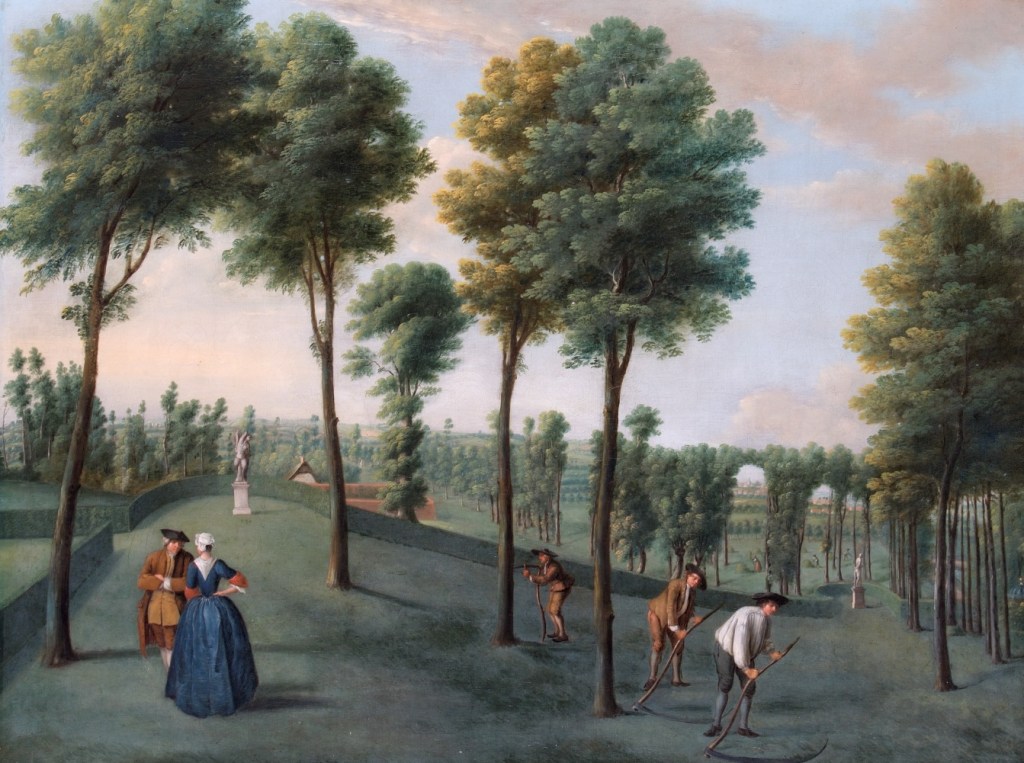
And as if those tasks weren’t enough to fill my time, I’m now at the halfway point in an online course on the history of the English landscape garden through Oxford Continuing Education. This week we’ve been looking at three of the key gardens of the earlier part of the C18, Stowe, Studley Royal and Stourhead. But in fact it was another garden of the period that no longer exists in its 1730s incarnation that I want to share with you, or more specifically three charming paintings of the garden. Hartwell House near Amersham is now a luxury hotel and the current layout of the grounds dates from a later period. The garden was made in the mid 1730s by Sir Thomas Lee. When the garden was complete he commissioned Balthasar Nebot, a little-known Spanish painter, based in Covent Garden, to record his estate and garden.  This he did, portraying the estate workers and gardeners in great detail.

How little and yet how much has changed in the work of a gardener. We still collect weeds and grass clippings in a container, my turquoise plastic trug being the equivalent of the C18 gardener’s basket. In non-lockdown winters we still manoeuvre a roller over the vegetable garden beds at Osterley after mulching them with leaf mould. And we still clip yew hedges by hand using shears. 300 years may have passed but these simple tasks and tools connect us to the gardeners who have gone before us.

And during a passionate talk this week by head gardener Ben Preston of York Gate outside Leeds, I learnt that the use of scythes is not confined to 300 year old landscape paintings and Ross Poldark. The meadow at York Gate is cut by hand by Ben and his team. He explained that by cutting it by hand they can identify the areas where the grass grows thickest. The hay is cut into windrows and sent to a local community farm. Apparently Eastern European visitors to the garden comment that the sight of the hay meadow being cut by scythes reminds them of seeing their grandparents working on the land in a similar way.

Meadow at York Gate

Another element of the garden at York Gate chimed with the Hartwell paintings where clipped yew is used to such dramatic effect. At York Gate a line of yew ‘sails’ cuts through the garden forming both a focal point and a boundary with one of the many ‘garden rooms’. The garden is owned and run by the gardening charity Perennial and a friend who until a couple of years ago also volunteered at Osterley now volunteers in the York Gate shop. I’ve added this special garden to a growing list of gardens to visit.

The yew sails at York Gate

I shall leave you here as I have some course reading to finish about the glorious landscape at Stourhead in Wiltshire, a garden I HAVE visited. I went on a beautiful autumn day in November 2019. Stourhead is only a short drive off the A303, my route to and from my niece and her family in Somerset. It was such a glorious day that I made a detour on the drive home and immersed myself in the tranquil atmosphere of Stourhead, where classical temples reflect into the lake and, on the day of my visit, the scene was all the more beautiful because of the leaves changing colour. A classic image of the garden follows.