An American in Paradise: Hever Castle Gardens

After becoming a British subject in 1899, American multi-millionaire William Waldorf Astor purchased Hever Castrle, near Edenbridge in Kent, the childhood home of Henry VIII’s ill-fated second wife Anne Boleyn. Between 1904 and 1908 he transformed the property, including the gardens surrounding the moated castle. I have read that the equivalent of £110 million was spent creating the gardens alone.

I visited Hever with a friend just over a week ago. Approaching from the Lake View entrance, the first part of the garden we encountered was the Blue Corner. Red brick walls enclose a steeply raked lawn on each side of which deep beds accommodate large boulders and hydrangeas and clematis in varying shades of mauve and purple contrasting with the foliage of ferns, hostas and euphorbias. Purple annual bedding plants provide ground cover in the form of velvety petunias and densely flowered heliotrope the common name of which, Cherry Pie, aptly describes its sweet scent.

In the Rose Garden brightly coloured and fragrant shrub roses occupy beds separated by lawned paths radiating from large urns, representative of the classical antiquities and Italian renaissance pieces which Astor collected whilst American ambassador in Italy in the late 1880s. Much of his collection of sculptures, urns, cisterns and fountainheads is displayed at Hever.

Beyond the Rose Garden stands the classically inspired loggia flanked by colonnades facing the 35 acre manmade lake fed by the River Eden. Set behind the loggia (the romantic venue for a wedding on the afternoon of my visit) is the Italian Garden where most of Lord Astor’s sculpture collection is displayed. Marble gods and goddesses stand amongst arches and pillars festooned with climbing roses and clematis. On the shady side of this large plot is the ‘Gallery of Fountains’ where ferns and hosts grow in abundance along a water filled channel beneath a succession of arches. The crevices of the stone wall bordering the gallery are filled with shield ferns and mosses.

The classical formality of this part of the garden gives way to blowsy prairie planting behind the walls of the Italian Garden. Diana’s Path follows the lakeside towards the castle complex and is bordered with Verbena bonariensis, Echinacea purpureum, Crocosmia, fennel and the silky tresses of a bronze fringed grass. Nepeta, Eryngium and Veronicastrum represent the blue and mauve parts of the spectrum. A magnet for bees, the Veronicastrum displayed signs of that mysterious botanical phenomenon, fasciation. Some of the mauve flower spikes flatten and fork, their bizarre forms swaying in a scene reminiscent of a submarine landscape, through which one might imagine tiny tropical fish darting. According to the RHS website, the abnormal flattening of the flowers in Veronicastrum virginicum ‘Fascination’, is thought to be caused by a genetic tendency to the problem.

Approaching the castle and the adjoining ‘Edwardian Village’, the style of the garden reverts to formality, evocative of Tudor England rather than renaissance Italy. Inside an outer moat lie a Yew Maze and a Tudor Garden, the latter containing a number of sheltered ‘rooms’ bounded by crenellated yew hedging. Here are an intricate knot garden   created entirely from box (Buxus sempervirens) and a physic garden featuring medicinal plants. Hever’s second rose garden consists of a square pond decorated with a two tiered fountain surrounded by stone paving and beds spilling over with a pretty pink and white polyantha (formerly floribunda) rose, Rosa ‘Ballerina’. Beyond the rose garden giant topiary chess pieces fashioned from golden yew loom across a lawn on which stands a tall sundial.

The castle itself stands within a square inner moat in which coy carp swim amongst the waterlilies. The ‘art of creative pruning’ as the inspirational Jake Hobson calls topiary, is represented on Topiary Walk by a series of large box and yew shrubs fashioned into abstract and animal shapes. They reminded me of the fanciful designs I saw lining the Thyme Walk at Highgrove when I visited in May.

Vibrantly coloured planting in the style of Gertrude Jekyll decorates the Long Border between the castle and the lake. Crocosmia ‘Lucifer’, Hemerocallis (Day lilies), Leucanthemum x superbum (Shasta daisies), Echinops ritro (Globe thistle) and fennel predominate but with subtly supported climbing plants dotted amongst the herbaceous scheme. I particularly liked a delicate yellow jasmine (Jasminum officinale ‘Clotted Cream’ and a dainty mid pink clematis which I believe is Clematis texensis ‘Princess Diana’.

Hever is described as one of the great gardens of the world and I plan to return to explore it further.


Bicycle botanics

Perched on a road bike on a hill climb and in the lowest gears is not the ideal situation in which to identify plants growing at the roadside, but I confess to finding myself doing so on Monday this week. I was lucky enough to spend last weekend with a friend in the north of the beautiful island of Mallorca. In preparation for a cycling challenge later this summer, we completed a 25 mile round trip to a cafe a couple of kilometres beyond the monastery of Lluc, in the mountains of the Serra de Tramuntana. Much of our route was a steady climb, craggy peaks visible ahead.

I was peripherally aware of intriguing plants to my right, but so fixed was I on the task in hand I did not give it the attention I might have done had I been on foot. The descent posed different challenges with bike handling taking precedence over botanising. However, along with a sense of a rise in air temperature as we rode towards sea level, I noticed that the scrubby white Cistus bushes (Rock roses) and Scabious (Balearic pincushion flowers) which lined the road at the higher levels, gradually gave way when we reached the plain to margins carpeted with Daucus carota (Wild carrot). Beyond the verges are olive groves and fields of almond trees.

Self-seeded beneath the wooden barriers which protect road users from cliff-sides and sheer drops I spotted species of Euphorbia and Verbascum. For most of the higher regions to either side of the route lay forests of Holm oak (Quercus ilex) and an aromatic conifer I haven’t been able to identify, with roadside signs indicating wildlife reserves and hiking paths. Fat dark brown pods approximately 15cm long scatter the tarmac in some places, the fruit of the Carob tree (Ceratonia siliqua).

Needless to say, being on a bike prevented me from photographing the plants I’ve mentioned. There follow images of some of the plants I saw in gardens on the island, several of which are grown in the Temperate House in Kew Gardens.

IMG_8282
Mediterranean fan palm: Chamareops humilis
IMG_8292
A species of Cycad

Strelitzia reginae

Succulents entwine the terracotta heads above this stone table in the gardens of a sculpture garden near Alcudia, ‘Museo Sa Bassa Blanca’.

IMG_8232
Apricot fades to cream in this climbing rose at the Museo Sa Bassa Blanca.
IMG_8234
Beyond the rose garden at the Museo sa Bassa Blanca lie the hills of the Alcudia peninsula


The wild banana, Strelitzia Augusta,  or giant white bird of paradise.

Finally, I’d love to identify the following plant, a shrub approximately 2 metres high, with pea-like purple flowers opening from this delicately veined bud. Do comment if you can tell me what it is.


Ex box and a princely garden

I recently completed the third front garden planting makeover since launching Weeds Roots & Leaves last autumn. The brief was to replace low box hedging and five larger box balls, all of which had been decimated by the lethal combination of box blight and box tree caterpillar, with Ilex crenata, Japanese holly. Whilst the central circular hedge and that beneath the bay window of the house were relatively easy to extract from the sandy soil, the mature box balls were reluctant to relinquish their positions, having developed very tenacious root systems. They eventually yielded in the face of extreme determination on my part, leaving behind soil in the planting holes which was depleted and dusty. I worked in several bags of well rotted farmyard manure and topsoil in order to improve the soil. This week, with the welcome help of a friend, I re-planted the hedged areas with 56 Ilex crenata plants which I sourced from North Hill Nursery in Chobham, using 2 Litre plants for the bay window hedge and 1 Litre plants for the circular hedge.

IMG_7957Because the garden already has a restrained dark green and cream colour scheme, I planted Anemone x hybrida ‘Honorine Jobert’ behind the bay window hedge. The gently curving bed beside the path to the front door already contained two fine Skimmia japonica ‘Kew Green’ and I  added a further specimen of this glossy leaved cultivar in the space left by a box shrub as well as two more beside the wall bordering the pavement.

When I visited Prince Charles’s gardens at Highgrove on Thursday for a guided tour, I learnt that even a future monarch’s plants are not immune from box blight. On a couple of occasions during the tour the guide pointed out box substitute hedging. The first of these was Euonymus ‘Green Rocket’, a low hedge of which surrounds a bed in the Sundial Garden, framing the deep red flowers of an Anemone coronaria cultivar and the blue of Camassia leichtlinii. The guide explained that as soon as the box shows signs of infection or infestation it is grubbed out and replaced with alternative evergreen hedging. It was good to see that many box plants are thriving throughout the garden indicating that the strategy appears to be working. The other example of a successful substitution was in the very impressive walled Kitchen Garden where the box hedges had been replaced with Teucrium x lucidrys, commonly known as germander.

IMG_7965
The only area where photography is permitted is beside the Orchard Room visitor centre where I spotted these tulips and olive tree.

The two hour tour took in much of the extensive grounds and, since photography was unsurprisingly not permitted, I jotted down the notes from the guide’s commentary and my impressions of a garden which has been 35 years in the making. A distillation of my notes follows.

  • A ‘signature plant’ whose bright yellowish green foliage highlights several sections of the garden is Philadelphus coronarius aurea, golden mock orange.
  • Throughout the garden are examples of what the guide described as ‘Highgrove whimsy’: wooden or stone pavilions and summer houses which I interpreted as the C21 equivalent of William Chambers’ ‘follies’ for George III at Kew.
  • The organic site is managed on sustainable principles, with all plant waste being recycled for mulch and compost and rainwater collected for irrigation. Biological control methods are implemented rather than pesticides. I was surprised to learn that in two areas of the gardens where azaleas are planted in raised beds, the soil is imported from Bowood House at Calne in Wiltshire approximately 22 miles away.
  • Camassia leichtlinii interspersed with deep red tulips are currently in bloom in the large wildflower meadow to the south east of the house, where the soil is Gloucestershire clay. An avenue of hornbeams, edged with low willow hoops, leads across the meadow to the Winterbourne Garden where more exotic species such as Chusan Palm and Tree ferns create an exotic display.
  • From here a long high walled corridor lined with waist height terracotta pots planted with azaleas, runs between the Kitchen Garden and the Arboretum. Halfway along this Azalea Walk a gate decorated with Egyptian hieroglyphs leads through to the Arboretum. The hieroglyphs read ‘The flowers in the garden are a reflection of the stars in the sky’.
  • In the Arboretum the acidic soil occurs naturally and acers and azaleas abound, the predominant colour being the pinkish red of  Acer palmatum ‘Shindeshojo’. The understorey included Narcissus jonquila ‘Sun Disc’ and wood anemones.
  • An apple arch leads through the Kitchen Garden to a ring of Malus ‘Golden Hornet’ at the centre of which stands a pool into which a woven willow frog ladder has been lowered to assist exiting amphibia. Several gardeners were planting up the vegetable beds when we toured this part of the garden.
  • One of my favourite parts of the garden was The Stumpery, with upturned tree trunks accommodating a profusion of Tellima, ferns and species of Epimedium, Dicentra, Trillium and Pulmonaria. The genus which recurs throughout this area is Hosta and the guidebook reveals that Highgrove holds the National Collection of large and broad-leaved hostas.
  • Topiary features in many areas of the garden such as the yellow yew balls either side of the Thyme Walk which the garden team have fashioned into crowns, helter- kelters and cakes, and the extensive yew hedge which surrounds the most formal parts of the garden and which was designed in 1989 by Sir Roy Strong.
acer-palmatum-shindeshojo-ras-05-2011-7984-gpp
Acer palmatum ‘Shindeshojo’
DCF 1.0
Philadelphus coronarius aurea
camassia_leichtlinii_blue_danube-w_2_1200
Camassia leichtlinii

As we drove away from Highgrove a cloudburst descended which accompanied us most of the way home, the only comfort being that hopefully the Ilex I had planted two days before were receiving a similar drenching. Rain, or the lack of it, was a popular topic in the Gardeners’ Bothy at tea and lunchtime at Osterley on Friday, where my gardening week concluded. The previous day’s heavy rain in the West Country had made less of an impression in Middlesex and it remained dry during our garden volunteering duties on Friday save that at 3.15pm as we were preparing to leave the heavens opened and gave the gardens a much needed soak and us a good excuse for a cup of tea.

The Friday team was deployed in the Winter Garden in the morning, cutting back the colourful stems of the willows and Cornus, before they begin to leaf up further and make pruning a heavier job. This will encourage the plants to develop fresh stems this summer  in preparation for another display of orange, red and yellow stems next winter. Head Gardener Andy pruned out branches of the large variegated hollies in the Winter Garden which were beginning to revert to a dark green. These prunings were shredded in the afternoon and deposited onto the pile of plant material in the yard which is the first stage of the composting system.

To the accompaniment of the shredder we split into smaller teams in the afternoon to work in and near the Tudor Walled Garden. Two of us weeded the area through and around the bean supports in the bed into which most of the edibles have been planted so far this year. Another three pricked out seedlings which will be hardened off in the cold-frames before being planted out in the next few weeks. The week before we had planted both flat leaved and curly parsley and lettuces in this bed which is divided into four quadrants, the planting lines having been marked out with twine. Slowly but surely the foundations are being laid for the profusion of crops which this bed will be producing by the end of the summer.


Purple days

Betrayal, remorse, death: and yet such beauty. Cercis siliquastris is said to be the tree on which Judas hanged himself after turning Jesus in to the authorities having identified him with a kiss, and in return for 30 pieces of silver. The Judas tree as it is commonly called is planted throughout the various gardens of the Alhambra in Granada: in those beside the Nasrid Palaces, the ramparts, the monastery of St Francis (now a hotel) and across the valley in the Generalife which my guidebook translated as ‘the garden of lofty paradise.

When I visited in the third week of March, few deciduous trees were in leaf, highlighting the many evergreens across the estate, notably the ranks of cypresses silhouetting the upper terraces of the Generalife. Consequently, the deep mauve flowers of the Judas tree stood out boldly in the landscape. Close examination reveals that the pea-like blooms erupt from branches, twigs and even trunks of these remarkable trees, with the heart-shaped leaves emerging several weeks after the flowers making the colour of the trees  all the more prominent.

IMG_7192

Shades of purple predominated in many of the plants in flower during my visit to Granada: the irises in the foreground of this view of the city from the Generalife Gardens and the wisteria clothing ancient walls and perfuming the air with the unique fragrance which in this country I associate with mid to late April.

And it wasn’t only the purple flowers which were in bloom at least four weeks before those at home. The palest of pink peonies dominated a bed surrounded with clipped myrtle in one of the Generalife’s upper gardens, the Jardines Altos.

This garden was beside the intriguing Escalera de Agua, where instead of a banister rail, water flows along stone channels on either side of the steps leading to the wonderfully named Mirador Romantico. This feature reminded me of William Kent’s early 18th century landscape garden at Rousham House in Oxfordshire where the shallow zig-zagged rill’s source is in a woodland glade leading to the cascades and pools which eventually flow into the River Cherwell. In the Generalife and the palaces of the Alhambra the numerous rills connect the pools and fountains at the centre of the patio gardens, many of them cloistered with elegant pillared arcades, off which lead chambers decorated with intricately worked plaster and ceramic tiles in vivid colours.

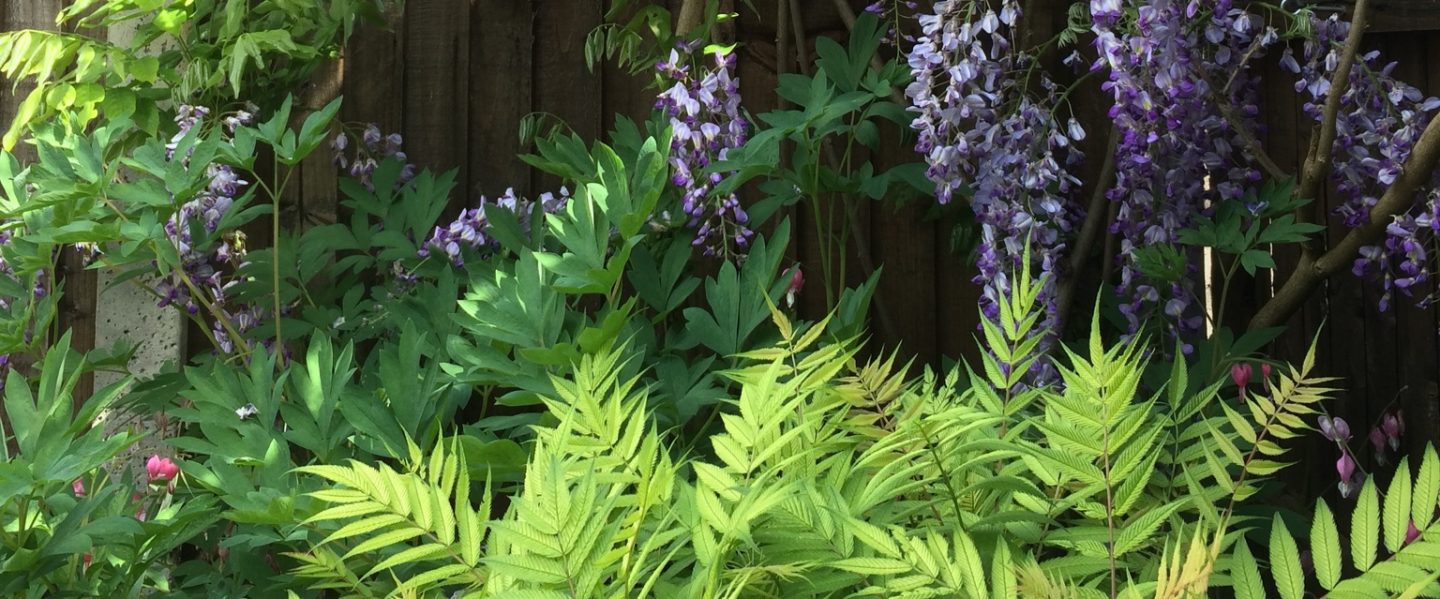
In the final week of April, at home in west London, the two notable Judas trees in Kew Gardens have been in full flower. One spreads its branches dramatically at the foot of the steps from King William’s Temple in the centre of the Mediterranean Garden and the other overhangs the perimeter wall beside the Queen’s Garden at the rear of Kew Palace. The former forms a backdrop to some of the glass sculptures of Dale Chihuly now erected in many parts of Kew Gardens, and to which I shall return in future posts. In my back garden at home I have been delighting in the extravagant purple and mauve swags of the wisteria, as well as its gorgeous perfume.

87cbc7f5-8281-4600-b5ad-3c1b657a274a

IMG_7914

Chambers, Burton and the seven o’clock club

Taking a break for lunch whilst working on a front garden in Teddington last week, I explored the nearby park, Grove Gardens. A bowling green with an immaculate greensward occupies much of the space, surrounded by a waist height evergreen hedge. What struck me, apart from Teddington Bowling Club’s pavilion buildings, which would not have looked out of place in a 1950’s Ealing Comedy, was the scale of the mature conifers around the park’s perimeter. One cedar in particular towers above its neighbours and looks to be of a venerable age. When I read the London Borough of Richmond’s interpretation panel near the park’s entrance, I discovered I was standing in what was once the garden of a large house, Teddington Grove, built in the 1760’s for wealthy business man Moses Franks and demolished in 1920.

The architect of the house is not known, but it is understood that the gardens were designed by Sir William Chambers who built Somerset House and the Kew Pagoda. The grounds at Teddington Grove included flower gardens, parterres, glades and statues. I am intrigued by the fact that at the same time that Chambers was commissioned by new monarch George III to embellish his gardens at Kew, he was also being asked to design a garden a few miles to the south.


The 160 foot high Pagoda was only one of the fantasy buildings designed by Chambers in a variety of exotic styles to decorate the royal gardens. Several have long since disappeared such as the Alhambra, a mosque and a Temple of the Sun. But three classical temples survive (devoted to Aeolus, Bellona and Arethusa) and the Ruined Arch is a feature of the path leading south from Victoria Gate to Lion Gate, known as Camellia Walk. The elegant Orangery is now a self service restaurant but was originally designed to accommodate a collection of citrus trees.

In the summer of 2018 Historic Royal Palaces completed its renovation of the Kew Pagoda, including the 80 fierce gilded dragons which graced its eaves. A few months earlier I had the opportunity to see the restoration project at close quarters when I joined a tour for Kew staff shortly before I left RBG Kew. We were equipped with steel-capped boots, hard hats and heavy duty gloves for the ascent of the building, climbing ladders constructed in the scaffolding with which the Pagoda had been encased for the previous couple of years. As we climbed, we glimpsed the expanse of Kew Gardens unfolding beneath us: the two vistas radiating from the Pagoda to the Palm House and the lake and everywhere Kew’s living collection of trees, a few of which were beginning to display autumnal foliage. The scaffolding extended above the apex to a platform from which we looked down into the space where the gilded finial was to be reinstalled a few months later.

IMG_5761IMG_3821IMG_3823IMG_3815

From my sometimes ‘Kew-centric’ perspective it is easy to forget that the eminent architects who designed its iconic buildings had careers which involved commissions other than for the royal gardens at Kew. I recently read that Decimus Burton (1800-1881), who designed Kew’s great glasshouses, the Palm House (1845) and the Temperate House (1860-1898), was the architect of the classical style Athenaeum Club in Pall Mall in 1824 when only 24 years of age. This discovery came about during a discussion with friends one of whom had recently been invited to dine at the club and another of whom had done so some years before. The latter recalled being shown the clock at the top of the imposing marble staircase where the Roman numeral VII appears twice: in its correct position and where one would normally expect to see VIII.


An internet search ensued to find an image of the clock and whilst we could not find an explanation for this orological phenomenon on the club’s website, it did refer to Decimus Burton as having been the architect of the club in which it hangs. In fact Burton’s influence on the layout and design of the West End of London extends well beyond a gentleman’s club in Pall Mall to the grand entrances to Hyde Park, the Wellington Arch at Hyde Park Corner and the enclosure of the forecourt of Buckingham Palace. In Dublin he re-landscaped the magnificent Phoenix Park over the course of about 20 years.


After my stroll around the little park in Teddington last week, I returned to my more modest garden commission (about which more in a later post) delighted to have found an unexpected connection between a secluded park not far from the north bank of the Thames with a famous cousin on the south bank of the river a few miles downstream.

Chiswick House camellias

In the second of a series of regular midweek posts with the emphasis on images rather than text, I’d like to share a few photos from a visit a week ago to the Conservatory at Chiswick House. Some of the collection of Camellia japonica housed in the Conservatory survive from specimens planted in 1813 when Samuel Ware completed a large glasshouse commissioned by the 6th Duke of Devonshire. From one end to the other of its two wings, spreading from a central dome, is a distance of 96 metres. Because of their sheltered location, the spectacular blooms do not display the frost damage evident on many camellias when planted outside. The cultivars in the collection include ‘Flore plena’ and ‘Pompone’.


‘It’s coming on Christmas, they’re cutting down trees’

Two years ago, in early December 2016, I was lucky enough to spend a couple of days in New York City, my first visit for eight years. At the top of my ‘must-sees’ was the High Line, the linear park which runs along a disused elevated railway track to the west of mid-town Manhattan. 30 feet above the city streets, the High Line is a perfect platform from which to survey the cityscape: the cross town streets and the canyon of Tenth Avenue.

The park’s landscaping is the work of Dutch landscape architect, Piet Oudolf, whose name is now synonymous with ‘prairie’ style planting where herbaceous perennials rub shoulders with numerous grass species. I have seen his work in the double borders at RHS Garden Wisley and hope to visit the garden he designed at the Hauser & Wirth gallery at Durslade Farm in Somerset in the coming year. Even on a cold December morning, the 1.45 mile long park displayed pockets of intriguing plants. I was especially struck by the unexpected sight of mature trees growing a few feet from the second storey windows of offices and apartment buildings. The site’s industrial past is embraced and grasses push up between complicated rail junctions. Every so often we encountered gardeners tending the planted areas and I saw a sign advertising for volunteers to help maintain what has become a major tourist attraction in the city.

Quirky sculptures and installations occur along the length of the High Line: here a car built of car tyres, there an alternative hand-typed political manifesto on a billboard several metres high. And in this park one has the rare opportunity in crowded Manhattan to stand and appreciate the monumental architecture of the city, the sky-scraping edifices of central Manhattan to the north and of the Financial District to the south. Craft plying the Hudson River glimpsed between buildings two avenues to the west are a reminder of New York’s maritime and mercantile foundations.

We were walking along the High Line on the way to lunch with a cousin and friends at Gene’s Restaurant on West 11th Street: a chance to catch up with dear people at their favourite Italian. En route I glimpsed Christmas trees for sale on a street corner and not for the first time in New York it felt like a scene from a movie. In this case ‘When Harry Met Sally’ when Meg Ryan single-handedly drags the tree back to her apartment.

IMG_1975

I’m keeping it brief for this post on Christmas Eve and wish you a very happy Christmas and New Year. Here’s to plenty of gardening work, visits and writing in the year to come. And thank you for reading my posts thus far.


From Russia with love: St Petersburg Botanical Garden and how a tropical beauty got its name

When I visit a city abroad I try, if possible, to visit the botanical garden. I am lucky enough to live less than a mile from arguably the world’s finest botanical garden, the Royal Botanic Gardens, Kew. Inevitably I draw comparisons with Kew when I go to other gardens, but it’s always fascinating to see, for example, how plants are arranged in their plant families, the standard of horticulture and the method of communicating the garden’s message to its visitors.

In May this year I travelled to St Petersburg in Russia and went to two very different gardens. I shall tell you about the gardens at the Tsars’ summer palace at Peterhof in a future blog post. Today it is St Petersburg’s Botanical Garden I would like to introduce to you and, more especially, to a plant associated with it. The garden is located to the north of the city centre, on Aptekarskiy or Apothecary’s Island, one of the many islands which make up this unique and grandly imperial city. The island is named after the medicinal herb gardens founded by Peter the Great in 1714.

The approach to the gardens from the Metro station is along streets lined with turn of the (19th) century apartment buildings, the last stage of the walk being alongside a canal. I confess that my overall impression of the garden was not favourable. I should mention that the weather was unusually hot and dry for mid May, so inevitably the flower beds looked dusty and droughty. But what I found sad was that, unlike the lavishly restored and maintained visitor attractions we had been to, not least The Hermitage and its annexe, The General Staff Building, this seems to be a site which has yet to receive an injection of cash to bring it up to world class standard. Admittedly, we arrived too late in the afternoon to join one of the guided tours of some of the 25 glasshouses, and had we done so I might be giving the garden a more positive review. What I did find impressive was the alpine area where different species of silky haired Pulsatilla nestle in the crevices of the rocks and the Japanese garden featuring a traditional tea-house facing a pond edged with Azaleas. Near the main entrance to the garden stands the Herbarium which is housed in an impressive three storey building, built in Art Nouveau style or Style-Moderne as it is known in Russia.

It wasn’t until last month, when I explored Kew’s Tropical Nursery during London’s annual Open House weekend, for the two days of which buildings usually closed to the public open their doors, that I discovered a link to St Petersburg’s Cinderella of a botanical garden. This was a rare opportunity to see the organisation’s conservation work in practice, where specialist horticulturists help to bring critically endangered species back from the brink of extinction. There are several different zones in the nursery, where the heating and lighting are adapted to particular plant families, for example ferns, orchids and cacti. On a table outside the Bromeliad section, my eye was drawn to plants native to the South American rainforests, Neoregelia, and a sign noting that the genus is named for Eduard von Regel (1815-1892), director of St Petersburg Botanical Gardens from 1875 until his death. I couldn’t help thinking that he might be saddened to see the garden in which he worked for so many years in its current slightly down at heel state. Not so these magnificent plants with their broad, rather flat leaves which are often brightly coloured in greens and reds with banding or striping. The other striking feature of the plant is the reservoir of water which collects in a shallow depression in the centre of the plant, and through which the flower rosette blooms. There are numerous specimens of this spectacular plant growing in the central zone of Kew Gardens’ Princess of Wales Conservatory.

IMG_5624

Readers of an earlier blog post (12 December 2017) where I wrote about the quirky and apparently cantankerous Miss Ellen Willmott, will have noted my interest in the personalities behind names of plants. In his obituary in the journal Nature, the German born Eduard von Regel was described as ‘learned and genial’. I hope that one day his garden will be restored to its former glory and in the meantime his name lives on in the name of a beautiful tropical plant.


Tulipomania

The arrival of the autumn equinox ten days ago and the accompanying unsettled weather signalled to this gardener it was time to plan a display of bulbs for next spring. Cooler temperatures and heavy rain justified a few hours of armchair gardening, studying cultivars of tulips recommended by the Royal Horticultural Society for planting in containers and I compiled a wish list in preparation for a visit to the plant centre at RHS Wisley.

I try to achieve a display spanning as long a period as possible, from late March through to early May. Variety of both colour and form influence my choice and whilst it is tempting to stick to the old favourites, I am keen to try some different colour combinations next year. I particularly like the ‘lily’ tulips which have narrow, goblet shaped flowers and pointed petals curving elegantly outwards. Into this category falls sugary-pink Tulipa ‘China Pink’. On a visit to an open garden day at Petersham House in April this year, I discovered the spectacular Tulipa ‘Flaming Spring Green’, its white and green flowers streaked with scarlet. Sadly, these bulbs cost twice as much as their more subdued cousin, Tulipa ‘Spring Green’, and prudence outweighed extravagance on this occasion.

IMG_4697.jpg

To ensure that the display is not bland, I’ve also bought mauve Tulipa ‘Blue Parrot’ which will open into a curly parrot flower, and Tulipa Cistula, another lily-flowered cultivar with lemon and cream flowers. Glancing back at an image of my tulip display in April this year, I shall certainly also include the orange lily tulip ‘Ballerina’ for both its impact and long flowering period.

IMG_4716.jpg

When I plant the bulbs in November, I plan to use a 50:50 mixture of compost and horticultural grit, to prevent the bulbs from sitting in a waterlogged growing medium during the winter. Unlike other bulbs, e.g. daffodils, which can be planted any time from now onwards, the experts recommend planting tulips in November to avoid a fungal disease called ‘Tulip Fire’ which distorts the leaves and makes the plant looked scorched. For the third year, I shall protect the planted containers from squirrel damage with the chicken wire cloches made for me by a friend.

I also bought a packet of Snakeshead Fritillary bulbs, Fritillaria meleagris, to plant in pots for a couple of friends who have admired my container of these under the kitchen window.  I resisted the temptation to buy a Fritillaria Persica whose flower spires I also admired in April at Petersham House, as it is too large for my borders.

IMG_4694.jpg

A recent visit to Kew Gardens reminded me that bulbiferous flowers feature in the autumn garden as well as the spring garden. I found a substantial clump of Sternbergia lutea, Autumn Daffodil, in the Mediterranean Garden, its yellow crocus-like flowers tricking the viewer into thinking that spring has arrived. Nearby, bordering Holly Walk, lilac shaded swathes of Colchicum speciosum glow in luminous contrast to the rich dark soil in which they are planted. These Autumn Crocus are also called Naked Ladies to describe their habit of flowering only when their leaves have died back. Overnight rain had flattened some of the flowers on the morning of my visit, but the overall effect remained striking beneath the evergreen foliage of the holly specimens.

Next time: what links Imperial Russia with Kew’s Princess of Wales Conservatory?

East meets west, in the west: Sezincote

On the last day of August this year, I visited a unique house and garden in the Cotswolds. From the main road, the A44, the tree-lined drive conceals the extraordinary sight of Sezincote House until its final bend. The grand honey coloured Cotswold stone house is crowned by an Indian style dome and decorated on the four corners of its roof by smaller domes. Peacock tail inspired window surrounds grace the front facade and the Indian theme was reinforced by a classic Ambassador car parked at the front door decorated with flowers in preparation for a wedding at the property the following day.

The garden also contains several Eastern features, the first to be encountered by a visitor being the Indian Bridge at the entrance to which stands the ticket kiosk. The bridge is decorated with kneeling Brahmin cattle sculptures, metal replicas of the Coadestone originals, the manufacturer’s name legible on each plinth. The bridge spans the area of the garden known as The Thornery, an extensive water garden. This descends in a series of pools and streams from a circular pool in front of a small temple dedicated to the Hindu god Surya down to the Island Pool, beyond which real cattle graze in the surrounding meadows. Immediately beneath the bridge and reached by a narrow path, a series of rectangular stepping stones lead you to the Snake Pool, in the centre of which stands a serpent entwined column.

The damp environment of the banks of the streams and less formal pools encourage plants such as Hosta sieboldiana, Rodgersias and Alchemilla mollis to thrive, their contrasting green shades, leaf shapes and structures providing interest at the water’s edge. The lawns to either side of the stream are planted with rare specimen trees and shrubs including three stately Cedars of Lebanon (Cedrus libani). Hydrangeas feature here as do two species of hazel: the ‘wriggly nut’ Corylus avellana ‘Contorta’ and the purple nut Corylus maxima ‘Purpurea’. Late summer afternoon sunshine highlighted the tiered branches of the wedding cake tree, Cornus controversa, which has been given adequate space in which to extend its graceful limbs.

IMG_5487

The artfully ‘natural’ planting of The Thornery contrasts with the formality of the Persian Garden to the south of the house. In keeping with the design principles of the paradise garden, this area consists of four quadrants, created by a waterlily filled canal intersected by paths lined with Irish yew columns (Taxus baccata ‘Fastigiata’). At the centre of the quadrant sits a raised octagonal pond.  A life-like pair of Asian elephant sculptures placed at the end of the canal have something of Disney’s Animal Kingdom about them. Beyond these beasts a steep slope rises towards woodland beyond the garden.

IMG_5466

The Sezincote guidebook contains a beautiful photograph of the garden showing brightly coloured autumn foliage beyond the bridge. A good season in which to return perhaps?

Next time I plan which spring bulbs to buy for containers and observe some bulbs which flower in autumn.