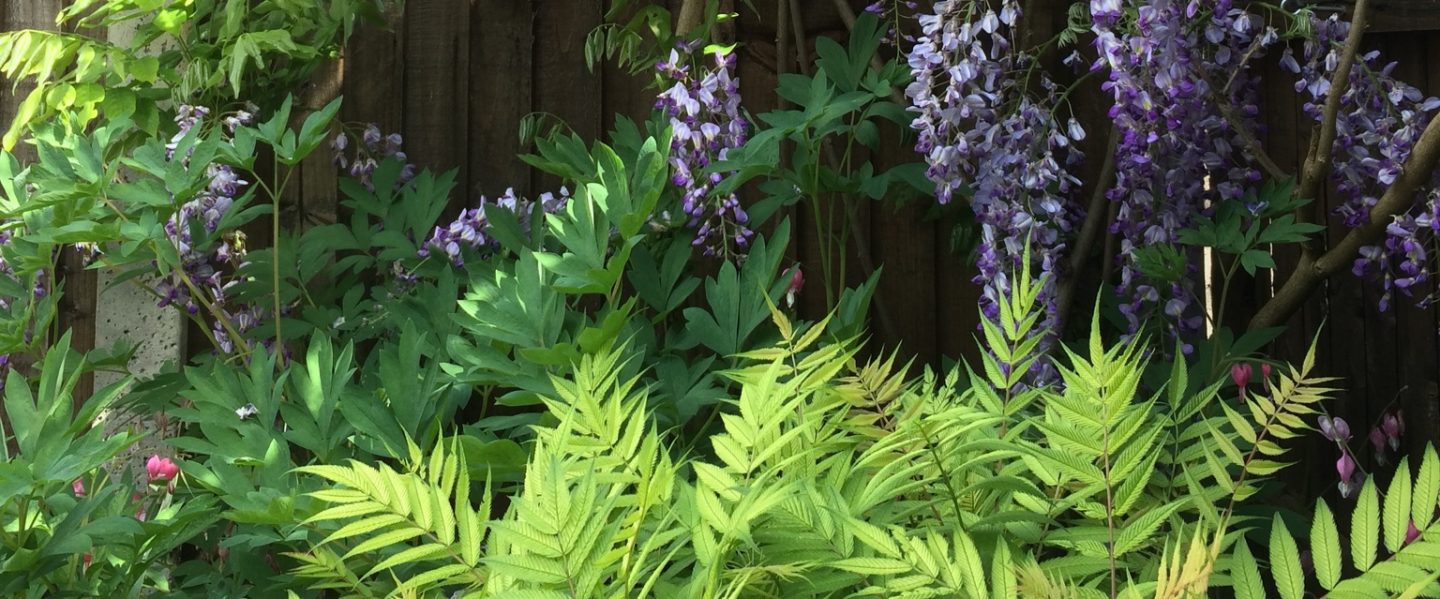
Wool gathering whilst gardening

Of the many benefits of gardening- fresh air, exercise (what one RHS course tutor dubbed ‘the outdoor gym’), an outlet for creativity- the opportunity to let your thoughts wander at will is for me one of its principal virtues. The meditative state that can arise, particularly when carrying out a repetitive task such as weeding, can sooth anxieties or, as it did when I was working in a client’s garden a week ago, trigger memories. Whilst we are counselled against ‘looking in the rear view mirror’, remembering the gardens we grew up in or the first gardens we created, is a delightful route along which to allow one’s thoughts to meander.

As I worked my way methodically around the garden, knee pads in situ and weeding fork in hand, I recalled the pleasure I derived from making a tiny ‘garden’ at the first flat I owned. The little studio flat in South Kensington was on the top floor of a five storey white stucco building which had once been a hotel. A property developer had converted it into dozens of studio and one bedroom apartments of which mine was probably one of the smallest. Although its one window was behind the parapet which crowned the handsome building, the room had a very bright east-facing aspect. For fire escape purposes, a small flight of wooden steps led from the window sill to the valley behind the parapet. Having grown up in a suburban house with a generous proportioned garden which I had taken little interest in helping to maintain, I suddenly discovered an enthusiasm for growing plants. I indulged this new passion with baskets suspended on decorative ironwork lavatory brackets (from said childhood home) on either side of the wooden steps. In those days, the early 1980s, there was a small garden centre on a triangular plot immediately above Gloucester Road underground station: now occupied by a branch of Waitrose and a large office building. It was in this unique plant centre and at Rassells on Edwardes Square off Kensington High Street that I bought the geraniums, lobelia and Black-eyed Susans (Thunbergia alata) with which I filled the baskets. I revelled in the gaudy colours of the display which decorated my climb to the parapet valley from which I could survey the London skyline. From left to right: Hyde Park , the roof of the Albert Hall, T E Collcutt’s Queen’s Tower in the heart of Imperial College’s campus and the Natural History Museum. I also had a small collection of houseplants including a highly temperamental shrimp plant whose botanical name I discovered whilst researching this blog post is Justicia brandegeana. 

The shrimp plant gave up the ghost when four years later I loved to a larger but altogether gloomier basement flat in West Kensington. The flat did, however, have the advantage of its own garden, albeit one that could not be seen from the flat since it was on the same level as the raised ground floor flat upstairs. In my six year sojourn there I did battle with a compacted clay soil and rather moth-eaten lawn. The garden was surrounded by high brick walls (which I would be very happy to have surrounding my current garden). It was overhung at the rear with a burgundy leaved tree I believe may have been a purple beech, Fagus sylvatica Atropurpurea Group. In my first autumn in the flat, I remember a trip to a garden centre near Maidenhead with my dear friend Pat, where I bought several shrubs and climbers which I had carefully selected from Dr DG Hessayan’s ‘The Tree & Shrub Expert’. These included Spiraea japonica, Choisya ternata and Solanum crispum ‘Glasnevin’, the latter chosen more for its Dublin associated name than for its beauty, but which romped away despite the dry shade in which it was expected to grow. I was also given Kerria japonica and a witch hazel, Hamamelis mollis. Another gift was Paeonia lactiflora ‘Bowl of Beauty’. I moved before it flowered and have often wondered how it fared after I left.

img_6369

I went to a very inspiring talk by garden designer Dan Pearson at Royal Botanic Gardens, Kew on Monday evening, ‘Journey of a Plantsman’. As he described his evolution from schoolboy botanist and horticulturist to world renowned designer and plantsman, I was struck by the detail with which he recalled the plants he included in the first flower border he created in his parents’ Hampshire garden 40 years ago. Hardly on the same level, but when during the gardening session last week I allowed my mind to focus on my own 1980s gardens, I found I too could see those gardens and the plants in them as if it were yesterday.

In other news, I spent today at Kew helping, along with many other volunteers,  to prepare orchids and bromeliads for the Orchid Festival which starts in early February. Attaching moss to the plants pots with elastic bands was a fiddly process but very satisfying and the horticultural chat around the table was fascinating. During a break I took a look at the progress with the installation of the exhibits and it’s already looking very impressive. The theme of this year’s festival is Colombia and the fauna of the country is being highlighted alongside its botanical treasures. A sloth, donkey and turtle caught my eye today. More orchid festival impressions to follow in a future post.


Toads and more

Imagine being woken from a deep warm sleep by someone wielding a shovel. This was the experience of the four toads we unearthed from a mature leaf mould pile in the gardens at Osterley two weeks ago. We were excavating the leaf mould to use as mulch in the Winter Garden. The amphibians had snuggled themselves into this dense and dark environment presumably with a view to remaining in hibernation until next spring. Each time we found a toad we carefully deposited its plump brown and understandably trembling body in the neighbouring leaf compound where last years leaves are slowly rotting down into a rich dark substance which will be ready to harvest in a year or so.

Recent work at Osterley has been varied and very satisfying. We have cut down to ground level the Asters and Heleniums in the American Border, the long deep area which backs onto the Tudor Walled Garden planted with specimens of shrubs and herbaceous perennials originating from North America. One of these is the towering herbaceous perennial American pokeweed, Phytolacca americana, which bears racemes of crimson-black berries in the autumn. This too was cut down to the ground. After weeding we planted a scattering of tulip bulbs between the crowns of the plants we had  cleared, which in some cases were already fringed in the first of next year’s leaves.

A week ago, in one quadrant of the Tudor Walled Garden, we grubbed out the Castor Oil plants, Ricinus communis, which provide height and drama amidst the Dahlias and Mexican sunflowers which two months ago were still thriving colourfully in the glorious open location. I described working in the midst of this bed in a blog post a couple of months ago and at its height it is truly a kaleidoscope of varying shades of orange, red and yellow. One of the Osterley gardeners explained that the Castor Oil plants have been particularly successful this year, having been started under glass in February in preparation for planting out after the frosts have ceased. Their success was demonstrated by their unwillingness to be extracted from the soil. Each spot plant had formed a tough knuckle of root from which radiated several anchoring roots necessitating some persistent spade and fork work for every plant. The waste material was shredded that afternoon in the work yard area near the Gardeners’ Bothy ready for composting. Out too came a few remaining stands of Rainbow Chard, a reminder that the planting in this bed deliberately mixes culinary and decorative specimens. Over the coming months the now empty bed will be rotavated and spread with a leaf mould mulch,  toads optional

IMG_5539 2
The profusion of growth in the Tudor Walled Garden in September
IMG_5536
Castor Oil plants in the Tudor Walled Garden on 14 September 2018

.

Autumn tasks at Osterley influence garden assignments

A colourless sky lowered over the gardens at Osterley last Friday, serving to highlight the intensity of the colour of the autumn leaves still clinging to the trees in the gardens and park and those carpeting the ground. Our morning task was to sweep the leaves from the lawns surrounding the mature oaks between Mrs Child’s Flower Garden and the path leading to the Winter Garden. Having filled our barrows, we deposited the golden haul on a new leaf pile on the site of the rich dark cliff face of leaf mould which we mined earlier this year to mulch one of the four large beds in the Tudor Walled Garden.

In the afternoon we worked in an area of the garden between the lake and the wider parkland where a stretch of the fence between garden and park needed to be cleared of brambles. Protected by elbow length red suede gauntlets, and using mattock and spades to sever the stubbornest roots, in two hours our working detail of five volunteers cleared the tangle of brambles from either side of the fence as well as a prickly patch at the foot of the nearby Ice House Mound. As with all weeding it is so satisfying to excavate as long a root as possible without leaving anything behind to emerge stronger than ever next year.

IMG_5868
Heading back to the Gardener’s Bothy with barrows of brambles

Our work on the previous two Fridays was slightly more sedate. For example we planted two lowish growing cultivars of Allium bulb beneath the roses in the Cutting Garden: the yellowish green flowered ‘Moly’ and the rose pink ‘Unifolium’ or American Onion. Later, on the bank opposite the American Border, we lifted and replaced divots of turf into which we posted two species of spring flowering bulbs. Both were familiar from Visitor Information team days at Royal Botanic Gardens, Kew when we were often asked to identify the canvas of bright blue starry flowered Chionodoxa forbesii on the triangular lawn near White Peaks cafe with Kew Palace as its backdrop. The path further along from this part of Kew is called Princess Walk where the early flowered Crocus tommasinianus reveal themselves in February.  The cultivar we planted at Osterley the other week was ‘Ruby Giant’ which is described on the RHS website as having reddish purple flowers. The squirrels which frequent that part of the garden kept a close eye on our activities and I do hope they find plenty of other naturally available nourishment and do not unearth the treasures we buried.

IMG_5797
Spring bulbs ready for planting

Planting in the Winter Garden on 9 November included a ribbon of Stipa tenuissima between contrasting tufts of lower growing ornamental grasses, the crowns of which we  cleared thoroughly of Field Bindweed, Convolvulus arvensis, as well as less pernicious weeds. In another section of the Winter Garden, other colleagues planted a drift of strap-leaved Hart’s Tongue ferns, Asplenium scolopendrium. Nearby several different species of dogwoods, Cornus, have shed most of their leaves revealing glossy stems shaded from orange-gold, crimson and purple through to almost black, demonstrating why this part of Osterley is a colourful and interesting area to visit throughout the winter months.


Weeds Roots & Leaves has refreshed a local back garden during three days’ work over the last few weeks and I planted three Cornus alba ‘Elegantissima’ in the 1.5 metre deep border I created at the rear of the site. I chose this cultivar both for its red stems in winter to contrast with the surrounding evergreen shrubs and for its cream edged leaves in spring and summer to bring an impression of dappled light into a shadier area of this largely sunny garden.

By coincidence a cultivar of another species of plant which is a dramatic feature of Osterley’s Winter Garden at this time of year turned up in a new client’s garden which I visited at the weekend in preparation for carrying out some seasonal maintenance work this week. Clematis cirrhosa ‘Freckles’ scrambles to the top of a tree in the central section of the Winter Garden forming a cloak of toothed foliage and pale yellow bell shaped flowers heavily speckled inside with maroon becoming a mass of silky seed-heads when the flowering has finished. While carrying out a quick inventory of the plants in the client’s garden we found, on the west-facing wall of the house, an exquisite specimen not unlike Osterley’s ‘Freckles’ but with more finely cut leaves and slightly less speckled flower interiors. After a short online search I identified this as C. cirrhosa var. balearica which is also known as fern-leaved clematis, an evergreen the interior of whose creamy flowers are spotted purple. I have read that the flowers are slightly fragrant and am looking forward to having a sniff when I start work at the site tomorrow.

IMG_5885
Clematis cirrhosa var. balearica

Volunteering in the garden at Osterley is always very enjoyable and doubly so when it informs the work of Weeds Roots & Leaves. As well as planting ideas and shared knowledge about the poisonous properties of some plants, I am, for example, so grateful for the information about a couple of wholesale nurseries which I would have known nothing about without the generous recommendation of a fellow volunteer.

Oh no, knot another weed!

In the 80’s, 90’s and noughties, when the author’s life was more ‘Reads Books & Deeds’ than ‘Weeds Roots & Leaves’, the nearest a property lawyer came to horticulture when acting in the purchase of a house, was to enquire of the seller’s solicitors if that large tree in the garden was the subject of a Tree Preservation Order. Since 2013 it is standard practice for the seller of a property to declare whether  Japanese Knotweed*, Fallopia japonica, is present on the property in the Property Information Form. This means that it is the seller’s responsibility to check the garden for this invasive weed and if it is present to provide a management plan from a professional eradication company. Once a buyer’s solicitor has noted the presence of the weed when checking the form, and has notified the lender, the latter is likely to seek assurance that it will be eradicated, in the form of a management plan, before agreeing to fund the transition. Failure to disclose the presence of Japanese Knotweed or the lack of a management plan will delay the sale and increase the cost of the buying process or, the worst case scenario, give rise to a potential misrepresentation claim.

How has a plant introduced from the Far East in 1825 as a garden ornamental, and praised by innovative William Robinson in 1879 as ‘one of the finest herbaceous plants in cultivation’, developed a reputation as a possible property deal-breaker? Had Japanese Knotweed confined itself to the garden, the story would have ended here, but it escaped from gardens to establish colonies beside railway lines, waterways, roadsides and on waste land. By shielding lower growing species from light with its dense canopy it obliterates local native vegetation and its fallen leaves form a dense mulch to suppress the growth of any incipient seedlings. In the UK it spreads not by seed but by a huge rhizome system, impervious to many herbicides and needing a saw to sever the rhizomes. I can understand why our gardening forebears liked this plant- it has an attractive and exotic appearance with up to 2 metre tall bamboo-like stems speckled purple, heart shaped leaves about 15cm long and sprays of small white flowers. It would fill a shady corner very satisfactorily were it not for its thuggish tendencies.

As well as competing with native species, it contributes to river bank erosion and increases the risk of flooding. In a residential or commercial property context, it can cause structural damage by forcing itself through paving and concrete foundations. Indeed under the Environmental Protection Act 1990 Japanese Knotweed is classified as controlled waste. This means that a property owner must prevent it from spreading into the wild and causing ecological damage. If it discovered on a property it does not have to be removed but the property owner can be prosecuted for allowing it to spread onto someone else’s property and will understandably wish to find a satisfactory means of control. The bad news is that such means are both drastic and expensive. A few examples follow:

  • Spraying, over a course of at least three years, with chemicals that are approved herbicides, until the underground rhizomes become dormant.
  • Burying the waste at a depth of at least five metres (!), having first sought the approval of the Environment Agency.
  • Arranging for the waste to be carried off-site by a registered waste carrier to be taken to an authorised landfill site.

Needless to say,  bio-security precautions are essential when dealing with this species and tools, boots and gloves require thorough cleaning and disinfecting after handling Japanese Knotweed to prevent pieces of plant material escaping and forming a new problem-laden clump. One recommendation I have read for how to deal with Japanese Knotweed is to move house! In light of the issues I have mentioned during the conveyancing process this may be easier said than done.

Before I move onto a more positive member of the knotweed family, I have seen the damage that an invasive plant can do to a building. In this case not Japanese Knotweed but the Tree of Heaven, Ailanthus altissima, whose roots had penetrated the foundations of a local church at the point where the wall of the building met the neighbouring path. I saw the plant material growing between the floor tiles inside the church! The tree, which was beautiful but unsuitable for planting so close to a building, has now been removed, but only after a protracted negotiation with the local authority.

Japanese Knotweed is a member of the knotweed family, Polygonaceae, which also contains the genus Persicaria. I planted a species of this plant in my garden earlier this year and I believe it is Persicaria amplexicaulis, or red bistort, I rescued it (with permission) from the ‘muddy clumps’ heap near the gardeners’ bothy at Osterley, a sort of holding area where discarded plant material is put before the garden team decide whether to compost it or use it for propagation. Although it did not flower until September, it put on a lot of vegetative growth during the summer, and has withstood a couple of overnight frosts and is still going strong this first week of November. The Royal Horticultural Society describe the plant as a robust, clump-forming, semi-evergreen perennial. All good qualities but I anticipate it might one day grow too large for this small garden. In the meantime I shall enjoy its narrow spires of reddish pink flowers atop a crown of pointed mid green leaves measuring 25cm with a slightly puckered appearance.

IMG_5807
The hard to photograph Persicaria

I am charmed by the idea that Persicaria hails from the Himalayas and can imagine it forming an understorey for Rhododendrons and Camellias on the mountains’ lower slopes. Quite a leap to a suburban garden, but the same can be said for many of our now familiar garden plants which originated thousands of miles away. And it reassuring to know that not all the plants under the knotweed ‘umbrella’ create a headache for the conveyancer.

  • Useful information about Japanese Knotweed and how to control it and dispose of it can be found at gov.uk and at RHS


Weeds Roots & Leaves is out front

I completed my first professional gardening project a week ago. The site, a local front garden, is already hard-landscaped to a high standard, with a Cotswold stone chip parking area bordered with brick edged paving. My brief was to soften the harsher lines of the space and provide an elegant feature to either side of the front window of the house. The existing layout includes a long rectangular border from street to house, a blank canvas save for a shaggy 2.5 metre high Yew shrub near the front door.

Having carried out a thorough weed and leaf clearing exercise and applied and dug in topsoil and well rotted manure to the border, I lopped a couple of feet off the Yew and clipped it to as boxy a shape as possible. This instantly created a focal point at the house end of the border.

I’ve always admired the airy lightness of Nandina domestica, Sacred Bamboo, which isn’t a true bamboo and has none of that genus’s invasive tendencies. It is a member of the Berberis family. The smallish leaflets have a pronounced tip and possess the photogenic ability to suspend water droplets in a similar fashion to Alchemilla mollis, Lady’s Mantle.

There is an extensive stand of these evergreen shrubs in Royal Botanic Gardens, Kew’s Bamboo Garden, surrounding the Japanese silk weaver’s dwelling, the Minka House. These have reached a height of about 1.5 metres and demonstrate the shrub’s quality of creating a screen without the density of traditional hedging species.

IMG_5715

Sprays of white flowers in summer followed by red berries are further appealing features. Four waist height specimens filled the border satisfactorily, with space between them in this season for white ‘winter bedding’ Cyclamen planted in groups of three. I continued the white and green theme with a scattering of Muscari armeniacum ‘Venus’ bulbs along the length of the border.

I sourced a recycled plastic range, ECOPOTS, ecopots.eu, for the three containers for the remainder of the planting scheme. These are high quality, beautifully finished and surprisingly weighty and their mid-grey shade is a good foil for evergreen foliage. Rather than opt for the predictable pyramids of Bay, Laurus nobilis, to fill the tall square-tapered containers to either side of the window, I chose a handsome alternative, Prunus lusitanica ‘Angustifolia’, Portuguese Laurel, which has striking burgundy stems. It will require shaping in coming seasons.

The final space to be filled on the site was a very shady corner behind a low wall facing the street, overhang with a neighbour’s Magnolia. I needed a solution which will in due course screen the dustbin and recycling boxes and which will tolerate the lowish light levels. I found it in the heft and strong structure of a Fatsia japonica with a speckled variegated leaf, the cultivar ‘Spider’s Web’. The white veins of the leaf patterning lighten a potentially gloomy corner. Here I used a large circular container in ECOPOTS’ Amsterdam range. IMG_5734 2

I was fortunate in my first assignment in having a straightforward site, a few streets from home with clients prepared to host my first professional venture. May it be the first of many projects for Weeds Roots & Leaves.


Buckets, buttons and St Brigid

Embedded in the heart of one of the quadrants of the ornamental vegetable garden at Osterley, I temporarily lose sight of the bucket into which I am putting the debris from this afternoon’s task. We are deadheading dahlias and pulling out Solanum nigrum, Black Nightshade. I have a vision of this large bed in December- its current plenty reduced to blackened stalks by frost, ready to be cleared away and the bed rotated. Standing in its centre, like the proverbial sore thumb, is a large plastic bucket full of rotting vegetation. My excuse for mislaying the bucket is that very plenty. Towering around me are Canna Lilies, some of whose vivid yellow and orange flowers have developed into seed-cases containing the black pea-sized seeds which give the plant its common name of Indian Shot. The red and yellow remnants of Mina lobata, Spanish Flag, cling to the large wigwam constructed from hazel poles. I remember a crisp day last winter in the park when we gardening volunteers graded into separate piles the hazel trunks and stems coppiced by the ranger team. Spanish Flag can be grown from seed and is a colourful annual climber for a sunny position.


From my position in the centre of this sea of plants I can see a tall Nicotiana, with creamy greenish bells clustered in a spire above large green leaves, the scale of which are a reminder of its cousin, Walter Raleigh’s tobacco plant. Clear pink Zinnia heads clash (in a good way) with the bright orange flowers of the Mexican Sunflower, Tithonia rotundifolia, whose flowers resemble the form of the Zinnias. There are fewer flowers than a month ago when they were a magnet for bumble bees.

The feathery claret flowers of Amaranthus wave throughout the bed, busily seeding themselves and eliciting enquiries from curious garden visitors. The ‘pseudo-grain’ produced from Amaranth resembles Quinoa, source of both protein and pronunciation debates.

Relieved to rediscover the elusive bucket, I continue to pull up the shallow rooted Black Nightshade which is doing its best to choke the surrounding plants by sending up stems closely packed together which entwine their victim. It is identified by small white flowers and glossy black fruits, and seems to grow at an alarming rate. Despite its sinister name, I have read that the berries are barely toxic and in some parts of India are regarded as a delicacy (William Edmonds’ ‘Weeds Weeding (& Darwin)’). On the subject of sinister plants, Ricinus communis, with its dark Burgundy hand-shaped leaves, provides a brooding contrast to the cheerful hues of the other plants in this bed. The seeds of the Castor Oil Plant are the source of the deadly poison Ricin.

Within touching distance are the large yellow dahlia blooms I am meant to be deadheading- carefully avoiding the tight buttoned buds and snipping off only the stems supporting the pointed (and confusingly bud-like) spent flowers, their inner petals still visible.

This morning we had the pleasurable job of planting tubers and bulbs for next spring. Into the front of ‘Dickie’s Border’, named for a long-time Osterley gardener, we planted the bizarrely shaped dark brown tubers of Anemone coronaria (of which more later). The central sections of Mrs Child’s Flower Garden were the locations for clusters of tulip bulbs, in my case ‘Couleur Cardinal’, which is a traditionally shaped Triumph tulip whose purple flowers open to bright scarlet as the flower matures.

Before finishing for the day, gardener Ed takes us to the cutting garden to see a row of the species of Anemone we had planted earlier in the day, which has confusingly started to flower this autumn. The label reads ‘St Brigid mixed’. The cerise, white and purple flowers are double with an almost shredded appearance around a dark purple stamens and ovary structure. I leave Osterley intrigued to have discovered a group of Anemone cultivars developed in Ireland and named after a saint The Penguin Dictionary of Saints describes as revered in Ireland ‘only less than St Patrick himself’! I haven’t been able to identify why this name was chosen. The saint’s feast day, 1 February, is too early to coincide with even a prematurely flowering specimen. Whatever the reason, St Brigid’s namesakes are undoubtedly pretty and I shall be looking out for those we planted when they flower next spring.

The author’s garden 7 July 2018

Sweltering temperatures for the past month and scarcely any rain have necessitated frequent watering sessions in my Kew garden assisted by a new acquisition, a very elegant long reach galvanised watering can from Haws, replacing the cracked plastic can I’ve used for years.

Thankfully several specimens in the garden are relatively drought tolerant and there are plenty of flowers on display providing nectar for an assortment of pollinators. Verbena bonariensis flowers, consisting of tiny five petalled florets clustered atop an Angelica like stem, attract both honey and bumble bees. Last summer’s window box lavender plant has settled comfortably into a pot in the sunniest corner of the plot, its grey-green foliage a foil for the sugary pink and orchid shaped petals of the Chinese Foxglove, Rehmannia elata. Nearby, a cerise pink Osteospermum has re-flowered, after I split the original specimen into the three plants of which it was made up when I was given it earlier in the summer. Each individual was enmeshed in the teabag like material which I sometimes feel inhibits vigorous growth of plants sold as annuals. Having dead-headed the spent petals and released the roots I re-planted each plant in pots located in different areas of the garden. Significantly, that in the sunniest spot has been the first to re-flower.

A tomato plant in this corner of the garden is the epitome of strength and vigour and I hope to avoid the blight which saw off last summer’s plants in an overnight collapse. I’ve enjoyed monitoring the success of three plants bought from a plant sale at Osterley House a year ago, all propagated on site from stock plants. Hydrangea arborescens ‘Annabelle’ has been a star performer. Tucked into a shady spot near the kitchen window, its blooms emerge as bright green pom-poms, fading as they increase in girth to a soft cream, until reaching the size of a football. The weight of the flowers means staking the stems but this is a small price to pay for a display which lifts my spirits each time I look out at the garden. Phygelius capensis was a discovery and thrives in the dappled sunshine provided by the Pieris planted in a corner of the patio. One of its common names is Cape Fuchsia and the 3cm orange trumpet shaped flowers certainly resemble those of Fuchsia ‘Thalia’. The tips of the petal openings are bright scarlet, visible only when tilted upwards for closer inspection. Like Annabelle, it’s a thirsty plant and a challenge during the current dry spell. Less susceptible to a scarcity of water is another pot-planted purchase from Osterley, Stipa tenuissima, whose fine curled tips create a golden haze of filaments which shimmer in the sunshine.

Having removed a yellow flowered Day Lily, Hemerocallis, from the pot in which it had languished without flowering for a couple of years, I have replaced it with perennials identified in the July edition of the RHS’s The Garden magazine as attractive to pollinators. Two are members of the daisy family: Echinacea purpurea ‘Magnus’ and Erigeron karvinskianus. The third, Eryngium planum ‘Blue Hobbit’, is a distant relative of the carrot and having read that the genus dislikes being crowded by other plants, I’ve now put it into a separate pot. This is a relatively dwarf cultivar, due to reach a height of 30cm.

Next time, I discover a hidden park in the centre of Dublin.

Lawn restoration at Osterley and a horticultural ghost

Volunteering in the gardens at Osterley House, the National Trust property a few miles from Heathrow Airport, is a special experience. Today was a day of autumn sun, long shadows and little wind. To see my Friday team colleagues clustered under a tree in the further reaches of Mrs Child’s flower garden, preparing an area for re-turfing, evoked a timeless scene. As I approached them from the work yard with a replenished barrow of soil, I might have been seeing Osterley gardeners from several centuries earlier. Silhouetted against the autumn sunshine, working with tools little changed over time, mattocks, shovels and landscape rakes, I had a strong sense of time suspended.

Today was devoted to lawn repair, with the morning occupied with removing ivy from a bed previously occupied by rhododendrons, where the stumps have recently been ground down. Having ripped the ivy stems from the soil, we raked level the area to be seeded, using wide wooden landscape rakes. We broadcast the grass seed generously across the plot and marked off the sowing area with rope, slung between shepherd’s crooks.

In the afternoon we moved into the sunny area mentioned above and created a neat rectangular plot where again roots and stumps had been ground out. We dug out the spent soil and sawdust to a depth of three or four inches and introduced more soil which we levelled in preparation for the turves. These had been dug from elsewhere in the garden some weeks ago and were stacked in the area occupied by the glasshouse, cold frames and nursery beds. After placing them carefully in a long low barrow, grass facing grass, we trundled the precious cargo around the Tudor Walled Garden to the denuded patch, where we placed the turves in a neat patchwork within the rectangle. The yellowing blades of grass in some of the turf pieces should green up satisfactorily, once exposed to the sunlight from which they have been shielded whilst in their temporary location.

At home in Kew the two pots of  Ceratostigma willmottianum plunged into the blue glazed pots in the front garden, have transformed in the last several weeks from their intense blue flowered prime, into bonfire hued red and gold. I knew the species epithet ‘willmottianum‘ to refer to a horticultural personality whose name features in some species and common names, Ellen Willmott. Earlier this week, when reading about Miss Willmott’s early life, I discovered that she was brought up near Osterley in the area of north west Isleworth known as Spring Grove, and attended Gumley House School. So after leaving Osterley, I took a detour by bike to see the area where she lived before her wealthy solicitor father moved the family to Warley Place near Brentwood, Essex. Spring Grove is an area of substantial Victorian properties and the Willmott family home at 52 Spring Grove is described as a three storey double fronted suburban villa with its own coach house and private three quarter acre formal garden. 

Wouldn’t it be intriguing to know if the protagonist of the ‘Miss Willmott’s Ghost’* legend visited the garden at Osterley House as a child and whether it contributed to her lifelong passion for plants and horticulture? What is likely is that she would have been taken to Kew Gardens given the proximity of what was once known as Spring Grove & Isleworth railway station (now Isleworth Station) on the Barnes to Feltham railway loop line, three stations from Kew Bridge Station.

*’Miss Willmott’s Ghost’ is Eryngium giganteum, a short lived perennial up to one metre tall with spiny silvery grey bracts, the seeds of which Miss Willmott is said to have surreptitiously scattered in gardens she visited.