Hampton Court Palace Garden Festival: Part 2

Plant Heritage etc.

Spending an afternoon chatting to people about plants ranks amongst my favourite pastimes. So volunteering in Plant Heritage’s seed shop on the final day of the show was a great pleasure. I arrived a couple of hours ahead of my 1pm start time and took in those parts of the show I had admired a few days earlier, and a few more I’d missed the first time: see below.

In February I spent an enjoyable day at Stone Pine, Plant Heritage‘s office next to RHS Wisley in Surrey, where I joined a team sorting seed collected by members for sale at 2024 shows. One member of that team was June James who holds the National Collection of Clivia. Those exuberant orange or yellow flowered houseplants occupy a glasshouse in her Hampshire garden. I was thrilled to find that the indefatigable June was my fellow volunteer in the seed shop. In between customers she explained the finer points of Clivia propagation.

As it was the final day of the show, the packets of seeds were being offered in a special offer of five for a suggested donation of £10. It was fun recommending combinations of plants for the tricky sites which customers described. The range of seeds was impressive, from common or garden love-in-a-mist and pot marigolds to some very unusual Clematis cultivars.

The seed shop was one element of a very large stand occupying much of the far end of the show’s huge marquee, the official title of which was Floral Marquee and Plant Heritage, highlighting the importance of the charity’s work in conserving cultivated garden plants for future generations. Two of the National Collections represented in other sections of the Plant Heritage display area were mini Hostas and Rosa Persica. Another section of the display encouraged plant lovers to consider starting a National Plant Collection of one of the 15 environmentally friendly plant groups that are not currently part of a National Plant Collection. Before the show, when I read about the plants needing a home, I got very excited and imagined squeezing more Caryopteris shrubs into my garden alongside the one shrub I already have. Or devoting a corner to the different cultivars of Origanum. Of course good sense prevailed and I realised I haven’t the room for such a venture, but how special it would be to curate one of these living plant libraries.

Just before closing time exhibitors sell off plants in scenes reminiscent of the January sales. On our stand, I bought a dainty flowered Sanguisorba and was kindly given a hot water plant (Achimenes) and an unnamed Pelargonium with very attractive leaf markings. June also has also given me the fruits from two plants in her Clivia collection: a challenge now to propagate them successfully and look forward to flowers in about four years’ time!

I’ve not been involved in the de-rig of a plant show before and it was an eye-opener to see how quickly the show is dismantled as soon as the last customer leaves the show ground. We all donned hi-viz and packed up the trays of seeds and other elements of the stand: pots, books and jugs of cut flowers (examples of the plants whose seeds were on offer). On the neighbouring display I watched as the plants were extracted from the ‘borders’ in which they were ‘planted’, revealing the ‘Chelsea planting’ method, where plants in pots are temporarily plunged into compost for the week or so of the show.

I mentioned that I arrived early that day. Here are some highlights.

The Lion King Community Garden designed by Juliet Sargent was awarded a gold medal by the RHS. Its warm colour scheme echoed the rising sun backdrop featured in the spectacular opening number of the stage show. The dry hedge shown here beside the yellow seats, is both a useful barrier in a garden and a wildlife habitat.

Scallop shell symbols point towards a garden inspired by the Camino de Santiago, one route of which passes through the forests of Galicia in Northern Spain. The statue represents a pilgrim (presumably the showers in the guest house were occupied and she’s opted for a skinny dip en route?) Not pictured is the clever route around the garden lined on either side with sweet scented star jasmine, through which tantalising glimpses of the pool were visible.

The Oregon Garden was the first of two USA themed gardens. Also featuring a central pool, its planting was evocative of the state’s rugged landscape with pollinator-supporting plants chosen to illustrate its biodiversity.

The elegance of the Antebellum South was the atmosphere evoked in the pocket garden replicated in the first section of the Explore Charleston Garden, morphing via a mulch of crushed shell into a beach representing the wild wetlands surrounding the city which I learnt are called the Lowcountry.

Look out for a future blog post about Denman’s Garden in West Sussex which I visited in late April. A corner of the garden (with garden designer John Brookes captured in a pool of light at work at his desk) was replicated to promote the RHS partner gardens along with Furzey Gardens in the New Forest in Hampshire. I visited the latter garden many years ago with a dear friend who lives nearby. She often took her children there when they were small and they loved to play in the range of treehouses. The Minstead Trust maintains the garden and supports people with learning difficulties to lead independent lives.

With time slipping by until my volunteering session was due to start, I briefly took in the several borders created by graduates of the London College of Garden Design, to celebrate the diversity of the daisy family. Here were an evocation of the planting beside a Wiltshire chalk stream, a display of healing remedies, a wildlife friendly border and a border of seed-bearing species, specifically designed to attract birds.

Next time I’m back at Hampton Court, visiting the palace gardens after hours and discovering they hold three National Plant Collections!

Kew Gardens 23 July 2024

Hampton Court Palace Garden Festival: Part 1

Resilient Gardens

Two of my particular horticultural interests were more than satisfied at this year’s RHS Hampton Court Palace Garden Festival: resilient gardening and plant diversity. I was lucky enough to visit the show twice: first as a punter on the second RHS members’ day and on the last day as a volunteer on the Plant Heritage stand. In this post I’m reporting on the gardens at the show which were planted with an eye to our changing climate.

Climate forward gardening, resilient gardening, sustainable gardening, gardening for climate change: all these expressions describe the same idea. Given the gradual changes in our climate: warmer wetter winters and dryer summers (well perhaps not so far this summer) and extreme weather events such as droughts or flooding, it is vitally urgent that we adapt our gardens to cope with such changes and design new gardens with this in mind. The eight gardens in the Resilient Pocket Planting category demonstrated this admirably. Knowing that your garden will be seen from 360 degrees must pose particular challenges to the designers, but each pocket worked from whatever angle you viewed it. Admittedly they were’t easy for an amateur to photograph, but then that wasn’t the point. Be it rainwater harvesting, biodiversity, food forests, using sustainable materials: the designers of these small spaces had it covered.

Moon shadow moth garden

I loved the concept behind The Moonshadow Moth Garden. When I give my gardening for wildlife talks, I emphasise the importance of attracting moths into the garden with plants with pale flowers and evening scent. Moths’ importance as pollinators can get overlooked by the arguably more charismatic creatures like butterflies and bumble bees. The creamy flowerheads of Achillea millefolium provided lots of flat landing stages and the hazy purple tangle of Verbena officinalis Bampton made a sheltered habitat.

Conservation charity Buglife sponsored The B-Lines Garden to promote a network of nectar rich corridors for bees and other pollinators. By increasing the abundance and diversity of flowering plants in gardens, we can extend this network across the UK. I was chuffed to see that many of the plants I’ve used in the resilient pocket planting I made in my little front garden earlier this year, featured in this and several of the other pockets. Specifically in this image, the purple-speared Salvia nemorosa Caradonna. Also used in the B-Lines garden is the spiky-leaved Berkheya purpurea with which I had less success when I attempted without success to grow it in the back garden last year but I’m going to have another go with it knowing it’s going to attract in pollinators.

The Ripple Effect Rain Garden

Perhaps the first thing that comes to mind when considering what constitutes a resilient garden is planting for drought tolerance, but given our increasingly wet winters, rain gardens which harvest rainwater and absorb stormwater are just as important. In The Ripple Effect Raingarden, stepping stones made a path across a central wet channel between low mounds planted with species that can withstand temporary waterlogging. Reading about this garden, I’ve learnt a new word ‘berm’, meaning a mound composed of soil and vegetation to slow and absorb stormwater. The designer of the garden, Sarah Cotterill, is based in Ballina, Co. Mayo and the limestone used for the stepping stones is typical of the rock formations found on the west coast of Ireland. In this image the pink flowers of are those of Rodgersia ‘Bronze Peacock’.

I enjoyed chatting to Becky Box the designer of the pocket based on The Edible Garden at Berkeley Castle in Gloucestershire, where the garden will be re-located to the walled kitchen garden. She explained how she divides her time between her garden design work and working in the castle gardens. I loved the willow structures which represent the castle’s chimneys: not shown to best effect in this image I’m afraid.

The designers of the resilient planting pockets were mentored by the doyen of resilient gardening, Tom Massey, whose gardens at last year’s Hampton Court Show and this year’s Chelsea Flower Show have done so much to promote the importance of adapting our planting philosophy to accommodate the changing climate. The designer of the Food Forests garden, Marina Lindl, told me how helpful it had been to consult with Tom when preparing for the show. Sadly I didn’t photograph her garden which highlighted the idea of multi-layered planting from fruit-bearing trees down to root crops. I admired an attractive plant with purple leaves which she identified as tree spinach, Chenopodium giganteum.

I had a lovely surprise when I moved across the Long Water to where most of the show gardens were located. Manning The Climate-Forward Garden designed by Melanie Hick, was Emma Whitten, one of my fellow students from the class of 2017 of the RHS Level 2 Practical Horticulture course at Capel Manor’s Regents Park branch. A garden designer and landscaper herself, she and Melanie often work together on projects. This is a front garden where slightly raised beds surround a porous gravel area designed as a soakaway for sudden downpours. Within half an hour of chatting to Emma in bright sunshine, which showed off the colourful planting scheme wonderfully well, the heavens opened to an intensely heavy thunderstorm. Just the weather with which this garden and the Ripple Effect Garden were designed to cope.

I’ll close this post with an image from the Strive and Thrive resilient pocket planting . This vivid tapestry will be re-planted at a girls’ care home in Ealing. As I left the show on Sunday evening, the pockets were being emptied and whilst it was sad to see such beautiful creations dismantled, it was good to know they were all going to have permanent homes where their messages of resilience in the face of the challenge of climate change will continue to resonate.

Strive and Thrive

Next time I’ll report on more highlights of the show and my wonderful afternoon volunteering in the seed shop section of the Plant Heritage stand in the Floral Marquee.

Kew Gardens, 12 July 2024

Of Bills and Beaks

Wild geraniums and their cultivated cousins

I deliberately allow some wildflowers to naturalise around the pond, providing shelter for frogs and softening the brick edging. Last month, while peering into the water to see what the frogs were up to, I noticed two similar pink flowers, one larger than the other. Glancing quickly, I’d assumed the dominant plant in this area was Herb-Robert (Geranium robertianum), but closer inspection revealed very different leaf shapes. The edges of the leaves of the plant with the larger flowers are deeply cut, almost ferny, emitting a strong vegetative smell evocative of lettuces, even if just lightly touched. This is Herb-Robert and in common with all the geranium family, the seed heads comprise an elongated ovary out of which extends a long beak, hence the common name for the genus, cranesbill.

I consulted the wildflower oracle, Francis Rose’s The Wild Flower Key, to find that the roundly lobed leaves of the smaller flowered plant belong to Shining Crane’s-bill (Geranium lucidum). True to its name the leaves do indeed gleam and some are tinged red, a feature shared with Herb-Robert.

The profusion of both species of Crane’s-bill in May and into June has made me look more closely at the cultivated forms of geranium, which so usefully bridge the gap between the spring bulbs and the flowers more associated with high summer such as salvias. They are perfect ground cover plants and their almost always open-petalled flowers attract flying pollinators in droves.

Geranium macrorrhizum

Geranium macrorrhizum is the first to flower in my garden, its white, slightly reflexed petals off-set by distinctive inflated rosy coloured calyces. This image clearly shows its prominent white stamens fading to pink and tipped with black pollen-bearing anthers, and a longer ‘beak’ or style, topped with five stigmas, primed to receive pollen from another flower.

Bees and hoverflies flock to Geranium Phaeum with its small flat dark maroon flowers which account for its common name of dusky cranesbill. The leaves increase in size as the as the summer progresses, as do their purplish brown markings. Cutting the growth back after flowering in late June encourages a second flush of flowers later in summer. The clear pink flowers of Rosa Gertrude Jekyll combine well with the darker red of Geranium phaeum.

Geranium nodosum

Last year I planted Geranium nodosum in a client’s garden in the dry soil and dry shade of several silver birches which occupy the rear of a long plot. I’ve been establishing an understorey of woodland perennials and this cranesbill has established perfectly. The plants are about 50cm high with mauve open flowers and quite large bright green leaves.

So far, the species geraniums I’ve mentioned have somewhat muted flowers, but G. Ann Folkard and G. Patricia have bold magenta flowers. I’ve included three images, that on the left in my garden, that in the centre growing in the borders of the pretty garden at Ardoch the Loch Lomond venue where I spent last weekend on a wonderful yoga retreat arranged by EmYoga and the image with several flowers taken at NT Osterley. Which is Ann Folkard and which Patricia I’ve not been able to distinguish, but they all share that vibrant colour which contrasts so well with the bright green of the leaves.

A quarter turn around the colour wheel brings us from purplish red through purple and mauve to the blues. Here are a couple of examples I’ve photographed in the last few weeks.

Returning to pastel shades, the white markings on the large pale blue flowers of Geranium pratense Mrs Kendall Clark always remind me of pyjama fabric. There are a couple growing in Mrs Child’s Flower Garden at NT Osterley and the petal colours are variable, perhaps fading with age?

All the examples I’ve photographed have had single flowers, giving easy access to foraging pollinators, but a client drew my attention last week to this pretty double flowered geranium she brought from her previous garden, in Somerset. A quick consultation with Dr Google reveals it might be Geranium pratense Summer Skies.

I shall round off with what must be one of the most reliable hardy geraniums, Rozanne, photographed on 3 October last year at North Hill Nurseries still flowering its socks off. Its shorter cousin Azure Rush, is another good ‘doer’ and I’ve used this successfully in containers also planted with mint (confined to a buried pot) and chives.

Hardy geraniums: good ground cover, a great range of colours and leaf forms, attractive to pollinators and not demanding too much moisture: they get my vote!

Kew Gardens, 16 June 2024

The Show Must Go On

Chelsea Flower Show 21 May 2024: Part 2

Since my last visit to The Newt* in Somerset about three years ago, the Roman Museum and Villa experience has opened at the gardens. The Newt brought a corner of pre-earthquake Pompeii to Chelsea in the form of a replica of the colonnaded courtyard garden of a villa belonging to a wealthy Neapolitan as it might have looked in 78CE. Dominated by a mulberry tree, the garden is planted with species that might have been used in the 1st century. It was fun to see some well-known TV gardeners wittily depicted in frescoes inspired by Virgil’s Dido & Aeneas. Can you spot them here? **Answers below.

As well as having children vote for their favourite show garden, this year’s show featured a garden designed by students from a primary school in Fulham with designer Harry Holding: the No Adults Allowed Garden. To quote from the show’s programme:

…the garden is a celebration of the natural world and the joyous wonder children experience within beautiful landscapes.

I’d have loved to try the slide which led to an underwater den! In this image you can see the Chinese fringe tree (Chionanthus retusus) which I have since read won the RHS Tree of the Show.

The Balcony & Container Gardens category of the show is always a great place for ideas for small space gardening and here are a few of them. I confess it was the beautiful blue scatter cushions that first drew my eye to the Anywhere Courtyard! The centrepiece was a waterfall flowing out of a living wall of ferns and Fatsia.

The weather conditions (by this stage of the day steady rain!) were perfect to demonstrate the message of the Water Saving Garden with stylish blue water butts fitted to the wall fed by copper rain chains. The three subtly lit items of ‘wall art’ were vertically planted frames containing drought tolerant succulents.

Tree ferns (Dicksonia antarctica) and nasturtiums burst forth from the balcony of the Junglette Garden, the vibrant green and orange shades intensified by the deep charcoal backdrop and furniture.

Sustainability is at the heart of the garden designed by Tsuyako Asada of Alice Garden Design. The ‘living drain’ at the top of the wall of the Japanese townhouse allows rainwater to filter along yet another rain chain to the water tank beneath, with the overflow directed to the various planters. A large terracotta pot without a base is buried deep into the raised bed for use as a compost bin and the beds are mulched with chopped prunings and collected leaves (conserving moisture and keeping the soil warm). The planters are stuffed to approximately half way with cardboard and newspaper as a solution to the weight limitations associated with balcony gardening.

Highlights from the Great Pavilion follow: a feast of plants from both well-known names and smaller specialist growers.

I was very happy to see the No Name Nursery from Sandwich in Kent won a gold medal. I visited the nursery in September 2022.

Pollinators will flock to this single petalled Rosa moyesii Geranium.

Kevock Garden Plants from Midlothian displayed these moisture lovers. I enjoyed chatting to Kevock about their beautiful planting scheme for the stream-side Church Walk area at Hever Castle which I revisited in April.

The mother and daughter team behind Days of Dahlia, another exhibitor from Scotland, created this ethereal installation of cut flowers grown on their flower farm and displayed on botanically dyed silk.

One year I’ll try to go to the show twice: one day for the show gardens and another for the Great Pavilion. So many treasures, not enough time!

27 May 2024, Kew Gardens

*The Newt is the sponsor of this year’s Chelsea Flower Show.

** From left to right: Monty Don, Joe Swift and Arit Anderson

Showing up

RHS Chelsea Flower Show 21 May 2024: Part 1

The route from Sloane Square station to the Royal Hospital, Chelsea is lined with flower show themed window displays. Roses, daisies and a panoply of picturesque edibles adorn the show-goers’ outfits. All this creates a growing sense of excitement as you approach the showground. I booked the tickets back in dreary November and here I am at last at the entrance to the greatest flower show in the world. Sadly, on Tuesday morning the weather was more dreary November than balmy May, but as soon as I reached the first show garden that faint niggle melts away.

The plot on the corner of Royal Hospital Way and Main Avenue (for this one week in May, the routes around the grounds of the Royal Hospital Chelsea acquire street names) is occupied this year by The National Garden Scheme Garden designed by Tom Stuart-Smith. Celebrating the wonderful charity that raises funds for nursing and health charities, the garden is designed as a woodland edge garden. The green and white colour scheme felt immensely calming, with pale flowers in contrasting shapes lining the path to the oak hut. Coincidentally, one of the volunteers stewarding the garden I recognised as Sarah Pajwani, whose beautiful garden St Timothee in Pinckney’s Green, near Maidenhead, I visited in January. She kindly said she recognised me too. She explained that many of the herbaceous plants had been donated by NGS garden owners including Melica altissima Alba, the delicate grass at the bottom left of this image, which came from her garden.

Ann-Marie Powell designed the neighbouring garden, inspired by the legacy of Octavia Hill, a founder of the National Trust, who pioneered access to open spaces for urban workers. For the first time, the RHS has introduced a Children’s Choice Award for the garden voted as the best in show by a panel of young judges and this garden won the award. The children clearly loved the colourful planting designed to attract wildlife. The tactile hand-carved benches are made from reclaimed timber from National Trust sites. While we were admiring the garden, Andy Jasper, Director of Gardens and Parklands at National Trust, brought out a precious cutting from the Sycamore Gap tree to show us onlookers.

There’s a National Trust connection with the next port of call, the Bridgerton Garden, because NT Osterley, where I volunteer on Friday mornings, was used as a location in the latest season of the show. Here the romantic style planting softened the stonework structures and, like both the gardens I’ve already mentioned, featured foxgloves. As did its neighbour, The Burma Skincare Initiative Garden, which highlights the work of a partnership supporting Burmese healthcare workers to treat and manage skin disease. In this image a boardwalk snakes over a pool to a traditional Burmese stilt house, blue Anchusa azurea lining the path.

Several years ago, Kazuyuki Ishihara designed a garden featuring a garage housing a mini and using his trademark surfaces of living moss. A spectacular waterfall forms the backdrop to his garden this year, the graceful acers and Siberian irises giving colour in an otherwise green scene. To one side of the garden a living wall of sedum camouflages a building. At the next plot we chatted to a representative of Landform Consultants, the contractors who designed and constructed the garden for financial consultants, Killik & Co. It was fascinating to hear about the complicated logistics involved in constructing then dismantling a show garden. Landform are involved in several gardens across the show. I was interested to see Cirsium used in the planting scheme in this garden, the pollinator-friendly thistle flowers vividly cerise with the acid yellow of an Achillea.

15 or so years ago willow sculptor Tom Hare displayed several huge seedhead sculptures along the mini Broad Walk leading from Kew Gardens’ Elizabeth Gate to the Orangery restaurant. I spotted his trademark style in the willow waves which flow through the garden made for Freedom from Torture, between groups of drought resistant plants supplied by Beth Chatto’s Plants and Gardens, where one of the first gravel gardens was created. This garden will be moved to the North London HQ of the charity for use as a place for rest and rehabilitation by the survivors supported by the organisation. A bread oven presides over a sunken communal space, a pebble mosaic forming an eye-catching centrepiece. Like several other gardens at Chelsea this has been funded by Project Giving Back.

Where philanthropy and horticulture meet:
Project Giving Back is the vision of two private individuals who want to support a wide range of charitable causes whose work suffered during the global Covid-19 pandemic and continues to be affected by the economic downturn and cost-of-living crisis. The grant-making scheme gives UK-based charities and other charitable organisations the chance to apply for a fully-funded garden at the RHS Chelsea Flower Show, subject to the usual RHS selection process. This is a unique opportunity for charities to raise awareness of and support for their work at the world’s most famous horticultural event.

Project Giving Back’s website

The other side of the climate change coin was tackled in the garden next door, Flood Re: The Flood Resilient Garden. Designed to harvest rainwater and minimise flooding during a period of exceptionally heavy rain, the central feature of the garden is a ‘swale’ where an ephemeral stream channels water into a pond. Additional tanks store water and the rain chains leading from the extra wide guttering are a stylish and effective alternative to downpipes. I loved the planting scheme: foxgloves and Verbascum in varying shades of pink with silvery poppies clustering at the foot of the spectacularly pollarded willow. Rodgersia with its deep pink zig-zag stems grows happily at the pond’s edge alongside Siberian Iris.

The World Child Cancer Garden is essentially a container garden formed of a series of circular raised beds of varying heights in a ‘keyhole’ shape, each with a gap leading to the hollow centre for access purposes. The beds themselves are made with interlocking 3D printed terracotta blocks, the soft reddish colour of which echoes paths of reclaimed brick and sets off the greyish leaves of aromatic plants such as Artemisia. We were intrigued to learn that the sculpted forms topping the posts punctuating the space were made from light tan leather, each designed to represent the five senses. Another garden financed by Project Giving Back, this calming space is to be re-located to the charity’s facility in Bristol accommodating families where a child is having cancer treatment.

I liked the soft lemon and apricot shades of the bearded Iris and Geum Tangerine Dream in the foreground of the next garden, again the work of Landform and sponsored by jewellers Boodles to celebrate the 200th anniversary of the National Gallery. I was intrigued to read since my visit that the metal canoe-like structures were inspired by the play of light on water in a canvas by Monet: ‘The Museum at Le Havre’.

Resilience was again the theme in the next garden on our tour of the show, co-designed by Tom Massey, the pioneer of this movement so important to address the challenges and opportunities faced by gardeners because of climate change. With wetter milder winters and hotter dryer summers, harvesting rainwater is becoming ever more important and the graceful funnel forms of the pavilion at the heart of The WaterAid Garden do just that. Tom Massey’s co-designer for this inspiring garden is architect Je Ahn. Before being raised into the air onto seemingly delicate pillars, the roof of each funnel was planted up. Enormously tall alder trees are planted around and through the eye-catching structure. Plants adapted to suit the damp conditions in this part of the garden: ragged robin, Siberian iris and Rodgersia, looked very at home. Foxgloves and Sanguisorba line the stone path leading to the pavilion. A conifer with a strongly horizontal silhouette, a form of Pinus, contrasts with the lighter greens of a field maple.

Whilst it’s not possible to walk onto and through these show gardens, the perspective that the average show-goer sees is often a path leading tantalisingly to a structure at the rear of the garden. In the National Autistic Society Garden the wooden boardwalk lined with the greyish-blue flowers of Camassia leads to a cork-block structure. Intended as a metaphor for the masking strategy adopted by some autistic people to blend in and be more accepted in society, the structure and the garden will be transferred in due course to a supported living site in Scotland. This is another garden built by Landform and financed by Project Giving Back. And another featuring a rain chain.

Two structures dominate the St James’s Piccadilly garden: one a recreation of a corner of the Sir Christopher Wren designed church itself, complete with vast arched window, and the other a circular timber cabin topped by a tall spire which, when the garden is re-located to the church’s garden, will be used for a drop-in counselling service. The bed which hugs the cabin exemplifies the largely green and white planting theme, with foxgloves, ferns (Blechnum spicant) and silvery Brunnera macrophylla Jack Frost clustered around the foot of a handsome Cornus kousa. The design incorporates a reference to artist Mary Delany* (1700-1788) to whom there is a memorial in the church. Her exquisite paper-cut flowers created using layers of coloured tissue paper on a black background can be seen in the British Museum. This and the next garden are financed by Project Giving Back.

I was happy to see the white-flowered Brunnera macrophylla Betty Bowring, used in the underplanting of more than 50 birch trees in Muscular Dystrophy UK’s forest bathing garden. As is always the way at Chelsea, some plants seem to crop up in several show gardens, and here again is the dainty white grass Melica altissima Alba. This garden generated a very serene atmosphere, which will be invaluable when it is recreated at the Institute of Developmental and Regenerative Medicine in Oxford.

Hard landscaping featuring jagged Welsh slate emulates a quarry cut into a hillside, with woodland giving way to a flooded pool in the Terrence Higgins Trust Bridge to 2030 garden. Pale coloured flowers and foliage give way to a more colourful scheme towards the centre of the garden, with a couple of plants seen elsewhere in the show: the wine-red poppy, Papaver somniferum Lauren’s Grape and the dark peach-pink spires of Verbascum Petra. The dots of red which lead the eye from the pale to the deeper shades were I later read, the almost circular flowerheads of Dianthus cruentus. Discovering plants I’ve not encountered before, whether species like this one or new cultivars, is for me one of the joys of the Chelsea Flower Show.

I’ve tried here to do justice to the eight sanctuary and eight show gardens at this year’s show, but I’ve realised, compiling this account of the show gardens, that I failed for some reason to photograph the Stroke Association’s Garden for Recovery. I must have been distracted by watching the process of Adam Frost presenting to camera and interviewing the designer, Miria Harris. I also remember that is was at this point that the rain began to fall, and indeed it rained for the rest of the day.

In the second part of this blog I’ll visit a children only garden, a Roman villa, the balcony and container gardens and explore the Great Pavilion.

Kew Gardens, 25 May 2024

*In 2022 David Austin Roses renamed the ‘Mortimer Sackler’ rose ‘Mary Delany’ in her honour.

More tea, vicar?

Saving and sowing the seeds of the cup-and-saucer vine, plus a day spent with Plant Heritage

It’s 10pm on the 1st of January, and before going to bed I see that the outer case of the cup-and-saucer vine (Cobaea scandens) seedpod I saved in October is dry and brittle, its four seams parting slightly. The twining flower stem and shrivelled leaves cling to the base of the pod. I gently prise the four curving lobes apart to reveal the treasure within: four chambers comprising satin coated beds of pith on which flattish brown seeds overlap one another, resembling hibernating dormice snuggled together for warmth. As I shake the seeds onto a sheet of kitchen paper they fall easily from their resting place. About 1.5cm long, similar in scale to pumpkin seeds, the plump tan storage area of each seed flattens out to a darker brown wavy margin. Certain that the seeds are thoroughly dry, I pop them into a small plastic clip-lock box.

Fast-forward to early March, and the heated propagator is in play, having already accelerated the germination of tomato and sweet-pea seeds. I station sow the 17 saved seeds into individual seed tray cells and wait. By 19 March every seed has germinated, the seed leaves thrusting upwards on fleshy red speckled stalks. I prick them out into 9cm pots and place them on the shelf above the window in the shed for protection.

Thankfully there have been few frosts and the seedlings have survived. Most of them were sold for £1 each at the plant sale held on Good Friday by my client in Richmond, the proceeds of which were donated to Parkinsons UK. I’ve kept back three plants: one of which I shall grow again on the south-facing fence, once the danger of frost has passed and the others I’ll take to clients looking to clothe a wall or fence this summer, albeit with a half-hardy annual. The plants have now reached a similar stage to the form in which I bought the ‘mother’ plant a year ago at a garden centre in Sherborne, Dorset. The true leaves have developed and measure about 11cm long, with four rich green leaflets arranged in pairs and two tiny ‘stipules’ or outgrowths near the base of the leaf stalk. The leaf stalk ends with a terminal leaflet. I can just see a couple of further leaves unfurling at the junction of the two leaves. When mature, the leaflets end in a tendril with tiny hooks with which it clings to its support.

Once planted in situ, the cup-and-saucer vine, also commonly known as cathedral bell, will spread quickly and the flowers begin to emerge during July. They emerge pale green, maturing to a deep shade of purple. I picked a bunch last August to submit to the Kew Horticultural Society’s annual flower & produce show and was delighted to be awarded third prize in the category of, if I remember rightly, a vase of a single species of annuals.

Like their cousins in the Polemoniaceae, the phlox family, the flowers of the cup-and-saucer vine are fragrant, though the scent is not as pervasive. They originate in Mexico and the genus, Cobaea, was named for Bernabé Cobó (1582-1657), a Spanish Jesuit missionary and writer based in Peru. Cobó’s most notable contribution to botany was to describe the bark of the cinchona tree and its use as a remedy for malarial fever in his Historia del Nuevo Mundo.

In 1875, Charles Darwin made a study of a number of climbing plants, to see how they reacted to the stimuli of light and touch. His findings were published in The movements and habits of climbing plants in 1906, and included his observation of the cup-and-saucer vine. Here he noted the exceptionally long tendrils (11 inches in old money), and their capacity to revolve rapidly, as well as the arrangement of tiny hooks with which they cling to the surface on which they grow. On one tendril, he counted 94 ‘of these beautifully constructed little hooks‘ with the hook at the end of the tendril being ‘formed of a hard, translucent, woody substance, and as sharp as the finest needle‘. He also noted that ‘every part of every branchlet is highly sensitive on all sides to a slight touch, and bends in a few minutes towards the touched side’.

What a remarkable plant this is, which deserves to be better known. It thrived last year in its south-facing position and it’s good to know that when I plant one of the seedlings in late May, it’s a direct descendant of that plant I bought a year ago. I recently heard Carol Klein describing the miracle of raising plants from seed and I couldn’t agree more. Furthermore, it’s sustainable, because you’re not buying a new plant in the inevitable plastic pot, but re-using old pots.

Still on the subject of seeds, a month ago I spent the day volunteering for Plant Heritage, the charity which seeks to ensure the cultivated plants we grow now will be available to future generations for cultural, medical, culinary and aesthetic use. The staff at Stone Pine, the HQ of the charity in the village of Wisley in Surrey, were very welcoming. The office we four volunteers worked in overlooked RHS Wisley though we were too busy sorting and cleaning seeds saved in the Sir Harold Hillier Arboretum to admire the view! The other volunteers were very experienced and it was fascinating to learn how to sift through the piles of seeds, removing chaff and so on. Many of the shrub fruits were challenging to deal with, being large and quite leathery.

I spent the day working through a large heap of Lilium regale seeds, trying to neither sneeze nor laugh too enthusiastically, and risk blowing away the fruits of my labours. The final stage of the process was to decant the seeds into small waxed paper bags and then into brown envelopes ready for labelling. The seed packets will be sold throughout the summer at Plant Heritage events and at garden shows and plant sales, to raise funds for the charity. I plan to return for another day’s volunteering in May and am looking forward to more planty conversation and the opportunity to contribute to the work of such a worthwhile cause.

Kew Gardens, 17 April 2024

Round-up of 2023: part 2 July to December

Reviewing last year through images of the gardens I visited and worked in has emphasised to me how much of my life is occupied with gardens and gardening. And how uplifting it is to be involved in the gardening world on a day to day basis. I’m excited about the year to come, which I plan to make as fulfilling as the one that has just finished. Here’s a summary of the last six months of 2023.

July

Seamus luxuriated on the garden bench in the summer sun whilst at NT Osterley the produce was fattening up beautifully in the vegetable plot in the walled garden. I went to the RHS Hampton Court Palace Garden Festival for the first time in several years to enjoy the show gardens and displays in the marquees. One highlight was the RHS Wildlife Garden designed by Jo Thompson, where the presence of dozens of small skipper butterflies was a testament to the wildlife friendly planting scheme. The assistance dog I captured in the photo was very taken with them too! At Pensford Field the wildflowers flourished and the trustees arranged summer activities including a butterfly talk and a summer picnic, the latter captured by a drone-borne camera. The daylilies and white Verbascums (V. chaixii Album) in the large herbaceous border in my Richmond client’s garden were a joyful sight. Hydrangeas and star jasmine attracted attention away from the parched lawn in another garden, which despite my best efforts has always struggled because of the shade cast and moisture taken by the mature trees in the neighbouring gardens.

August

Extreme heat then a damp start to the month saw off the sweetpeas with powdery mildew, but the rain freshened up the garden and turned it into something of a jungle for Seamus whose obsession with the residents of the pond intensified. My plant of the month was a tall intensely blue salvia (S. patens Guanajuato) which went on to flower well into November, despite an inauspicious start on the sale bench at North Hill Nurseries. Astrantia major also thrived, a seedling from a client’s garden the year before. I saved, then sowed, its seeds at the end of August and now have a dozen or so small plants which I hope will form part of the stock at a client’s charity plant sale in April.

A kind friend took me for a picnic tea at Highclere Castle, the location for Downton Abbey. The towers and turrets of the house rise dramatically from the surrounding parkland and meadows. Like many grand estates, the walled garden is located at some distance from the house. Here the dark greens of the parkland trees give way to colourful herbaceous borders.

From High Victorian style to the simplicity of the Arts & Crafts movement later in the month when I went to Rodmarton Manor and Kelmscott Manor. Inspired by a visit to the Emery Walker House in June, where I noticed a watercolour of Rodmarton, both the house and the garden are elegantly spare in style and very beautiful. William Morris’s spirit pervades Kelmscott Manor which has been lovingly restored by the Society of Antiquaries of London. The house dates from the C16 and is a treasure trove of furniture and textiles collected or designed and made by Morris and his family. This exercise of reviewing the past year has reminded me that both these properties deserve a separate blog post. Watch this space.

I entered some exhibits into The Kew Horticultural Society’s annual Flower & Produce Show on the Bank Holiday weekend and was delighted to receive two second prizes and one third for, respectively, a selection of herbaceous perennials, a single Annabelle hydrangea head and a vase of cup & saucer vine flowers. I’m afraid the produce from the allotment plot did not warrant competition with the high standard of the entries to the show.

September

Audley End in Essex was the venue for BBC Gardeners’ World Autumn fair and the first of these fairs I’ve attended. I went with a fellow freelance local gardener, Liz, and we had a great day chatting to the exhibitors. The palatial mansion formed an elegant backdrop to the show and I particularly liked a ‘dry’ show garden where sun-loving plants were planted into a substrate topped with pebbles, larger rounded stones providing variation in height and texture. Back at the allotment, my plot yielded a good crop of potatoes and in a client’s garden I was very happy to see how well my pot planting scheme had turned out. Zonal pelargoniums, Mexican fleabane (Erigeron karvinskianus), purple nemesia and Senecio cineraria ‘Silver Dust’ made for a generous and colourful display. At the rear of the same garden, Rudbeckia Goldsturm fulfilled the client’s brief for a bright colour scheme.

The splendid Lords’ Robing Room in the Palace of Westminster was the location for a recording of Radio 4’s Gardeners’ Question Time for which I was fortunate to get free tickets through BBC shows and tours. The show was eventually aired in November, to coincide with the publication of a report into the state of the UK’s horticulture industry by the House of Lords’ Horticultural Sector Committee. It was fascinating to see the show being recorded and to hear the answers by the panel (Matthew Wilson, Dr Chris Thorogood and Christine Walkden) to the audience questions. At home, the China rose Rosa mutabilis which I’d planted in a large pot earlier in the summer, was awash with flowers, the lax petals ranging from pale lemon to watery pink. Caryopteris clandonensis proved once again to be the best flowering shrub at this time of year for attracting pollinators. We revelled in Tom Hart Dyke’s zest for the exotic specimens in his care in The World Garden at Lullingstone Castle when he welcomed a group of us from the Garden Media Guild.

Having heard Xa Tollemache speak at the Garden Museum in 2022 about A Garden Well Placed, her account of creating the garden at Helmingham Hall near Woodbridge in Suffolk, and how doing so inspired to become a professional garden designer, it was good to visit the place where her career began. The exuberantly planted walled garden complements the moated Elizabethan house which resembles something from a fairytale.

October

Giving a talk about wildlife gardening to the friends of Pensford Field conservation area was great fun and I’ve recently been invited back (in May) when I’ll be taking about adapting our gardens and gardening practices to the changing climate. Reading the biography of Ellen Willmott led to visiting Kingston Water Gardens when they opened for the NGS.

On the last day of the month I went to Leonardslee Lakes & Gardens in West Sussex to admire the autumn foliage reflected in the seven lakes which run through the landscaped estate. Sitting in the bird hide beside one of the lakes, we saw a female Sika deer and her fawn tread gently in front of us whilst we held our breath and savoured the magical experience. I was charmed too by the delightful scenes of Edwardian country life in the village and at the big house, captured in the 1:12 scale models in the ‘Beyond the Dolls’ House’ exhibition. The dense tapestry of planting almost obscures the Pulhamite stone structures which form the basis of the Rock Garden created in 1900. I was particularly interested to see this artificial material again, having so recently been to the Kingston Water Gardens where it was used for the area around the Fernery. Leonardslee is one of the three Sussex gardens associated with the Loder family.

The Loder family boasted many gifted gardeners. Combined, they founded three significant gardens in Sussex, passing down a love of plants and botany throughout generations.

Royal Botanic Gardens, Kew website

Leonardslee is the creation of Sir Edmund Loder. His father Sir Robert started the garden at High Beeches which was further developed by brother Wilfrid and his son Giles. Another brother, Sir Edmund Loder, bought the Wakehurst estate in 1902, administered by Royal Botanic Gardens, Kew and home to part of its living collection of rare plants.

November

As we hurtled towards Christmas, there was still a surprising amount of colour evident in the garden at NT Osterley, due no doubt to the mild weather which characterised last autumn. On 17 November, two salvias shone out in the long border of the walled garden: Salvia Amistad and S. confertiflora. Earlier in the month the alluring but poisonous Aconitum napellus dominated a bed near the Garden House in Mrs Child’s Flower Garden. Visiting a friend in Oundle, Northants I couldn’t resist being photographed outside a houseplant shop whose strapline echoes my own sentiments. At home, Rosa Sceptr’d Isle flowered until late in the month and one afternoon the garden was illuminated by a rainbow which arced over the scarlet hips of Rosa Rambling Rector. We spent a morning planting bulbs in Pensford Field (snowdrops, native daffodils, snakehead fritillaries, wood anemones) and admired the autumnal tints ringing the wildlife pond.

December

Visiting family in south Somerset, I went to NT Montacute House and marvelled at the monumental cloud-pruned yews. As ever, the final garden visit of the year was to Christmas at Kew, where the lit trail didn’t disappoint.

With the start of the year dominated by domestic issues around a boiler failure and kitchen refurbishment, publication of this blog has taken far longer than intended. As I write this on a chilly February evening, I know that in the darkness outside, spring bulbs are nosing yup through the soil. Late last evening, I opened the back door and beyond the welcome sound of heavy rain (it’s been bone dry for a few weeks), I detected frogs croaking their welcome to the season to come.

Kew Gardens 7 February 2024

Round up of 2023: Part 1 January to June

With only a day and a bit of the old year to go, it seems timely to review my horticultural year: in my own garden, in my clients’ gardens and when visiting gardens and shows. So, rattling through, month by month, here goes with the first six months of the year.

January

After Christmas at Kew on the evening of New Year’s Day, it was time to admire the gardens by day, particularly the newly planted winter garden. I popped back yesterday morning to see that the plants in this image from a year ago have filled out considerably. Fridays mornings at NT Osterley were sunny and crisp, the ghost bramble in the Garden House an unusual addition to the winter display. Back at Kew, I did a couple of ‘mossing’ sessions in the Princess of Wales Conservatory to prepare for the February orchid festival themed around Cameroon. Temperatures stayed below freezing for several days at the end of the month, making life difficult for these Egyptian geese at the pond on Kew Green. In my clients’ gardens, I applied mulch and found a way to rescue a broken Whichford pot with wallflowers. Garden reading: The Jewel Garden by Monty and Sarah Don reveals the hard work and hard times behind the Long Meadow of today.

February

At NT Osterley and East Lambrook Manor Gardens carpets of Crocus tommasianus heralded spring, whilst in my garden the watermelon pink of the flowering quince (Chaenomeles x superba Pink Lady) brought colour to an otherwise drab palette. On the feline front cheeky Seamus was caught posing beside the pansies on my neighbours’ front windowsill and a magnificent lion with a mane of colourful orchids roared out from the centrepiece of the festival display at RBG, Kew. The sunlight highlighted the trunks of the cherry trees (Prunus serrula) in the winter garden at Sir Harold Hillier Arboretum and Gardens. The Garden Press Event at the Business Design Centre in Islington was both sociable and informative, introducing new products and trends to the gardening media fraternity. A kind friend allowed me to use two plots on her allotment this year where I’ve grown potatoes and chard successfully and cauliflower and lettuce rather less successfully! I’ve sadly had to concede that there aren’t enough hours in the day to cope properly with a veg plot elsewhere and have decided not to proceed with it in 2024. In this image I’m making a fuss of working cocker spaniel Molly before mulching one of the beds with cardboard and well-rotted horse manure in preparation for adopting the no-dig system.

March

A gardening challenge this year has been to enliven the third ‘room’ of a client’s garden with woodland style planting beneath the silver birches. As the year has progressed I’ve introduced Brunnera macrophylla: both the species and Jack Frost and have planted dozens of Scilla sibirica and Tete-a-tete daffodils. More daffodils feature in this posed shot of Seamus in his favourite lookout spot, tail curled nonchalantly beneath the window ledge. I used the image during a one day CityLit course in cyanotype printing later in the month. I enjoyed refreshing a narrow Kew front garden by adding Nandina domestica Lemon and Lime between three Rosa Bonica plants which went on to flower profusely (and pinkly) throughout the summer. As the month wore on, I photographed the daffodils naturalised at NT Osterley between the walled garden and the rear of the Garden House, in my garden and amidst the hellebores in the terraced woodland border at my Monday morning client’s garden near Richmond Green. The annual carpet of scillas in front of Kew Palace and a pot of Scilla bifolia lend a blue note to the end of the month.

April

Parks and gardens style it might be, but the formal planting in St James’s Park on 2 April was stunning. Later that day I began chitting the seed potatoes and it was warm enough the next morning for Seamus to recline beside the pond. The stately stone pine, Pinus pinea, on the south west side of Richmond Green was stop 4 on the trail of Richmond’s Trees which a friend and I followed using the book of that name published in November 2022. I greeted the arrival of tulip season using my new Canon compact camera, in time for a mid month expedition to RHS Bridgewater in the rain (more tulips) and the next day a drier Piet Oudolf planting at the Trentham Estate (fritillary close-up). Back home I explored the Fulham Palace Walled Garden and admired the naturalised tulips beneath the cherries near Kew’s Davies Exploration House before walking down to the natural area of the Gardens to see, smell and photograph the bluebells. For the first time I tried a winter/spring windowbox combination of Bellis perennis and daffodils, the latter being rather longer stemmed than I’d anticipated. I’ve gone for a similar theme this year, with Narcissus ‘Golden Bells’ which I hope will be daintier. I noticed today that they are already nosing through and the first of the daisy flowers has emerged. Barely a week after the trip north I headed to East Sussex to see the tulips at Sarah Raven’s Perch Hill where the delicate shades of the glass bud vases in the shop caught my eye as did a pink themed tulip container featuring Merlot and Flaming Flag. The next day at NT Osterley we all donned protective headgear and fed the heavy duty shredder with rhododendron prunings, the resulting material which we later used to replenish the surface of the path through the winter garden. I completed the month with a garden rich stay in Cornwall’s Roseland peninsula, amply documented in the pages of this blog. On returning home on the last day of the month, the garden rewarded me with wisteria, sweet rocket about to bloom (Hesperis matronalis) and pots of tulips.

May

Having spent much of April either away or out for the day on garden visits, I caught up with client work including mowing in this Richmond garden. The bluebells in Kew were a joy as ever. I always look out for the deep rosy flowers of this special chestnut in Mrs Child’s garden at NT Osterley where the pots beside the entrance to the walled garden overflowed with a red white and blue combination: I forgot to ask whether it was to mark the Coronation on 6 May. Before standing to marshal for Richmond Ranelagh running club’s half marathon, I sneaked a peek at the nearby garden dedicated to Alexander Pope located beside the river in Twickenham. The pale yellow of Mrs Banks’ rose were a gentle backdrop for alliums and forget-me-nots and a cheeky squirrel posed on one of the elegant benches inscribed with quotations from Pope. At home, Seamus relaxed on the damp soil and I photographed the Ballerina tulips. April showers threatened my client’s fundraising plant sale for the Red Cross but we succeeded in selling most of the stock, all raised from seed or cuttings by Gill plus a few plants from cuttings or divisions from my garden. The car boot was brimful after a plant buying morning at North Hill Nurseries, stocking up for clients. Stood in crates through its central path, the new stock made my garden look especially full and verdant. It was great to be back volunteering in Pensford Field on a Saturday morning weeding around the base of the fruit trees and anticipating the flowering of the wildflower meadow as well as enjoying a talk by the beekeepers who passed around a comb and wax cells from the hives. At NT Hinton Ampner in Hampshire I noticed a china rose in flower very like my own Bengal Crimson, a precious purchase from Great Dixter a few years ago. In the Rock Garden at RBG, Kew a Ceanothus cascades over an arch. Eliza Doolittle clothed in moss greets visitors en route to the Chelsea Flower Show. Back at NT Osterley, head gardener Andy Eddy chats with fellow volunteers beside the abut to be planted vegetable bed in the walled garden, irises framing the walkway at the end of the cutting garden. By 26 May my garden is burgeoning, watched over by one of my precious metal hens. I returned to the gardens on Kew Green open for the NGS (white alliums) and Ramster Garden near Godalming (candelabra primroses) before ending the month with a session at a client’s garden where the Geum, Lychnis and Nandina I planted the previous November were holding their own alongside a beautiful pink rose.

June

I visited three historic gardens in June: Luton Hoo Walled Garden, Long Barn and Upton Grey, the last of which is to be the subject of a blog post early in 2024. For the last 20 years the owners of this property in north Hampshire have devoted their time to restoring the garden using Gertrude Jekyll’s original planting plans. The sight of the red-roofed house rising up behind a generously planted herbaceous border reminded me of one of the classic views of Great Dixter. At Pensford Field the wildflower meadow was at full throttle, the oxeye daisies dominating for a few weeks. In the garden at home, the roses revelled in the warm sunshine as did Seamus and the sweetpeas were a temporary triumph until powdery mildew set in a few weeks later. Every year, on the Tuesday closest to midsummer evening, my group at the running club undertakes the Richmond Park ponds run, with the aim of finding as many of the park’s 21 (I think) ponds as possible. It was a warm’ limpid evening and we found more than half the ponds before dusk defeated us. In a client’s garden my planting from the year before in a shady corner had filled out and improved the appearance of a problem area. The Garden House planting at NT Osterley this summer was vibrant and fragrant, featuring lilies and pelargoniums. I was impressed with the bold modern planting in a garden opened for the NGS in East Sheen, grasses softening the structure given by evergreen balls along the border’s edge where it met the lawn.

Reading matter this month: A Country Life publication from 1966, Miss Jekyll, Portrait of a Great Gardener by Betty Massingham, photographed here alongside a bloom from my Gertrude Jekyll climbing rose planted in 2022.

Kew Gardens, 30 December 2023

Next time: July to December 2023

World Class

The World Garden at Lullingstone Castle

We humans like sorting things into categories: even when doing the laundry and the washing up. We separate socks from T-shirts and put knives, forks & spoons into the correct compartments of the cutlery drawer. I guess it’s our way of exerting some control in what sometimes feels like a chaotic world. Horticulture and botany excel in sorting. Botanists classify plants into families, genuses (genii?) and species. Gardeners divide them into trees, shrubs, herbaceous perennials, biennials and annuals, with sub-categories for plants thriving in particular soils or in certain aspects: sunny or shaded, dry or boggy. I could go on ad infinitum: herbs, grasses, succulents…..

Nowhere is the horticultural imperative to sort plants into categories more manifest than in a botanical garden. Traditionally these consist of sometimes dozens of rectangular order beds where plants of a particular family or genus are massed together forming a living textbook for study by professional and amateurs alike. I’m thinking here of the botanical gardens in Edinburgh, Oxford, Cambridge and the Chelsea Physic Garden. And, until a few years ago, The Royal Botanic Gardens, Kew. The Order Beds in the northern section of the Gardens were replaced in 2019 by the Agius Evolution Garden, where those rectangles were transformed into sinuous curved ‘rooms’ containing plants of species and families linked by evolutionary connections revealed by DNA research.

On 14 September this year I went with other members of the Garden Media Guild to a botanical garden in Kent created less than 25 years ago, where a map of the world informs the horticultural sorting. This is the World Garden at Lullingstone Garden near Eynsford in Kent, the creation of plant explorer Tom Hart Dyke within an existing one acre walled garden* and one acre of polytunnels. A world map is set into the walled garden, the continents containing ‘phyto-geographically’ categorised species, the borders against each perimeter wall housing hybrids and cultivars. Tom was our hugely enthusiastic guide around this unique garden, generously spending the morning with us and regaling us with fascinating facts about the many rare species featured in the garden.

This is a remarkable garden for many reasons. It’s been made with a small budget, 92% of the plant material having been donated, often raised from cuttings and small plants. The ‘continents’ are landscaped with rocks from the British Isles, but chosen because their geology mirrors that of the continent featured. Where appropriate, Lullingstone’s flinty alkaline soil has been replaced with acidic soil sourced from glacial deposits near Wisley in Surrey.

But perhaps the most remarkable fact about the World Garden is that when Tom had the idea for it he didn’t know if he would live to see his beloved Lullingstone Castle again let alone make the garden of his dreams there. In 2000, whilst on a orchid hunting trip to Central America, he and fellow adventurer Paul Winder were kidnapped and imprisoned by guerillas when crossing the notorious Darien Gap between Panama and Colombia. Tom made very light of his ordeal in the introduction to his tour, but I’ve been reading The Cloud Garden (2003), his and Paul’s account of their 9 month captivity, which reveals the desperately dangerous and terrifying nature of their situation during that period.

After being kidnapped a day or so after beginning their 66 mile trek to the Colombian border, they were forced to move between several encampments, trekking many miles through the thickly forested mountain terrain. They often spent several weeks in each camp, some of which were located in the cloud forest where Tom found relief from the oppression of his circumstances when he found immensely rare orchids growing in profusion. Bizarrely his captors would occasionally allow him to wander from the camp to collect these epiphytic plants which he brought back to camp and displayed on a makeshift luggage rack he had fashioned out of cut branches. When the time came to decamp, he was forced to abandon his living collection of rare species which would have been the envy of many an orchid specialist.

Their captors changed leader several times during the nine months, as did the armed guards in the camps, some reappearing after a few weeks. Despite their protestations, the kidnappers believed that the pair came from wealthy families able to afford million dollar ransoms for their release. Or that they were CIA operatives intent on foiling the exploits of the drug cartels operating in the area. Between gruelling interrogations, Tom and Paul found solace in playing draughts with pieces hand carved by Paul or teaching the guards to sing ‘Always Look on the Bright Side of Life’! Their good humour and resilience saw them through dark times of illness induced by poor food and parasites, as well as the terrifying uncertainty of their circumstances.

The pair were held from February until being freed shortly before Christmas 2000, having endured many months of deprivation. They never established for certain who their captors were, though they were thought to be guerrillas belonging to FARC, the anti-government armed militia with whom the Colombian government reached a peace deal in 2016. Tom has written about the building of the World Garden and his plant-hunting exploits in An Englishman’s Home: Adventures of an Eccentric Gardener (2007).

Starting his tour near the crenellated gatehouse built in 1493, Tom introduced us to the rare conifers planted between the house itself and the walled garden. I think this photograph captures something of his infectious enthusiasm for the plants in his care. In all there are 450 different species of tree at Lullingstone.

A series of island beds, approximately 3m across, planted with about 500 dahlia cultivars, draw the visitor towards the moon gated entrance to the World Garden.

Our first stop in the World Garden was Asia where we saw species from across the continent, before moving to Australia to admire a Eucalyptus volcanica, one of the specimens which make up the National Collection of Eucalyptus of which Tom is the registered curator. Mexican plants, including a tree Dahlia from the cloud forest region, enjoy a south-facing aspect. Protection against winter cold takes the form of a polytunnel about 18 metres long and over a metre wide.

I was fascinated by the use of a coal mulch on the South American bed to protect many tender plants from slugs and snails. I’ve not come across this material being used in this way before.

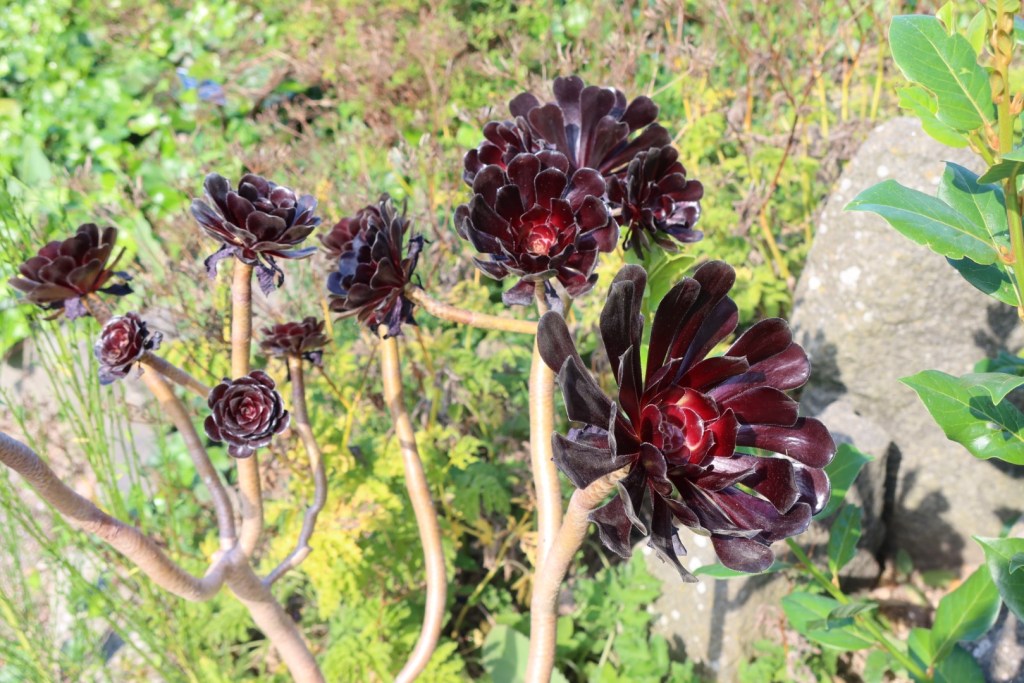
Pots of aeoniums are embedded into soil and dug up and protected under cover during the winter. The south-facing border provides the right place for numerous salvias, Helianthus, and South American Dahlias such as species Dahlia Dahlia merkii.

I am now going to let the photographs do the talking. Sadly I didn’t photograph all the plant names so a few of the plants featured are unidentifiable.

The anti-burglar plant Colletia histrix, also hails from South America.

The following images of a Begonia, Pelargonium and spectacular cacti were taken in the polytunnels.

Tom and his small team run a nursery shop stocked with plants raised at Lullingstone. A beautiful garden in its own right, few of us could resist the temptation of buying a souvenir of a memorable visit to this unique place. I treated myself to a pretty light purple Salvia Lavender Dilly Dilly, destined for new resilient planting in the front garden, a project I plan to progress and document here in the coming months. Also a green tinged Aeonium Velour, now getting VIP over-wintering treatment on the shelf in the spare bedroom. I feel a responsibility to nurture these two plants, given that Tom mentioned them both when signing my copy of his book!

How much the poorer the horticultural world would be had the kidnappers not freed their prisoners 23 years ago. Tom Hart Dyke’s vision of a garden encompassing unique specimens from across the globe would never have seen the light of day, a garden which has put Lullingstone Castle well and truly on the map for all plant lovers.

Kew Gardens, 3 December 2023

*The walled garden was formerly home to the white mulberry bushes (Morus alba) for the Lullingstone Silk Farm set up by Tom’s grandmother Lady Zoe Hart Dyke. Silk produced by the farm was used for the late Queen’s wedding dress in 1947 and her coronation dress in 1953. I love the fact that until the operation of the farm moved to Hertfordshire in 1956, hundreds of thousands of silkworms were bred in 30 rooms in the house where they grazed on the leaves of the mulberries.