

What follows is a summary of a talk I gave on 14 October to the Friends of Pensford Field, a conservation project here in Kew.
A garden doesn’t have to be a wilderness in order to be a haven for wildlife. I’ll detail the key components for a wildlife friendly garden, and argue this isn’t merely a trend, but that it’s vital that we all take steps to maintain and hopefully increase the biodiversity in our gardens.
Biodiversity loss is increasing at an alarming rate: Since 2004 the insect population in these islands has decreased by 64%. In the State of Nature report issued in the last week of September, it was stated that 1 in 6 of 10,000 species assessed is at risk of being lost from the British Isles, with a far higher figure for birds. In the January 2023 Big Garden Birdwatch the sighting of sparrows, song thrushes and skylarks was down again as it had been the year before.
Gardens are said to occupy more landspace than all Britain’s conservation areas and nature reserves combined, so re-wilded gardens could create important wildlife corridors between fragmented woodlands, meadows and other wild habitats.
As a gardener, my instinct is to keep the garden looking neat and tidy so surely making it wildlife friendly will mean sacrificing that sharp-edged smartness for something resembling a jungle? Not at all, you can for example devote a small area of the garden to a ‘re-wilded’ area where the grass is longer, there are woodpiles and wildflowers, perhaps a pond or a bog garden and after a while, the place will be buzzing with insect and amphibian life. This doesn’t mean that the rest of the garden should still need treating with pesticides and herbicides: if you get the balance right pesticides won’t be needed because birds and invertebrate predators like solitary wasps will have seen off the destructive bugs. As for weedkillers, there’s nothing like a session of intensive hand weeding to clear the mind, relieve stress and achieve attractive results without the equivalent of that scorched earth effect when the poison has done its stuff and the weeds have turned to an unsightly brown crispy mess.
What are the fundamental elements of a wildlife friendly garden? If you think about the three things we all need to function the same applies to garden wildlife: shelter, water and food. Dealing with each of these in turn:
SHELTER
Imagine micro versions of the habitats that wildlife thrives in: woodlands, meadows and wetlands.
Trees: You might already have a tree in your garden which shelters many different organisms, both at the invertebrate level as well as larger creatures like birds and squirrels. If you possibly can do introduce a tree into your garden. Many trees are well suited to smaller gardens and there are cultivars that have a narrow growing habit rather than having wide spreading branches. Examples are Prunus Amonagowa and Amelanchier Ballerina: both are deciduous but with interest in all seasons with spring blossom, fruits attractive to birds in late summer and attractive autumn foliage. Use the height and protection offered by the tree to install bird nesting boxes or open-bottomed bat boxes. Bear in mind that brand new boxes are usually made from treated wood which will smell of the chemicals used to preserve the wood (do also make sure that the product you buy is made from wood from sustainable sources). Birds and bats prefer to wait for a season or two until the box has weathered before setting up home. A bat box has an open bottom for the roosting bat to fly up into and needs to be fixed as high as possible, say at least 2 metres. Bird boxes must be sited away from potential danger points, such as fencing where a determined cat is likely to be able to take a swipe at a parent flying in or out while feeding a brood or indeed a fledgling leaving the nest for the first time.
Log piles: Piles of rotting wood in the form of log piles or stacks of brash, such as the prunings from a renovation prune of a favourite shrub, can be placed in shady corners to accommodate myriad invertebrates, including stag beetles. Despite their scary appearance and erratic bumbling flight, these fascinating animals are garden friends and by feeding on rotting wood the larvae help to keep our gardens tidy. The adults live for a few weeks of the summer and when seen on the wing are likely to be in search of a mate. Their distribution is confined to the southern counties with the highest concentration recorded in the south east. They are classed as endangered in many European countries and indeed have gone extinct in Denmark and Latvia. If you have to have a tree cut down for some reason, do not have the stump ground down but leave it to decay naturally where it will provide a des. res. for stag beetle larvae. If the stump looks unsightly in the centre of a bed or border, plant herbaceous perennials around it to grow up around it each spring and summer and hide the stump. Amphibians such as frogs, toads and newts will favour log piles for over-wintering. They also like to shelter in compost heaps, leaf litter, and spaces under sheds or greenhouses and decking: somewhere damp and protected. Their bodies need to be allowed to enter a period of low metabolic function to help them survive the cold. You don’t have to have a pond to attract amphibians (although a pond is a wonderful addition to a wildlife friendly garden as I shall go on to demonstrate). As long as there is dense planting rich in insect life for hunting which provides a damp hideaway, amphibians can reach other nearby ponds.
Bug hotels are another fantastic way to provide shelter for invertebrates in your garden and there’s a splendid example of one at Pensford Field. They’ve also become a popular garden accessory and can be bought off the shelf, though they’re not quite the same as creating one out of a log drilled with varying sizes of holes and stuffed with hollow stems for solitary bees and wasps. A commercially made bug hotel, like the bird and bat boxes, might smell and feel rather new and strange so may take a while to be occupied. There are houses for solitary bumble bees in the kitchen garden at Kew Gardens.

Long grass/meadows: Since the 1970s we’ve lost a shocking 97% of flower rich meadows in this country. The No Mow May campaign has been running now for a few years, started by Plantlife, the charity which aims to protect the vital habitats which so many creatures call home. The purpose of the campaign is to encourage gardeners and green space managers not to mow during May, thereby creating a space for nature. Long grass shelters many species of insect, grass hoppers included, and is a vital habitat to support their life cycles. If you do decide at the end of the month of May that you want to make the lawn look more Wimbledon Centre Court than Serengeti, there are a few things you can do to protect wildlife as you mow.
- Before starting to cut, hand search longer grass areas for small mammals like hedgehogs.
- For the first cut, set the blades as high as possible, and mow strips only half as wide as the mower to reduce the load on the mower.
- Don’t mow around the edges to the centre, as this prevents the creatures which have adopted this area as home from escaping towards the uncut section of grass.
- As you mow progress gradually towards sanctuary areas such as uncut grass strips at boundaries.
Let it Bloom June allows the lawn wildflowers which began to emerge in May to bloom by extending No Mow May into June and making part of the garden a wildflower landscape: encourage an area of lawn to be left as a flowering lawn to be mown once every 4 to 8 weeks during the growing season. Common low growing plants will re-grow and re-flower throughout the summer after a cut to maintain a shorter, neater height: red and white clovers, golden trefoils, blue self heal and white yarrow. Even in a period of drought, when the grasses fall dormant and go brown, the wildflowers remain green.
You can go one step further by mowing only twice a year avoiding the period from April to July. This enables you to recreate the effect of a traditional hay meadow. Taller flowers like red campions, purple knapweeds and mauve scabious will thrive. Treat an area like this as a perennial herbaceous border you never need to feed or water: by leaving it undisturbed for longer, the wildflowers and grasses will support the lifecycles of the invertebrates which depend on them.
By leaving some grass permanently unmowed, it won’t support as many wildflowers but will provide a sanctuary for wildlife in hot summers and cold winters: this could be a sanctuary strip at the base of a hedge or fence for toads and voles with seed heads acting as natural bird feeders for finches. This is low maintenance gardening with the only management being to snip out woody saplings or over-vigorous brambles.
When you do cut the meadowed area, it is advisable to collect and rake off cuttings : leave them for a day or so to dry and for invertebrates to escape. This prevents a build-up which might inhibit the re-growth of wildflowers and no cuttings rotting down into the soil means less soil fertility. The more fertile the soil the better the grass will grow at the expense of wildflowers. A further advantage of a wilder lawn is that it captures and locks away more carbon helping you to do your bit for the climate. In the next section I look at creating a wildflower meadow from scratch.


FOOD
Soil dwellers: When you’re planning a garden that will provide food for the creatures you want to attract, it helps to start at the bottom of the food chain with the invertebrates and other creatures and organisms which occupy the soil in your garden. We are constantly being told by gardening pundits to enrich our soil with organic matter. Not only does this improve the structure of the soil (particularly important here in Kew where we have very sandy soil from which nutrients are easily washed away), it provides fodder for the soil fauna like earthworms, mites, nematodes, springtails, ants etc. that spend much of their life underground. These in turn feed burrowing rodents like moles as well as omnivorous birds such as robins and blackbirds. You can mulch the garden with garden compost you’ve made yourself in a home compost heap or bin or with a number of media which will bulk up sandy soil or open out the structure of clay based soil. Examples are spent mushroom compost, composted bark fines or well-rotted farmyard manure. The best time to apply such mulches is in late winter just as spring bulbs and last year’s herbaceous perennials are nosing through so you can work around them rather than submerging them. As well as helping the underground creatures, your garden plants will thank you too as such mulches help to conserve moisture in the soil and feed the plants for the rest of the season.
Butterflies: Moving up the food chain brings us to the larvae of the butterflies and moths which when full grown will help to pollinate many of the flowers and food plants we grow. It’s easy to forget that a beautiful peacock butterfly was once a plump caterpillar. Caterpillars are also a favourite food of many bird species and invertebrates such as solitary wasps. A bluetit chick can eat as many as 100 caterpillars a day. In a fascinating butterfly talk and walk at Pensford in July the supervisor of Kew’s natural habitat areas, highlighted a number of plants which are particular favourites of certain species of butterfly:
- Brimstone caterpillars feed on buckthorn.
- White species of butterfly famously eat brassicas but as they also like nasturtiums these can be planted alongside as a sacrificial plant to distract the caterpillars from your cabbages.
- Tortoiseshells feed on stinging nettles.
- As well as holly, holly blue butterfly caterpillars feed on ivy and brambles
- Meadow browns and small skippers feed on grasses


Thistles are also good caterpillar food plants. If possible, leave an area in a sunny corner of the garden as a caterpillar larder for some of these plants to thrive. The results of the Big Butterfly Count this summer organised by Butterfly Conservation published in September revealed the great news that butterfly numbers increased this summer compared to the last four summers, though sadly many species have been shown to be in decline since the count started 13 years ago. This year’s mixed weather meant there was an abundance of green food plants for caterpillars and nectar-rich flowers for adult butterflies. The most successful species were red admirals, gatekeepers and holly blues. Since it is habitat loss which causes species to decline, it’s all the more important that we create wild spaces in our gardens for butterflies to feed, breed and shelter.

Pollinating insects: Choosing nectar-rich plants is easy these days when many garden centres use special labelling to highlight ‘plants for pollinators’ using a bee logo to reinforce the message. The important thing to remember is that the flowers you choose give insects easy access to the sweet nectar at the base of the flower and enable the pollinating insect almost incidentally to brush against the male pollen-bearing stamens and transfer the pollen to the female organ, the stigma. This can mean for example:
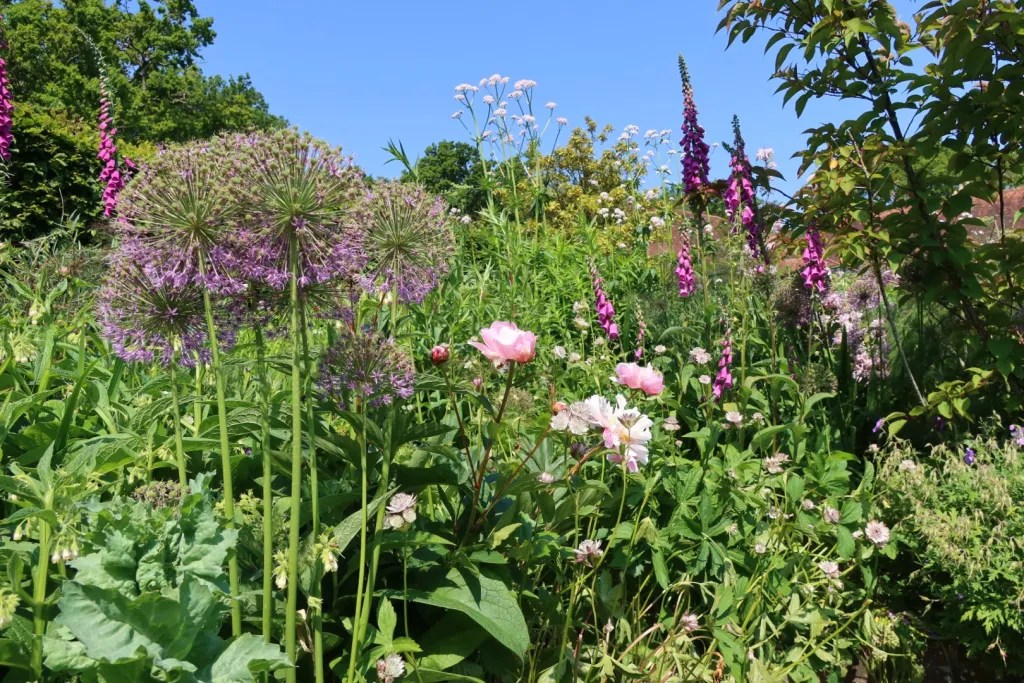
- Open, single-flowers are easy for flying insects to access: the petals are arranged as a guide, directing the pollinators to the centre of the bloom where the nectar is found. Think of daisies where the petals arranged around a central disc guide the insect to the bectar via the pollen. With dahlias, the slim-petalled ‘Honka’ dahlias or the ‘Bishop’ series like the dark-leaved, scarlet flowered Bishop of Llandaff are more likely to appeal to flying insect pollinators than the big showy blooms of dahlias like fashionable Cafe au Lait. Roses are another popular flower where we all fall for the multi-petalled beauties promoted by the likes of David Austin Roses. For a wildlife friendly garden choose a single-flowered china rose like the multi-coloured Rosa mutabilis, the deep red Bengal Crimson or the white climber White Star.
- Flowers with a wide landing platform (technically known as an umbel) where the flower heads consist of dozens of tiny flowers arranged in a plate-like structure. These include members of the carrot family such as fennel or sweet cicely, the succulent Hylotelephium (formerly Sedum) spectabile also known as the ice-plant or several members of the daisy family such as Achilleas. A. Goldsturm is a deep yellow cultivar which is very popular and looks particularly good in the borders either side of Kew’s Great Broad Walk.
- Flowers with a landing strip often highlighted with markings on the petals at the entrance to a tube or trumpet leading to the nectaries. Think of the spots near the lip of foxglove flowers or the wide apron like lower petal of salvia flowers.
- ‘Thistle’ like flowers attract pollinators. Examples include the globe thistle, Echinops ritro ‘Veitch’s Blue’ or the crimson Cirsium rivulare ‘Atropurpureum’ which featured a lot at this year’s Chelsea Flower Show. Also teasels and cardoons.
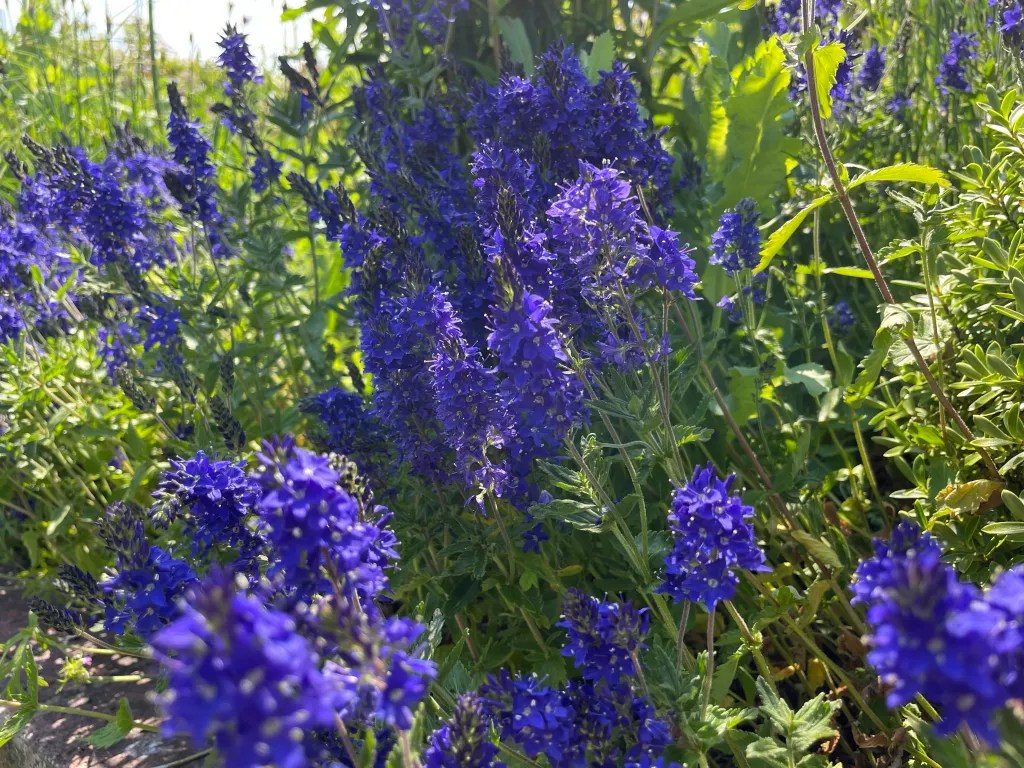
- Spires of flowers are popular with pollinators: I’m thinking of Veronicastrum virginicum ‘Fascination’ from North America or the various cultivars of loosestrife, Lythrum salicaria, whose nectar and pollen rich flowers are a hit with bees, butterflies and moths.
- Verbena bonariensis, has become a garden staple over the last few years and is a good flower for the hummingbird hawk moth whose long proboscis is able to feed on the nectar at the base of the tiny tubular flowers which make up the purple flowerheads.


Early and late flowers: Many of the flowers I’ve listed so far bloom through the summer months but let’s not forget the early months of the year when some of the early emerging pollinators are foraging for sustenance. This is where the early spring bulbs like snowdrops, scillas and crocus are important. And if you choose carefully from the bulb catalogues advertising their wares at this time of year, you’ll find varieties of Narcissus (daffodil) covering February all the way through to April, when some of the herbaceous perennials start to flower in earnest. Late sources of nectar are important too, and the creamy globe-shaped flowerheads of mature ivy are perfect for providing nourishment in October and November.

Flowering shrubs. The many forms of flowering shrub provide nectar. An obvious example is lavender, but early in the year Forsythia flowers are good, followed by Buddleia which if you keep deadheading them will flower well into September and are called the butterfly bush for good reason. In the last few weeks of Sepember I revelled in the bright blue spiky flowers of deciduous shrub Caryopteris x clandonensis which plays host to dozens of solitary bees, hoverflies and honey bees. A useful evergreen shrub for pollinating insects is Abelia.


Establishing a wildflower meadow I promised earlier to return to wildflower lawns and meadows. I’m including this topic when considering the food that will attract wildlife to the garden because the flowers that thrive in this kind of habitat are usually rich in nectar for flying insects. You can supplement the naturally occurring flowering wildflowers you find in lawns (aka weeds! like plantains and dandelions) with a wider range of meadow plants. either by sowing a wildflower mix of seeds, planting individual plug plants or installing a square or strip of wildflower turf as has been done here at Pensford. If you decide to make a meadow on bare soil don’t be tempted to enrich the soil with fertiliser, the poorer the soil the better. And dig out all perennial weeds like nettles and docks! Nurture these instead in the area you’ve set aside as a caterpillar larder. Let the area rest for a few weeks before sowing or planting, so that any ephemeral weeds can be hoed off and the soil raked, levelled and firmed lightly with penguin steps.
- Seeds. Broadcasting a packet or packets of seeds is the cheapest method of making a meadow. The seed companies produce mixes to attract particular creatures (eg. pollinating insects, birds) and it’s a question also of whether you want to make an annual or a perennial wildflower meadow. An annual mixture of seeds consists of colourful cornfield annuals like cornflowers, field poppies, corn marigolds and corncockles which will distribute their seed at the end of the season and produce flowers the following year although further sowings may be needed. Other mixes contain the seeds of perennial meadow plants. These can take longer to establish and might include ox-eye daisies, ragged robin, red campion, knapweed and field scabious. The best time to sow wildflower seeds is March or April or in September. The site you choose should ideally be in full sun and well-drained, though there are mixes for other areas such as shady or damp sites where the species chosen will thrive in such conditions.
- Plug plants. Using plug plants to create a meadow is more labour intensive and expensive but ultimately often more effective at establishing perennial meadow plants. Approximate cost: a tray of 104 plugs of 13 different species is about £90 and would cover an area of approximately 20 square metres. Method: create a grid of metre squares with canes and garden string and plant about 5 plugs per square metre.
- Meadow turf is sold by the metre and has been created by the suppliers sowing onto a mesh or a biodegradable plant fibre backing. The latter is the preferable method. Like seed mixes, in the case of both plug plants and meadow turf, there are numerous permutations depending on aspect, site conditions etc. The method of site preparation is the same. You’ve probably all seen the wildflower meadow around the base of The Hive in Kew Gardens? This was made using metres and metres of wildflower turf, much of which had to be pinned to the steep sides cut into the mound on which the structure is built.
- It is always recommended, in particular where a meadow is being created in a formerly lawned area, to sow yellow rattle seed in late summer to suppress the growth of the grass which if left unchecked will out-compete the floral element of the meadow. Yellow rattle, Rhinanthus, is a semi-parasitic plant which reduces the vigour of established grass.
- Teasels. Dipsacus fullonum, grow to about 2 metres and as well as looking pretty in flower with fluffy mauve flowers to attract pollinators, dry back to spectacular seed heads which will attract charms of goldfinches during the winter months. Like foxgloves, teasels are biennials and complete their life cycles in two years: growing a crown of leaves in year 1 and flowering and setting seed in year 2. To establish an annually recurring display, plant the crowns two years running.

Berries & hips for birds I’ve concentrated on pollinators but as the season progresses and berries and hips develop, many shrubs are good food sources for birds. Examples include the shiny berries of the so-called Guelder rose, Viburnum opulus, a favourite for thrushes and redwings, or the pink and orange fruits of the spindle tree Euonymus europeaeus beloved of starlings. Another good reason for planting this useful shrub is that it is host plant of the species of aphid that in their turn attract an army of predators such as ladybird larvae which will deter aphids from infesting your roses and broad beans. Rosehips are a great food source in late autumn and winter for birds.

WATER
Ponds. On a bat walk in August at the field, led by one of the rangers from Barnes Common, he described a pond as a ‘food funnel’ for species such as bats because it draws insects towards it on which bats can predate. In the same way that a watering hole in East Africa attracts animals from many miles around to quench their thirst, so a pond in your garden will act as a gathering point for an army of invertebrates. Not only the obvious waterside dwelling insects like dragon and damselflies, which if the pond is large enough to support a population of underwater creatures on which dragonfly larvae can feed, might breed there, but also pollinators like bees, hoverflies, moths and butterflies will swoop down to the surface of a pond to drink. As I mentioned before, a garden pond will provide a wonderful habitat for amphibians like frogs, newts and toads. It doesn’t have to be enormous, but you must provide some form of exit route for these creatures to get out of the pond because they spend much of their time on land, sheltered in the undergrowth. A staircase arrangement of bricks leading to the surface or a wooden ramp as I’ve seen in some gardens will enable them to get out when they need to. The huge advantage of having a resident colony of amphibians is that they will suppress the population of snails and slugs. An example of the phenomenon that introducing wildlife friendly gardening practices, like making a pond, will have a beneficial effect on the way you garden. If you’re making a pond from scratch, be sure to site it in a position where it will get direct sun for at least 8 hours a day in summer. The best practice is that one half or up to two thirds of the pond should be covered with vegetation. Having a small fountain in your pond will not deter the wildlife and will help to oxygenate the water. Even in a dedicated wildlife pond, as opposed to one that is ornamental, it is important to make sure that the water is kept moving, to avoid the water becoming stagnant. It is best not to install a water feature which throws the water high into the air as this will cause the water to evaporate more quickly in hot weather and in a dedicated wildlife pond would look incongruous. Just install a water pump with the fountain base just showing above the water line for a gentle bubble effect which is enough to agitate the water. Even with a fountain, you should still introduce submerged oxygenating plants (available from water garden suppliers) as these provide a habitat for small animals to live and breed.
Cleaning ponds. Even taking these precautions, ponds inevitably get clogged up and benefit from skimming over occasionally with a fishing net to remove blanket weed and any fallen leaves from neighbouring trees. Don’t immediately empty the debris you collect into the compost bin: just deposit it on the side of the pond to give any creatures that you’ve scooped up to disperse back into the pond. After about three days you can pick up the waste and dispose of it.
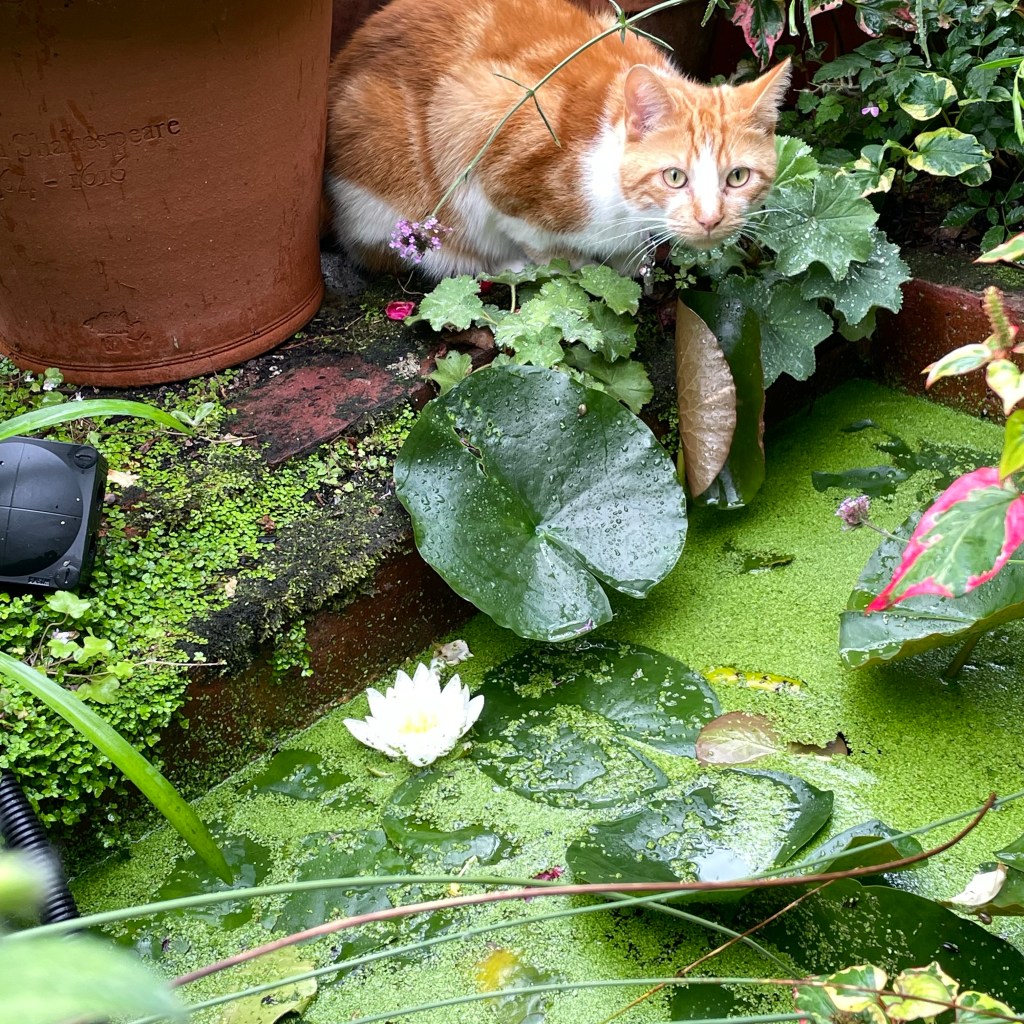

There are dozens of aquatic plants available for garden ponds, with waterlilies being the most popular. Whatever you choose be sure to avoid invasive species like parrot’s feather (Myriophyllum aquaticum), though the sale of this is restricted and shouldn’t even be available from a reputable aquatic plant retailer. Choose your plants according to the scale of your pond: there are several dwarf cultivars of water lily available for smaller ponds. Make sure to include some marginal plants around the edges of the pond for amphibians and insects like dragon and damselflies to shelter in. There are several rushes which look attractive though bear in mind they can grow quite densely and are hard to shift once established: an example would be Juncus effusus (Soft rush). If you’re looking for an online supplier, Lincolnshire Pond Plants is a good one. They won gold at both Chelsea and Hampton Court Flower Shows and are really helpful with advice as to the best plants to choose.
Bird bath If you hang birdfeeders in the garden for garden birds you should also provide a bird bath or similar to enable them to drink and bathe. Do keep it as clean as possible and make sure it’s kept topped up.
Bee bath. You don’t have to have a full-sized pond to help pollinators to swoop down and drink: you can provide a shallow saucer with a few pebbles which you keep topped up with water.
Having covered the basic 3 elements needed to attract wildlife to the garden, I’ve a list of DON’TS to share with you.
- DON’T use weedkillers. In the words of Joni Mitchell in Big Yellow Taxi ‘Hey farmer, farmer put away that DDT now, give me spots on my apples, but leave me the birds and bees, please’. She went on to sing ‘they paved paradise, put up a parking lot’, but run off from hard-standing which causes surface flooding is a whole other talk about resilient gardens! There’s no substitute for hand weeding accompanied by a good podcast or audiobook, not to mention a hori hori or Japanese trowel which while it might look like an offensive weapon is the most useful tool in my gardening toolbag.
- DON’T use pesticides. Once you establish a good balance in your garden by attracting natural predators with shelter, food and water, you won’t be as troubled by aphids, slugs, snails and pesticides won’t be needed. There are biological controls available for certain pests in the form of predators or pathogenic nematodes but this is a whole other topic and perhaps a talk designed to encourage wildlife is not the forum to be looking at ways to kill certain elements of it!
- DON’T use slug pellets aka molluscicides. Although the really toxic ingredient in slug pellets (metaldehyde) is now banned, you might have some of the old product in the shed. It’s poisonous to birds and pets as well as gastropods and SHOULD NOT BE USED.
- DON”T let the cat out at night. According to a Landscape & Urban Planning report in April 2022 on small mammal predation, UK cats kill 160-270 million animals a year, a quarter of them birds. Cats Protection League recommends the following steps to reduce predation: a dusk to dawn curfew, feed cats meat-derived protein food, and playing with your cat for at least ten minutes a day.
- DON”T over-illuminate your garden. It’s better to use a few solar-powered bulbs than an elaborate lighting system that confuses birds who don’t know what time of day it is and a brightly lit garden deters bats.
- DON”T deadhead roses from late summer onwards. Leave the spent flowers to develop into nutritious hips for over-wintering birds. They look decorative too.
- DON’T cut hedges or large shrubs before checking for nesting birds.
- DON’T cut sunflower heads when the flowers have finished. Leave them in place after they have finished flowering as blackbirds love the oil rich seeds.
Here are a few suggestions for wildlife friendly gardens which are open to the public:
- Kew Gardens: especially the natural area in the south of the Gardens.
- The wildlife garden at RHS Wisley next to RHS Hilltop, designed by Ann-Marie Powell. The beds are inspired by the shape of a bee’s wing and includes two large pools with aquatic and marginal planting. https://www.rhs.org.uk/gardens/wisley/garden-highlights/the-wildlife-garden
- The Knepp Estate in West Sussex. Like the wider estate, the walled garden is being managed to maximise biodiversity, whilst being as sustainable as possible. You can join a ‘rewild your garden safari’. https://knepp.co.uk/knepp-estate/gardens/
- Vineyard Passage Burial Ground in Richmond. ‘Wild woodland garden’ https://habitatsandheritage.org.uk/get-involved/our-projects/vineyard-passage-burial-ground/
- Pembroke Lodge gardens in Richmond Park where there are two ‘wildflower’ meadows being established. One is a traditional wildflower meadow, the other is in the North American prairie style and planted with pollinating attracting flowers such as Dianthus carthusianorum and Echinacea.
Kew Gardens
21 October 2023