I went down to Cornwall, a most wonderful place. Not England at all!
Barry Humphries (1934-2023). BBC Radio 4 ‘Desert Island Discs’ 24 May 2009
Following in the footsteps of Barry Humphries who sadly died on Saturday, I’ve arrived this afternoon in south Cornwall to explore some of the great gardens in the area. Leaving the main roads, I was immediately struck by the density of vegetation on either side of the famously narrow country lanes: primroses, bluebells on the brink of opening, harts-tongue ferns, arum lilies. At the foot of these Cornish hedges (described on the Cornwall Council website as resembling a vertical flower meadow), I glimpsed an abundance of wild garlic. Cornish hedges are often ancient structures built of stone which over centuries have accumulated a covering of soil making them perfect habitats for a wealth of native plants. Not to mention birds, invertebrates and mammals.
My first stop en route to the cottage I’ve rented was the Duchy of Cornwall Nursery. It is situated on the side of the River Fowey valley with a series of terraces looking west across the valley to Restormel Castle, an English Heritage site. Whilst enjoying the view I spotted a pair of choughs flying gracefully above the trees in the middle distance, distinguishable from other members of the crow family by their finger-like wing feathers.
Restormel Castle
The nursery site was once a slate quarry and has been cleverly landscaped to include plant sales areas as well as themed gardens and a high terrace where snacks and coffee can be bought from the shepherd’s hut style cafe and enjoyed at nearby tables and benches. I was impressed at the vast range of high quality containers displayed on the next level of terracing. And it was a happy surprise to encounter one of the handsome Indian elephants fashioned from Lantana whose herds graced The Green and St James’s Parks in 2021 (see my blog Scenes and Herds).
The Bumblebee Garden is planted with pollinator friendly species and included a useful key to the wide range of solitary bees to be found in this country as well as tips to attract them into the garden. It was a useful reminder to read that a shallow dish with pebbles will provide the bees with water. I enjoyed the neat arrangement of raised beds in the Kitchen Garden, where herbs and edible flowers are grown for the cafe.
I’m staying on the east coast of the evocatively named Roseland Peninsula, looking across Gerrans Bay to Gull Rock. On a brief walk down the lane to the nearby Porthcurnick beach I spied developing spires of Echiums springing up at the roadside and the spent spikes of the 2022 harvest of these pollinator attracting Canary Island natives. Thick clusters of Alexanders, Smyrniumolusatrum, populate the verges at the foot of the Cornish hedges and I can see red valerian growing between the stone steps leading to the upper level of this cottage. It’ll be next month before I’d expect to see it flowering in the south east.
My activities this afternoon have whetted my appetite for the treats to come when I continue my south west road trip tomorrow.
Tom Stuart-Smith has put his mark as a landscape architect on numerous gardens across the country. I’ve seen his planting at Chatsworth House in Derbyshire and in July 2021 was fortunate to go to the inspiring garden at his home, Serge Hill at Abbots Langley in Hertfordshire. This last weekend gave me the opportunity to compare two more of his creations: the new Royal Horticultural Society garden, Bridgewater, south of Manchester and the Italian Garden at Trentham Gardens, Staffordshire.
Steady rain fell throughout the afternoon at RHS Bridgewater but it meant that the gardens were very quiet enabling us to see the structure of the garden for which Tom Stuart-Smith created the masterplan for the development of the site as a centre of excellence for horticulture in the north-west. He also designed the layout and planting of the Paradise Garden which forms one half of the restored 11 acre Weston Walled Garden, a major feature of the new garden, as well as the Worsley Welcome Garden located close to the Welcome Building.
The joy of a RHS garden (like RBG Kew and other botanical gardens) is that all plants are labelled, so you start learning as soon as you step outside into the garden. A perennial honesty (Lunaria rediviva) soon caught my eye. In borders between the outer and inner walls of the walled garden, massed plantings of tulips and daffodils lit up the gloom of the rainy afternoon. Terracotta rhubarb forcers nestle amongst the bulbs, a clue to the presence at Bridgewater of the National Collection of rhubarb, with 100 cultivars having recently been moved from RHS Wisley. I also liked the gnarly branches (driftwood?) which accent the border every so often, resembling abstract sculptures.
I love to see show gardens from flower shows re-purposed, and the high brick wall of the Weston Walled Garden provided a perfect backdrop for Windrush Garden from RHS Flower Show Tatton Park, 2021, designed by Dawn Evans.
The Weston Walled Garden is divided into two equal halves: the Paradise Garden and the Kitchen Garden. High metal obelisks, designed to resemble the chimney of the original boiler room which heated the glasshouses which served Worsley New Hall, punctuate the enormous Kitchen Garden which contains more than 100 planting beds! Unobtrusive strainer wires are fitted along the walls. to support an impressive collection of wall-trained fruit, including heritage pears.
The heart of the Paradise Garden is a very large body of water, the Lily Pond, fed by two rills which intersect the garden. Partially covered by a decorative grill in a geometric design, the rills are just one example of the wonderful attention to detail manifest throughout Bridgewater. At this time of year and on a wet afternoon, the colours were muted: greens and the reddish brown of the beech columns planted around the Lily Pond. From photographs in the guide book and having seen Serge Hill* in high summer, I can imagine just how colourful the Paradise Garden must be later in the season. One of the features of Serge Hill which impressed me was the Plant Library, trial beds laid out in a numbered grid, designed as an open resource for garden design students to see how plants behave and move, featuring many drought tolerant plants. I’m imagining that some of the species in the Plant Library are also planted into some of the Paradise Garden’s 80 planting beds.
Two new glasshouses in Victorian style have been built along the southern wall of the Paradise Garden, to house tender specimens such as Aeonium. On the opposite side of this wall stands the Old Frameyard, home to the boiler room and its chimney, as well as potting sheds (now an exhibition space), a brand new Propagation House, and beds laid out for plant trials. Near here we spotted another show garden, the Blue Peter Discover Soil Garden designed by Juliet Sargent for the Chelsea Flower Show in 2022.
Just beyond the walled garden stands the restored Garden Cottage, once home to the the head gardener of Worsley New Hall. The cottage is surrounded by an immaculately mowed, semi-circular lawn.
Heading into the wooded area of Bridgewater we found a friendly ent, and in the fields beyond the woodland, the Pig Pen for the black Berkshire pigs which have been used throughout the creation of Bridgewater to act as ‘biological ploughs’ and clear the ground in various parts of the garden before planting. Here and there in the woodland, are remnants of the original gardens and to the north of Ellesmere Lake, the remains of the terraces which stood in front of Worsley New Hall, the large Victorian House which was demolished after the Second World War.
Flowing from Ellesmere Lake down the hill to Moon Bridge Water, the new body of water next to the Welcome Building, is the Chinese Streamside Garden, which is intersected with a series of small pools and crossed by a series of wooden bridges. The planting is designed to reflect the numerous Chinese native plants which are now favourite shrubs and trees in the west: acers, magnolias, primulas included.
Thankfully the weather improved for the second garden visit of the weekend: Trentham Gardens near Stoke-On-Trent, Staffordshire. Here three eminent contemporary garden designers have made their mark on a garden which has its origins as an eighteenth century landscape garden (the lake around which the garden and parkland are located was designed by Capability Brown). Piet Oudolf designed the Floral Labyrinth which stands beside the River Trent at the eastern end of the garden, near the ruins of the Italianate Victorian house: 32 beds of herbaceous perennials in the Dutch designer’s trademark prairie style. The beds were just beginning to spring to life, with tantalising crowns of greenery promising a lush summer display. Snakeshead fritillaries (Fritillaria meleagris) nodded gracefully in several beds.
The Perennial Meadow Garden along the edges of the lake was designed by Professor Nigel Dunnett (Tower of London Superbloom, Gold Meadows London Olympic Park and the Barbican). The third of the designers to shape this garden in the 21st century is Tom Stuart-Smith. When she showed us around her own garden at Serge Hill in July 2021, his sister Kate Stuart-Smith told us her brother’s nickname in the family was GAT, Great Arbiter of Taste! The Italian Garden at Trentham is certainly a class act. Like Bridgewater’s Paradise Garden, it is on a grand scale, a formal parterre style layout of symmetrical beds, some edged with low hedges arranged around low walled formal pools, centred with fountains. The Italian theme is reinforced with classical statuary, monumental urns and slim columns of Irish yew standing in for cypresses. The simplicity of the planting prevents the space from seeming unduly elaborate. One set of beds is planted with white flowers and silver-leaved plants: tulips, narcissus and a white-flowered Brunnera with silver-veined leaves, possibly B. macrophylla Mr Morse.
Low evergreen domes and similarly scaled stands of grasses planted into lawned areas echo the yew domes dotted on the lawn alongside the Worsley Welcome Garden at Bridgewater.
Trentham GardensRHS Bridgewater
The Italian Garden is divided from the Floral Labyrinth by an arched pergola running its entire length, entwined with climbing roses and Wisteria, yet to bloom. Running alongside the pergola is the David Austin Rose Border, designed by Michael Marriott. I can only imagine how fragrant and beautiful this must be when in flower. The roses were certainly looking wonderfully healthy last Saturday.
Whilst brief, my 36 hour trip to the north west was enormously satisfying, and it was a joy to see Tom Stuart-Smith’s work in both gardens.
20 April 2023, Kew
*Here are some of my images of Tom Stuart-Smith’s garden at Serge Hill, taken in July 2021.
In my last blog post I featured an image of an unusual bell-shaped snowdrop, Galanthus Phil Cornish. I took the photograph in February on a Sunday afternoon visit to East Lambrook Manor Gardens, near South Petherton in Somerset, the creation of garden writer Margery Fish. I first went to this fascinating garden in May 2021 and vowed to return during another season. In winter you can see the bones of a garden without the distraction of abundant foliage and flowers.
Galanthus Phil Cornish
In this case the skeleton consists of narrow paths between cottage garden borders, a mini avenue of curvaceous yews and the ditch which Margery Fish cleverly incorporated into the heart of the garden. In the winter months these elements are embellished with a splendid display of snowdrops: in pots lining the paths, in borders and on the banks of the ditch. This Festival of Snowdrops takes place every February.
Naturally snowdrops were the main attraction in the plant nursery which adjoins the garden. Here they were set out on tables for sale with some of the price tags reflecting the rarity of the specimens displayed. Examples of each of the cultivars grown at East Lambrook were arrayed on the long stone shelves which on my last visit featured the hardy geraniums loved by the garden’s creator.
Snowdrops in the nursery shop
I chatted to the gentleman operating the till at the nursery who told me that he had worked with several members of staff who had known Margery Fish until her death in 1969. He told me a story which summed up her passion for her garden. During a trip away from home, a fire broke out and badly damaged the Malthouse (which now houses a cafe and gallery). When she was called to be told the bad news, Margery Fish’s first reaction was to ask if the garden had been damaged in any way. It had not, she expressed her relief and only then enquired about the state of the smouldering building.
Here are some of my photos of the garden in February, which as I write this on a very chilly April evening, doesn’t seem so very far away.
I spent yesterday on a one day course in cyanotype printing at the CityLit Institute in Holborn. I’d come across cyanotype prints in a couple of amateur art exhibitions and in a Landscape magazine article about an artist who prints onto fabric from which she makes lampshades and soft furnishings, and thought I’d like to try it. In case you’re wondering what this has to do with gardens and gardening, it’s a technique that has been used since it was invented in the C19 to document plant material.
The story starts with the astronomer Sir John Herschel who invented the cyanotype printing process in 1842. His friend Anna Atkins (1799-1871) is credited with being the first woman to create a photograph and the first to publish a photographically illustrated book. She was, first and foremost, a botanist and adopted this new technique to record with great accuracy the plants and seaweed she collected and studied. She often dried and pressed the plants she portrayed before laying them out for the image. Many of her works are now in the collection of the Victoria & Albert Museum.
Our tutor Adam Hogarth explained that by the end of the course we would have learnt how to make cyanotypes using both photographs and found objects. The first step is to coat the paper with ‘iron salt’ a solution combining two chemicals with bottled still water. Adam prepared the light sensitive solution in a plastic flask and kept it in a cupboard to protect it from daylight until we needed it. Fortunately the day was very overcast and the light levels in the studio were low, because the process should be carried out in subdued light.
Using Canaletto 330g paper, we painted on an even amount of solution with a broad dry brush, leaving it to dry in a dark cupboard until needed. This usually takes about an hour, but the process can be speeded up by using a hair dryer. These sheets are called contact sheets.
Before I go on to describe the various techniques we learnt for creating the images which we were to learn how to print using the cyanotype printing process, here is the recipe for the solution:
10g Potassium Ferricyanide: using still bottled water, make up to 100ml in a calibrated flask.
25g Ferric Ammonium Citrate: ditto
Make sure both components are thoroughly dissolved before combining them.
The components of the light sensitive solution Applying the solution to the contact sheet
Technique No. 1: Digital acetate
We emailed a few images to Adam who used Photoshop to convert them to black and white, he then adjusted the images for brightness and contrast before turning them into negatives and printing them onto A4 acetate sheets.
I chose four photographs: Seamus the cat on the kitchen windowsill, a scene from Kew Gardens with the Davies Alpine House in the background, a Euphorbia flower head and a pair of snowdrops photographed at East Lambrook Manor Gardens in February (Galanthus plicatus Phil Cornish).
Technique No. 2: Autographic marks
This was the bit I found very challenging: the brief was to hand draw bold marks on tracing paper using a selection of black wax crayons, a Japanese calligraphy pen, black markers etc. The blacked out areas would appear white when printed. I tentatively made some random shapes with a wax crayon, trying to make the blacked out areas as dense as possible. Drawing is not my strong suit and part of the appeal of this printing method is to create something artistic without having to draw!
Technique No. 3: Found objects
Plant material such as fern fronds, leaves or seed heads seem the obvious subject but I learnt that you can use all sorts: feathers, lace, scraps of woven fabric such as scrim, anything that might create a pleasing pattern on the finished print. Because we were using a light box with a rubber cover which was suctioned down flat onto the objects whilst they were being ‘printed’, our found objects had to be relatively flat so as not to damage the cover. Wineglasses were not allowed!
Next came the fun part: placing the acetate, tracing paper or found objects (or a combination of them) onto the surface of the lightbox and covering them with a contact sheet before closing the lid and pressing the GO button. The lightbox was on a setting of 55F meaning it was on full beam. A thin sliver of UV light was visible around the edges of the cover while the lightbox rumbled loudly during the period of exposure. Lifting the lid, we transferred the contact sheets into a bath of tap water to wash off the yellowy green solution. Swirling the paper around in the bath the image begins to emerge against a blue background which, as the paper dries, intensifies to a deep indigo. We stuck our images to a screen above the bath to drip dry for a few minutes before moving them to a huge multi-sectioned drying rack.
The original and most low tech method for developing cyanotype prints is to harness the sun’s UV light by exposing the contact sheets in bright sunshine. The rest of the process is much the same, save that because the light source is from above rather than below the contact sheet is placed facing upwards with the found object or the acetate* placed upon it. A sheet of glass or a perspex clip frame is used to hold the subject flat.
Once we’d printed a couple of conventional sheets using found objects and acetates, we were encouraged to experiment by mixing our source material. I tried superimposing a fern onto my Kew Gardens photograph, and popped a cut out of a snowdrop acetate onto the same image, resulting in a rather ghostly scene!
Cyanotypes can be tinted using tannin (tea, coffee, red wine!) to substitute sepia tones rather than an intense blue. Adam also told us about another technique, anthotype printing, where the light sensitive solution is made from strongly pigmented plants such as spinach leaves or beetroot instead of chemicals. The plants are mashed up in a blender and strained through a muslin, the liquid is used to create a light-sensitive contact sheet with the images or objects being placed on top of it as outlined above before exposing the sheet to the sun. Rather than blue, the images emerge in green or dark red, depending on the material used. It struck me this would be a great activity for the great nephews on a hot summer’s day.
I’d no idea until attending this course how popular cyanotype printing is and the extent to which you can make quite abstract images. I’m abuzz now with ideas for perhaps a seaside themed image, using shells and seaweed or for a cyanotype record of the flowers in the garden through the seasons.
*The image printed onto the acetate should be a digital positive when printing with a light source from above.
At lunchtime I walked across Kingsway to Lincoln’s Inn Fields and through to New Square in Lincoln’s Inn where I worked in the late 1980s and early 1990s. Although the squares and courtyards of this atmospheric Inn of Court are still lit by gas light I noticed that a concession to the 21st century has been made with the installation of electric car charging points. I admired the beautiful planting in the garden areas of the Inn, exemplified by this stunning combination of Euphorbia and Stachyurus praecox in the garden to one side of New Square.
I think this was my favourite image from the eight or so I made yesterday, combining the skeleton of a magnolia leaf, a piece of fern and a cut out acetate of an unusual snowdrop (Galanthus plicatus Phil Cornish).
I was at a pub quiz once when the quizmaster asked contestants the former names of a series of places: Ghana (Gold Coast), Istanbul (Constantinople), Iceland (Bejam!!!)* I was reminded of this trick quiz question when I came across two plants within a week bearing similar species names** deriving from the word Formosa, the name given to the island of Taiwan by Portuguese sailors in the C16 and in common use by English speakers until well into the C20. Thinking it would be a jumping off point for a blog about a couple of plants sharing the old name of this island to the east of mainland China I started to dig into the subject. I discovered I was mistaken about at least one of the plants in question originating in Taiwan. Formosa means beautiful in Latin, so the botanists who named it were referring to its attractive appearance, not geographical origin!
For the last three years, in February, I have pruned all the late summer flowering shrubs in a garden in Teddington. One of the largest shrubs there is Leycesteria formosa, a spectacular deciduous shrub which is sometimes called Himalayan honeysuckle. Forming a thicket of upright branches, it can reach heights of 2m and bears tapered dark green leaves. At or near the the tips of the branches hang flower ‘spikes’ measuring up to 10cm long made up of white flowers threaded between dark purplish-red bracts. Pruning is easy: like Buddleia and hardy Fuchsia, the bare branches (which are hollow and bamboo like) are cut down to the base each winter. The RHS Encyclopaedia of Garden Plants states that it originates in cliffs and mountain woodland in India, China, the Himalayas and Myanmar, with no mention of Taiwan. This plant is named for its beauty not its native territory.
Thankfully though my romantically named island theory does apply to Tricyrtis formosiana which hails from Taiwan! The common name of this woodland herbaceous perennial is toad lily. Whether this is because its purple spotted flowers resemble a particular species of toad I have yet to find out. I recently refreshed the planting in a client’s shady cottage style front garden by introducing some shade loving ground cover (Brunnera macrophylla Jack Frost and Epimedium perralchium Frohnleiten) and thought it would be fun to throw in something more unusual in the form of a toad lily. The cultivar I chose is called Dark Beauty and flowers in August and September growing to approximately 60cm. Apparently young plants can be susceptible to slug and snail attack, so it would be good to think there might be some real amphibians in the vicinity to see off the gastropods!
Regular readers of this blog have probably noticed that I am fascinated by the history of plant names. Studying these two plants has taught me that it pays to look beyond the words used, because the obvious meaning is not necessary the correct one.
This is a rare post without photographs as neither plant flowers until later in the year. I’ve made myself a note to revisit this post when I’ve had a chance to take photographs of both.
*In January 1989, frozen food retailer Bejam was bought by its rival Iceland.
**Most plants bear names consisting of two words. The first is the genus name to indicate the group of plants it belongs to. The second is the species name and is usually descriptive of its origin, colour, appearance or other distinctive feature.
Swapping my secateurs for a notebook and pencil two days ago, I headed east to the Business Design Centre in Islington to attend the Garden Press Event where companies showcase innovations in garden tools, machinery, accessories and materials to the garden media. This was my third GPE if I don’t count the two virtual events held during the pandemic. As well as tracking trends it’s a great opportunity to meet up with fellow members of the Garden Media Guild be they bloggers like myself, journalists, podcasters or social media influencers.
It was refreshing to see the huge emphasis on sustainability throughout the show and I’m highlighting some of the initiatives in this direction in this blog post as well as a nifty way to stop garden hose connectors from leaking and a collaboration between the National Trust and a garden centre chain.
I chatted to as many of the stands as I could identify promoting growing media free of peat. By 2024 no compost can be sold containing peat. This is not a moment too soon to protect unique habitats such as the Somerset Levels, which we’ve plundered for decades to produce potting compost for amateur and professional gardeners alike.
I buy masses of peat-free compost throughout the year for myself and for clients, for use in containers as well as for propagating plants so it was interesting to see the well-established brands and some newcomers. The RHS endorsed Sylvagrow peat free range is made by Melcourt who this year celebrate 40 years in the industry. Cumbria based Dalefoot is gaining a reputation for high quality (and expensive) peat free products based on bracken and the wool of Herdwick sheep. Two exhibitors use compressed coir (coconut husk) in compost blocks: Eazy Grow Compost from Eazy Gardening Ltd and Coco & Coir from Southern Trident. Once soaked in water these relatively light blocks transform into all purpose potting composts. It would certainly save lugging 40 and 50 litre bags of compost around. Southern Trident has also blended different nutrients into 9 litre blocks specifically for orchids and houseplants respectively. New Leaf peat free compost made in Northern Ireland is endorsed by garden designer and TV personality Diarmuid Gavin.
I was very taken by the attractive designs of the 100% recycled plastic bird feeders from Dutch company Singing Friend. They have developed a way to recycle the plastic lining of Tetrapak-type drinks cartons, making it into lightweight bird feeders in a neutral khaki shade retailing for less than £10. I love the story of this family company, now run by its third generation, being founded in 1951 by a man with a passion for birds. Their mission statement sums up the company philosophy well: We build a bridge between design and nature, and stimulate the creation of new living environments for birds, by people.
Continuing the sustainability theme, it was good to meet Chris Wiley of the Sustainable Plant Store, a new company selling eco-friendly alternatives to popular plants and garden products. I particularly liked the 8cm coir pots bound with natural latex as an alternative to the ubiquitous plastic flower pot. Another exhibitor proposing a substitute for plastic pots was Wool-Pots whose minimalist ecru coloured knitted ‘socks’ approx. 12 cm long can be filled with compost and stood on a terracotta saucer or stood en masse in a seed tray and used for potting on seedlings or growing cuttings and can then be planted straight into the ground. The wool will biodegrade in time and leaving the ‘lip’ proud of the soil is said to deter slugs and snails. At the moment the product is manufactured in Egypt in a factory which is SEDEX* certified and plants two trees for every order under their ‘plant one get one tree’ initiative. Wool-Pots ambition is to start its own factory in the UK.
I can’t be the only gardener to waste frustrating time each summer trying to fix a connector back on the end of a hose after it’s shot off under pressure. Qwickhose from Rivendale products have created a universal hose connector using a wing-lock system instead of the plastic teeth used in conventional connectors. Their starter set consists of two connectors, a tap connector and a nozzle spray to be stored in a neat wall mount which I shall fix to the shed wall this week. Unlike their competitors’ trademark yellow plastic, this product is a distinctive shade of blue. I got a pleasant surprise when I opened the carton to find it included a strip of recycled cotton embedded with tomato seeds!
One of the largest stands at the show was occupied by Blue Diamond Garden Centres which in 2022 began a five year collaboration with the National Trust. Naturally, as a garden volunteer with the Trust I was keen to find out more about this project. So it was fun to chat to Andy Jasper, National Head of Gardens and Parklands for the Trust. A fellow South Cornishman, he of course knows NT Osterley’s head gardener, Andy Eddy. The Blue Diamond/National Trust collaboration has resulted in several new lines including a collection of more than 60 flower seed varieties inspired by the Trust’s gardens, at least 10% of the retail selling price of which will be given to the Trust. The beauty of the Trust’s gardens is reflected in several ranges of bulbs, the collection of naturalising bulbs such as crocus and species tulips to be launched later in the year.
My favourite product on this beautifully designed stand was the box containing 14 herbaceous perennials in various sized pots inspired by the herbaceous border at NT Nymans in West Sussex. The cover of the container includes a plan of the planting scheme and a description of each plant. This bespoke collection includes Heuchera Lime Marmalade (which I love despite a client having told me after I planted it in his garden that it reminded him of lettuce!) and Rudbeckia Goldsturm. Close inspection of the plant descriptions revealed that they were all describing a Crocosmia, possibly Lucifer, but I think the exhibitors can be cut some slack for displaying a prototype containing placeholder text. The collections, which will also include the herbaceous border at Hill Top in Cumbria, the White Garden at Sissinghurst and the Red Borders at Hidcote will go on sale in April. These would be brilliant presents for someone moving into a brand new house with a blank page of a garden to plant up.
Another clever initiative arising out of this collaboration is the propagation of a limited number of specimens from two iconic trees at Trust properties: Isaac Newton’s Apple Tree from Woolsthorpe Manor, Lincs and the Ankerwyke Yew from the banks of the River Thames opposite Runnymede. The young trees are being raised in The National Trust Plant Conservation Centre based in a secret location in Devon and will be for sale in exclusive auctions in 2024. Blue Diamond is already selling a collection of the roses which can be seen in the rose garden at Powis Castle in Wales and is launching a new rose this summer: ‘Mottisfont’ is named for the home in Hampshire of the National Collection of old roses. From the photograph this new rose looks to be a beautiful multi-petalled rich deep pink.
My final shout out is to Niwaki who as always displayed their beautiful garden tools and accessories on a stylish stand. They displayed endless patience in answering my questions. The hori hori Japanese trowel remains my favourite garden tool and it was interesting to see a demonstration of its blade being sharpened with a diamond file. I also found out I’ve not been using the Crean Mate tool cleaning block properly: I should dip the tip of it in water before use. Thank you Niwaki for the selection of Japanese salad and vegetable seeds.
I’ve only scratched the surface here of what was on view at the GPE: makers of ladders, machine tools, plant foods were all there in force. It was a hugely enjoyable show and I’m only sorry there were a few Guild members I didn’t get to chat to on this occasion. Roll on next year’s show!
23 February 2023
Kew Gardens
*SEDEX stands for Supplier Ethical Data Exchange, an online system that allows suppliers to maintain data on ethical & responsible practices and allows them to share this information with their customers.
The winter garden I wrote about in my last blog post was planted over the course of the last couple of years. That at Osterley House and Garden is about 10 to 15 years old, but already has an air of maturity. In contrast to the symmetry of the layout of Mrs Child’s flower garden and the floral exuberance of the cutting garden, the winter garden feels more informal. The winter garden is located between the Long Walk (which skirts the gardens themselves and the perimeter of the park towards the lake) and the grassy slope opposite the American Border which is beginning to colour up at this time of year with hundreds of bulbs (narcissus, crocus and later on Camassia).
The wood chip surface path through Osterley’s winter garden is interrupted by a generous circular lawn in the sunniest part of this garden: a peaceful area to sit and listen to the birdsong and admire the winter flowering shrubs, colourful stemmed dogwoods and willows, and ground cover planting.
The season starts with the bright purple berries of the Beauty Berry (Callicarpa bodinieri) which complement the aqua tones of a Euphorbia. Scent arrives next in the clustered tubular flowers of Viburnum bodnantense Dawn and V. Charles Lamont and the delicate cream flowers of winter honeysuckle Lonicera fragrantissima. My favourite plant in the winter garden is the large paper bush (Edgeworthia chrysantha) whose silky flower buds open in February into tiny trumpets each lined in vivid yellow, gathered into neat hemispheres suspended from the generously spreading branches of this graceful shrub.
Like so many winter flowering shrubs, Japanese quince flowers on bare stems, emphasising the purity of the form of the blooms. The elegant white form Chaenomeles speciosum Nivalis features repeatedly in the bed opposite the paper bush.
The loss of a large conifer in the last couple of years has created a space for new planting and we recently spent a morning, supervised by head gardener Andy Eddy, planting hellebores and witch hazel in one of the newly cleared areas. The planting scheme includes the striking combination of black Mondo grass (Ophiopogon planiscapus Nigrescens) and snowdrops which also features in Kew’s Winter Mound.
When non-gardening friends ask me if I have anything to do in the winter, they’re surprised when I reply that I’m as busy at this time of year as I am in spring and summer. Doing what? Tidying, pruning and mulching mainly. And surely there are no flowers to see in a garden in winter? Quite the contrary, this is the season when shrubs that take a back seat for the rest of the year bloom their socks off to attract early flying pollinators, often flowering on bare wood as well as pumping out sweet perfume. Early bulbs too are a welcome sight in January and February gardens, flashes of brightness against the newly mulched soil.
There’s now an area of Kew Gardens dedicated to this season. The Winter Mound has been created on Flagstaff Mound*, one of the few ‘hills’ in Kew’s otherwise flat 330 acres. Whilst winter flowering shrubs abound in the Gardens, notably around the Ice House, it is a joy to see them centre stage in a new garden. A new path curves elegantly around the mound towards the summit, where vestiges of the flagstaff’s concrete base and fixings remain apparent. This vantage point gives a good view of The Temperate House’s eastern facade and a bench has been installed from which to enjoy it.
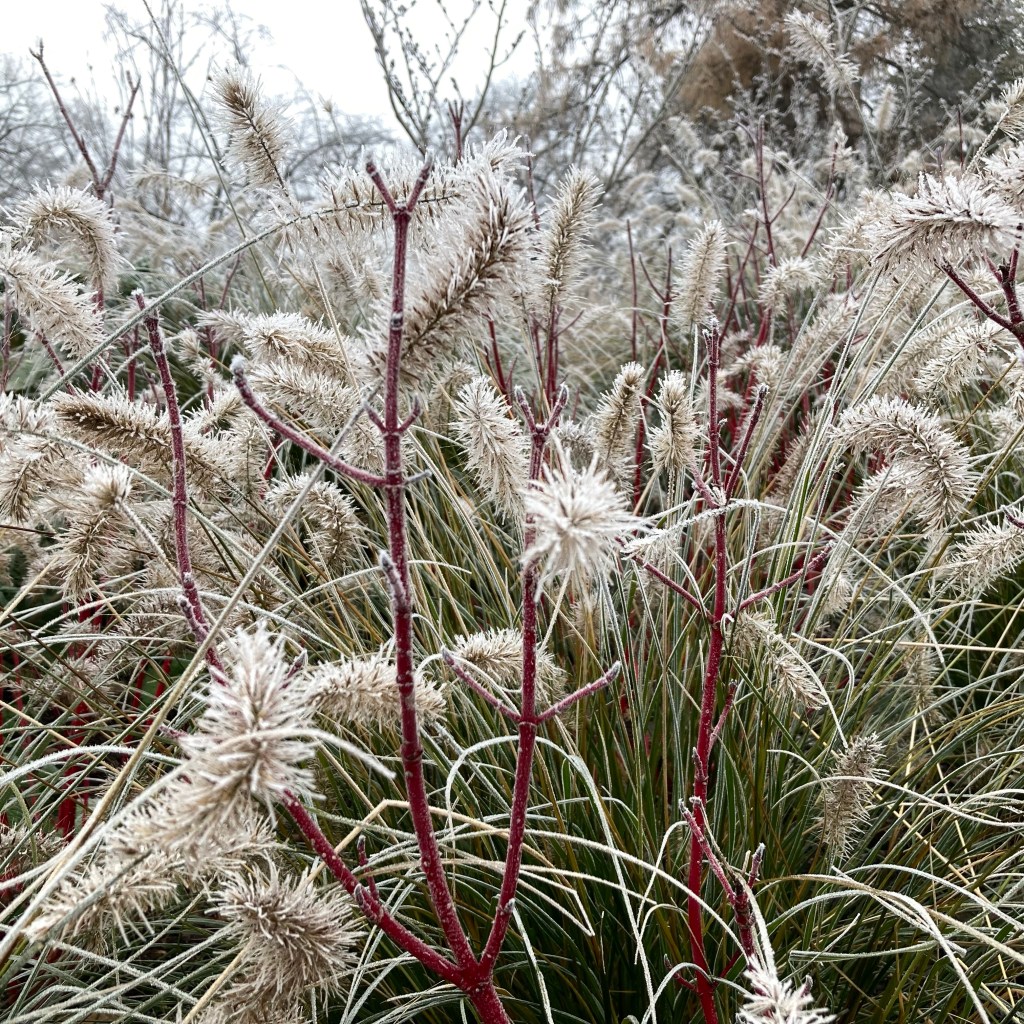
Snowdrops are now in flower on the lower slopes, in one section gleaming brightly amidst a mass planting of black mondo grass (Ophiopogon plansicapus Nigrescens). All the plant combinations are inspiring: the fern Polypodium vulgare nestles beneath white stemmed birches, Betula utilis subs. jacquemontii Doorenbos. The paper bush, Edgeworthia chrysantha Grandiflora is underplanted with Anna’s Red hellebores; the crimson stems of the Westonbirt dogwood, Cornus alba Sibirica contrast with fountains of a grass which I believe is Pennisetum.
The bare stems of dogwoods are used to great effect: yellow-stemmed dogwood Cornus stolonifera Flaviramea and orange Cornussanguinea ‘Anny’s Winter Orange’. The latter provides a fiery haze towards the top of the mound. So far I’ve counted at lease two cultivars of witch hazel, Hamamelis x intermedia, to my mind one of the most striking winter flowering shrubs: scarlet Diane and sunset-toned Jelena. Like the paperbushes, these are planted more sparingly across the scheme, as are two further winter flowerers: Viburnum bodnantense Dawn with its sweetly scented pale pink flowers and Prunus incisa Praecox, a midwinter flowering cherry. I read that the latter will achieve a height of 4-8 metres in 20 years. Helleborus Ice Breaker is used extensively in the lower reaches of the garden as lower storey ground cover. Sarcococca hookeriana Winter Gem is another source of sweetness in this garden. Its rather insignificant shaggy cream flowers emit a powerful scent.
When the bare branches of the dogwoods, birches and Viburnums green over in spring, the Winter Mound will undergo another transformation and I’m really looking forward to seeing it evolve over the coming months.
See below for more photos of the Winter Mound, taken on a freezing day in early December. Next time I’ll take you to the Winter Garden at Osterley House and Gardens, a well established garden for this season.
Kew Gardens 5 February 2023
*When it was erected in 1959, a gift from the provincial government of British Columbia, the flagstaff was, at 225 feet long, entered in the Guinness Book of Records as the tallest in the world. It was the third flagstaff to be erected on the site and stood until 2007 when it had to be dismantled because deemed unsafe. Artist Edward Bawden has included the flagstaff in this charming image.
The Winter Mound in early December during the cold snap
Part 2 Medicinal Garden of the Royal College of Physicians
At the south-eastern corner of The Regent’s Park stands a building quite unlike its elegant Regency neighbours. Designed in 1964 in modernist style by Denys Lasdun, architect of The National Theatre, this is The Royal College of Physicians. Its quarter acre garden is home to a large living collection of medicinal plants. My first visit was for a guided tour on 14 September, arranged by the WGFA, and when I returned with a friend in early November for a tour of the building and its collections of art and medical artefacts, we also strolled around the garden.
The September tour was led by a retired consultant dermatologist, Sue Burge, assisted by Anthony Dayan, Emeritus Professor of Toxicology at the University of London, both of whom shared a wealth of fascinating stories about the plants in the College’s garden. We learnt that nearly all plants have evolved to be poisonous to protect against animal predators, but that many poisons have been found to make useful medicines. This unique garden tells the story of plants once commonly used in the treatment of disease, those used in contemporary medicine and those with names commemorating early physicians. There are about 1,100 species represented, all of which are documented in a database. Each plant is clearly labelled, with those named after physicians having a brief biography on a blue label, and green labels denoting those used to produce modern medicines.
Tours start in the car park, where the raised bed opposite the main entrance is planted with specimens from the Americas and the three raised beds alongside the Outer Circle of the park form the World medicine area of the garden. In the small front gardens of the eight terraced buildings of St Andrew’s Place, opposite the College, the head gardener, Jane Knowles has incorporated plants whose flowers (house 1), roots (house 2), barks, fruits, leaves, seeds, sap, gums or resins were referred to by the College of Physicians in its Pharmacopoeia Londinensis of 1618. Low box hedges in knot garden style frame much of the planting, evoking seventeenth century garden fashion.
Rheum palmatum
You enter the main garden through gates at the end of St Andrew’s Place, near William Harvey House, with its classically inspired facade, a Grade I listed building designed and built in 1826 by the architect of much of Regency London, John Nash.
William Harvey House
Plants from classical antiquity and arid zones are represented in beds alongside the house. The lawn of the main garden is dominated by an oriental plane tree, Platanus orientalis, grafted from the plane tree on the Aegean island of Cos under which the ‘Father of Medicine’ Hippocrates is said to have taught his students. The borders surrounding the lawn contain medicinal plants from the orient and southern hemisphere, Europe and the Middle East. A shady courtyard tucked into a corner of the college building shelters a pot garden of tender plants including a fine lemon tree, Citrus x limon. From 1795 lemons and later limes were used to prevent scurvy in the British navy. Nearby is a a handsome memorial the Latin inscription on which translates: Remembering the doctors who died while working in the COVID-19 pandemic. It had been unveiled by Sir Christopher Whitty only a week before my first visit to the college.
The COVID 19 memorial
Here I’ve picked out here just a few of the numerous plants which our guides, Sue and Anthony highlighted during the tour.
Arnica chamissonis. Used for bruises by Native Americans.
Taxus baccata, the European yew, source of paclitaxel (‘Taxol’) which is used both as an anti-cancer drug and to prevent clogging up in the stents used to open up blocked coronary arteries.
Rheum palmatum, Chinese rhubarb. Used in traditional Chinese medicine as a laxative. See photo above.
Ricinus communis, the castor oil plant. The coating of its seed capsules contain an extraordinary powerful poison, Ricin, which was used in the murder on Waterloo Bridge in 1978 of Bulgarian dissident Georgi Markov, where the KGB is alleged to have fired a pellet of the poison into his leg from the tip of an umbrella.
Pelargonium sidoides. This one intrigued me because it’s a plant I’ve grown for the last several years in a container, having been given a cutting at Osterley. In South African native medicine its tubers have been used in the treatment of acute bronchitis, coughs and colds.
Artemisia annua. Annual mugwort. The 2015 Nobel Prize for Physiology or Medicine was awarded to a female Chinese professor Tu Youyou ‘for her discoveries concerning a novel therapy against Malaria’. She detected artemisinin in the plant and proved its antimalarial properties.
There can be few gardens which concentrate so many extraordinary stories into so small an area. The garden can be visited between 9am and 5pm on weekdays and from April to October tours of the Medicinal Garden are given by senior physicians from the RCP on the first Wednesday of the month at 2pm.
An aerial view of London shows plenty of green space amidst the urban layout of streets, shops and offices. The expansive royal parks account for much of those spaces- Hyde Park, The Green Park, St James’s Park and The Regent’s Park- as do squares (both public and private), churchyards, private gardens and the gardens attached to some professional bodies. In this and my next post I explore two of the latter: the Inner Temple (commonly known as The Honourable Society of the Inner Temple) and The Royal College of Physicians.
Occupying a site beside the River Thames, from which it is separated by the Victoria Embankment, the three acres of the Inner Temple Garden are surrounded to the west, north and east by the buildings of the Inn, housing barristers’ chambers, judges’ lodgings as well as Inner Temple Hall and the offices of this ancient Inn of Court, one of the four located in this area of London, between the theatres and shops of the West End and the banks and financial institutions of the City of London.
In early September, a kind friend who works for the Inn arranged for me to meet Sean Harkin, the Inn’s head gardener. During lockdown I had watched Sean give an online lecture to the Kew Mutual Improvement Society about Inner Temple Garden and was struck by his enthusiasm for plants and for his work in this unique sanctuary in the heart of the busy city. Sean’s CV is impressive: RHS Wisley, the National Trust’s gardener in residence for the city of Manchester and head gardener at Kensington Palace where he created the white garden in memory of Princess Diana. My friend and Sean took time out of their busy schedules to meet me on a rather overcast and damp day, a contrast to the extreme heat of only a week or so before. Sean explained that over the last couple of years, he and his small team of three gardeners had created a new meadow on part of the lawn in the centre of the garden. Now mown, I can imagine that the meadow added a very natural and contemporary aspect to what might otherwise be expected to be a rather conventional space. But Sean’s vision is for bold planting in scale, form and colour. And this is most evident in the deep herbaceous border along the garden’s northern side where tall grasses and cardoon seedheads jostle alongside blowsy pink dahlias, Salvia Amistad, giant fennel and rudbeckias. A broad-leaved plant I didn’t recognise (resembling a very tall canna lily or a banana) added an exotic accent. It reminded me of the long border at Great Dixter where what at first glance seems informal planting is in fact a carefully woven tapestry of textures and hues. Sean told me the garden is at its best in April and May, and I shall certainly return then, but I loved the late summer colour scheme of pink and gold and was impressed at how well the plants had fared in the recent drought.
Sean reminded me that until 1911, the Royal Horticultural society staged its annual spring show in the garden, before moving to its current venue, the Royal Hospital in Chelsea. The border I have just described was turned over to allotments in WW2 and blitz spoil lies beneath much of the soil of upper part of the garden. A magnificent avenue of London plane trees (Platanus x hispanica) runs parallel with the Victoria Embankment, screening the Inn from traffic and filtering the fumes. In a peaceful spot alongside the avenue stands a large circular lily pond, raised above ground and screened from the surrounding lawn by a recently planted hedge.
Elsewhere pillowy yew topiary forms settle plumply at the corners of a shady lawn. Silvery hued plants such as Mexican fleabane (Erigeron karvinskianus) and a Euphorbia echo the pale stone of an elaborate pillar supporting a sundial.
Tucked to the east of the garden are steps lined with pots containing tender plants including a flamboyant Brugmansia and Cobaea scandens, the cup and saucer vine. A nearby lean-to greenhouse is full of succulents and cacti.
As well as the planes, the garden is home to some other beautiful trees including a Magnolia soulangeana and a dawn redwood (Metasequoia glyptostroboides). And to some wonderful roses: tall China rose shrubs smothered in loose-petalled blooms.
Inner Temple Garden might be located in the heart of an ancient institution but thanks to the head gardener’s vision and flair, it’s a garden for the twenty first century.
The Inner Temple Garden is usually open to the public on weekdays (excluding bank holidays) from 12.30-3pm. Access is via the main gate opposite the Treasury Office on Crown Office Row, London EC4Y 7HL.